52-0017-0100 EP14-02.doc 1 of 2
The amplifying stage basic structure is actually the one commonly used until now, this is,
a push-pull mounted A-B class amplifier, using P-type (IRFP9240) and N-type (IRFP240)
mosfets.
The system's controlling core is a NE5534 OpAmp, which is internally compensated in
order to obtain an amplifying gain ratio equal or greater than 3. The amplifier's feedback
runs through a resistor and a capacitor associated to the OpAmp's non-inverting input.
Transistors BF871 and BF872 are common-base configured, becoming actually a current
source structure. They accomplish a dual function: on one hand, they polarise the mosfet's
gate-source junction, keeping them on their conduction knee. On the other hand, they
carry out the OpAmp's output voltage variations, referred to signal ground.
The polarisation current adjustment is fixed by a 2k5 trimming potentiometer connected to
the BF transistors base. This current is added to the current source's output, which passes
through the BF-transistors load resistors. The bias current stability against temperature is
fixed through the BD437 transistors. Their temperature- dependent base-emitter voltage
curve is used to alter adequately the current source's reference voltage. As a
consequence, if the temperature rises, the reference voltage decreases, thus the gate-
source voltage also does, and finally the bias current also decreases.
The Zobel network, formed by a resistor-inductor-capacitor group, and which is located at
the amplifier's output, intends to keep the amplifier's load impedance as constant as
possible, no matter which load is connected to the stage's output, or which signal
frequency is to be amplified, in order to prevent an inverted-phase feedback signal.
In order to avoid a DC offset on the output signal, a diac-triac tandem system is used,
which shorts the output to signal ground when the DC level is enough to get the diac
triggered. To prevent this from happening while carrying audio signal (sine-wave, music),
the diac's reference voltage is taken from a filter formed by resistor R161 and capacitor
C123.
The protection circuitry supervises at any time the power consumed by the MOSFETS. The
circuitry basically consists on two sections: MOSFET's drain current (Id) monitoring and
drain-source voltage (Vds) monitoring.
When the drain current exceeds a certain limiting value, a transistor (called control-
transistor) becomes conducting, together with an auxiliary circuitry (helper), formed by a
transistor (which is the same type as the control-transistor) and a 8'2V Zener diode. This
value determines the point where the auxillary circuitry starts to run. The helper-
transistor's base-emitter junction curve is used to obtain a non-linear variation on the
MOSFETS gate-source voltage control, and thus on their drain current.
author: Queralt date: 020927 project:
EP14-02
product:
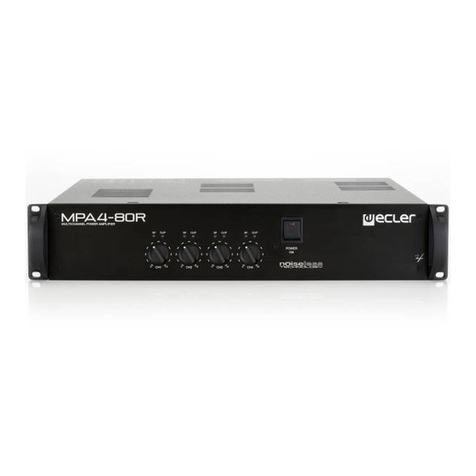
MPA4-400
E
C
LER approved:
num: 52..0017 version: 01.00
title:
FUNCTIONING DESCRIPTION