Learning a New B tton Code into Receiver (channel 1)
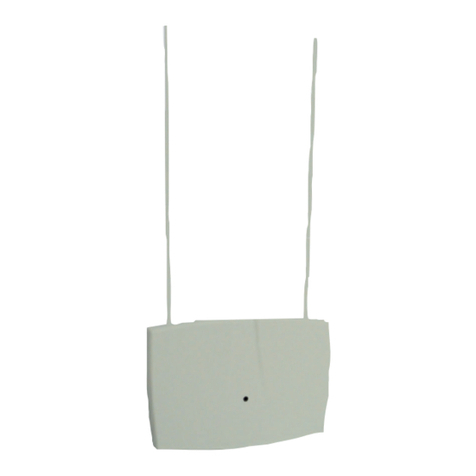
1. Press receiver mode switch #1 for three seconds. The green LED will start to flash quickly.
2. While the green LED is flashing quickly, press Weatherproof Transmitter Box test switch. The green LED
will flash once and then turn off to show that that button was learned.
NOTE — The green LED will flash a maximum of 15 seconds. If no transmitter button is pressed during this
time, the receiver will exit the code-learning mode, and the green LED will turn off.
Learning a New B tton Code into Receiver (channel 2)
The procedure is the same as for channel 1, except mode switch #2 initiates the code-learning process, and
the red LED shows status.
Note Regarding Code Learning
1. The receiver will only learn the code of a particular button once. Once a button’s code is learned, if you try
to code-learn that button again, whether it is for the same channel or not, the receiver will exit code
learning mode.
2. Each channel can learn the codes of a maximum of 15 transmitter codes. If you attempt to learn a
sixteenth button, the earliest code learned will be deleted.
3. To clear all codes — Press the appropriate mode switch (#1 or #2) for three seconds. When the LED
starts flashing, press that switch again for three seconds. The LED flashes twice to indicate that all codes
associated with that channel are now deleted.
Receiver Programming Relay O tp t Modes
The relay output(s) can be programmed for one of four different modes, depending on the
application:
• 4-second momentary — Press the transmitter button once. The relay turns on for 4 seconds,
and then turns off. (This is the DEFAULT mode)
• 1-second momentary — Press the transmitter button once. The relay turns on for 1 second,
and then turns off.
• Toggle — Press the transmitter button once, and the relay turns on. Press a compatible
transmitter button again, and the relay turns off.
• Validity — The relay turns on for as long as the transmitter button is pressed.
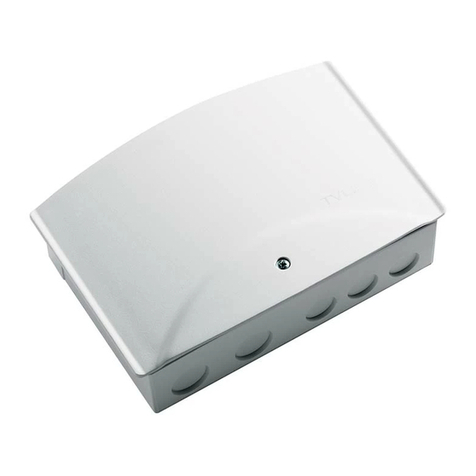
To program outputs, open case and
find the 2 jumpers marked LP1 and
LP2. Cut these jumpers, if needed, as
follows:
O tp t type LP1 LP2
4-second momentary Uncut Uncut
1-second momentary Uncut Cut
Toggle Cut Uncut
Validity Cut Cut
NOTE — On the 2-channel models,
the output mode of both relays is the
same. In other words, you cannot
have 4-second momentary output
for channel 1 and latch output for
channel 2.
ENFORCER Wireless Request-to-Exit Plates
SECO-LARM U.S.A., Inc 3
Mode Switch Operation (one per channel)
• Learn mode — Press and hold the switch for three seconds.
• Clear memory — Press three seconds, then when the LED starts flashing, press again for
three seconds to delete all previously learned codes.
• Memory Display — Press and release the mode switch to show number of codes stored. LED
will flash a number of times to correspond to the number of codes stored.
LED Indication (one per channel)
• Steady on — Senses signal from a transmitter button whose code was already learned.
• Fast flash — In the code-learning mode.
• One flash — A transmitter button code was learned.
• Two flashes — All previously learned transmitter button codes were deleted.
Typical Applications:
Specifications
Rx:
Operating Frequency: 315MHz
Memory Capacity: 15 transmitter button codes per channel
Operating Voltage: 11VDC ~ 24VDC or 11VAC ~ 24VAC
Operating Current: 8 mA @ 12VDC (standby), 3 mA @ 12VDC (activated)
7 mA @ 6VDC (activated), (SK-91 RL / SK-91 RL-4 only)
Relay Contact Rating: Form ‘C’ type; 1 A @ 24VDC or 12 VAC per channel
Connectors: Screw Terminals, +, –, with N.O., N.C., and COM per channel
Dimensions: 3.25” x 2.7” x 1.1” (83 x 68 x 27.5 mm)
Tx:
Operating Frequency: 315MHz
Operating Voltage: 12VDC
Dimensions: 1”x2.56”x1.9” (24x65x49 mm)