4
Operating Instructions
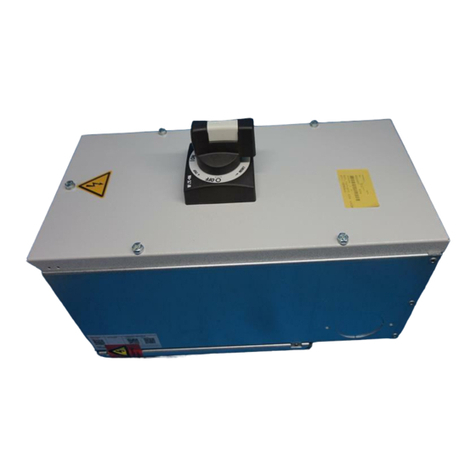
Safety Relay ESM-BA7..
Correct use
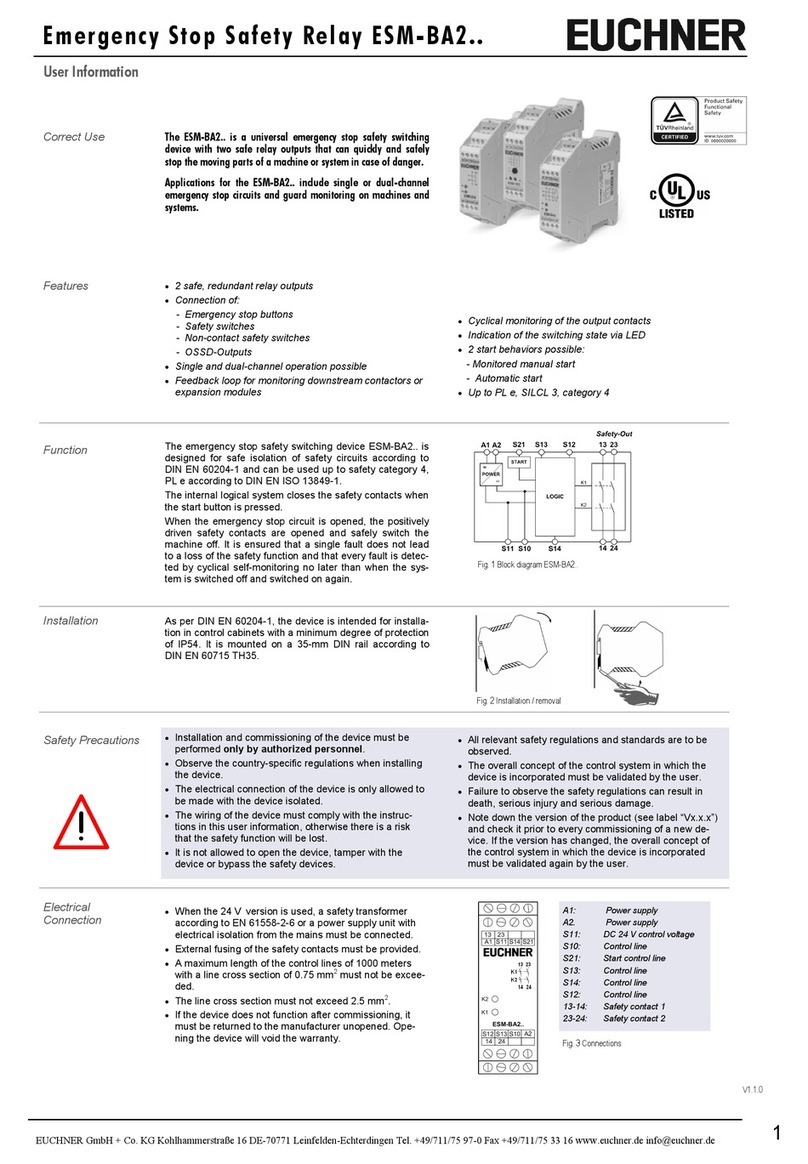
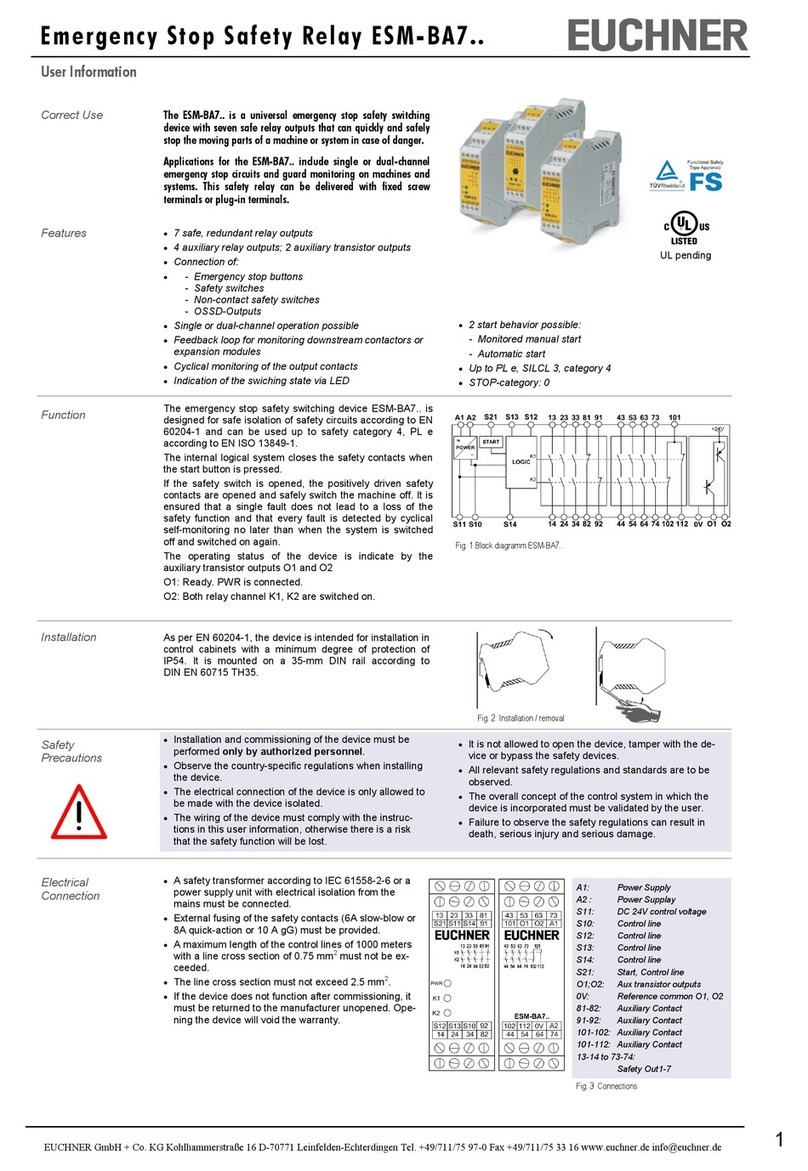
The ESM-BA7.. is a universal emergency stop safety
switching device with seven safe relay outputs that
can quickly and safely stop the moving parts of a
machine or system in case of danger.
Applications for the ESM-BA7.. include single- or
dual-channel emergency stop circuits and guard
monitoring on machines and installations. The device
is available with plug-in or xed connection terminals.
Before the device is used, a risk assessment must
be performed on the machine, e.g. according to the
following standards:
fENISO13849-1
fENISO12100
fIEC62061.
Correct use includes observing the relevant require-
ments for installation and operation, particularly
based on the following standards:
fENISO13849-1
fEN60204-1
fIEC62061.
Important!
fThe user is responsible for the integration of
the device in a safe overall system. For this
purpose, the overall system must be validated,
e.g. according to ENISO13849-2.
fThe device user must assess and document
remaining risks.
fIf a data sheet is included with the product, the
information on the data sheet applies.
Safety precautions
WARNING
fInstallation and setup of the device must be
performed only by authorized personnel.
fObserve the country-specic regulations when
installing the device.
fThe electrical connection of the device is only
allowed to be made with the device isolated.
fThe wiring of the device must comply with the
instructions in these operating instructions,
otherwise there is a risk that the safety function
will be lost.
fIt is not allowed to open the device, tamper with
the device or bypass the safety devices.
fAll relevant safety regulations and standards are
to be observed.
fThe overall concept of the control system in
which the device is incorporated must be vali-
dated by the user.
fFailure to observe the safety regulations can re-
sult in death, severe injuries and serious damage.
fNote down the version of the device (see type la-
bel Vx.x.x) and check it each time prior to setup.
If the version changes, the use of the device in
the overall application must be validated again.
Features
f7 safe, redundant relay outputs
f4 relay auxiliary contacts, 2 semiconductor aux-
iliary contacts
fConnection of:
- Emergency stop buttons
- Safety switches
- Non-contact safety switches
- Safety components with OSSD outputs
fSingle- and dual-channel operation possible
fFeedback loop for monitoring downstream contac-
tors or expansion modules
fCyclical monitoring of the output contacts
fIndication of the switching state and operating
status via LED
f2 starting behaviors possible:
- Monitored manual start
- Automatic start
fUp to PL e, SILCL 3, category 4
fSTOP category: 0
Function
The emergency stop safety switching device
ESM-BA7.. is designed for safe isolation of safety
circuits according to EN 60204-1 and can be
used up to safety category4, PLe according to
ENISO13849-1.
The internal logic system closes the safety contacts
when the start button is pressed.
When the safety switch is opened, the positively
driven safety contacts open and safely switch off
the machine. It is ensured that a single fault does
not lead to a loss of the safety function and that
every fault is detected by cyclical self-monitoring
no later than when the system is switched off and
switched on again.
The operating status of the device is signaled via
the semiconductor auxiliary contacts O1 and O2
(reference potential 0V terminal).
O1: Device ready for operation. PWR (UB) is present.
O2: Both relays K1 and K2 are switched on.
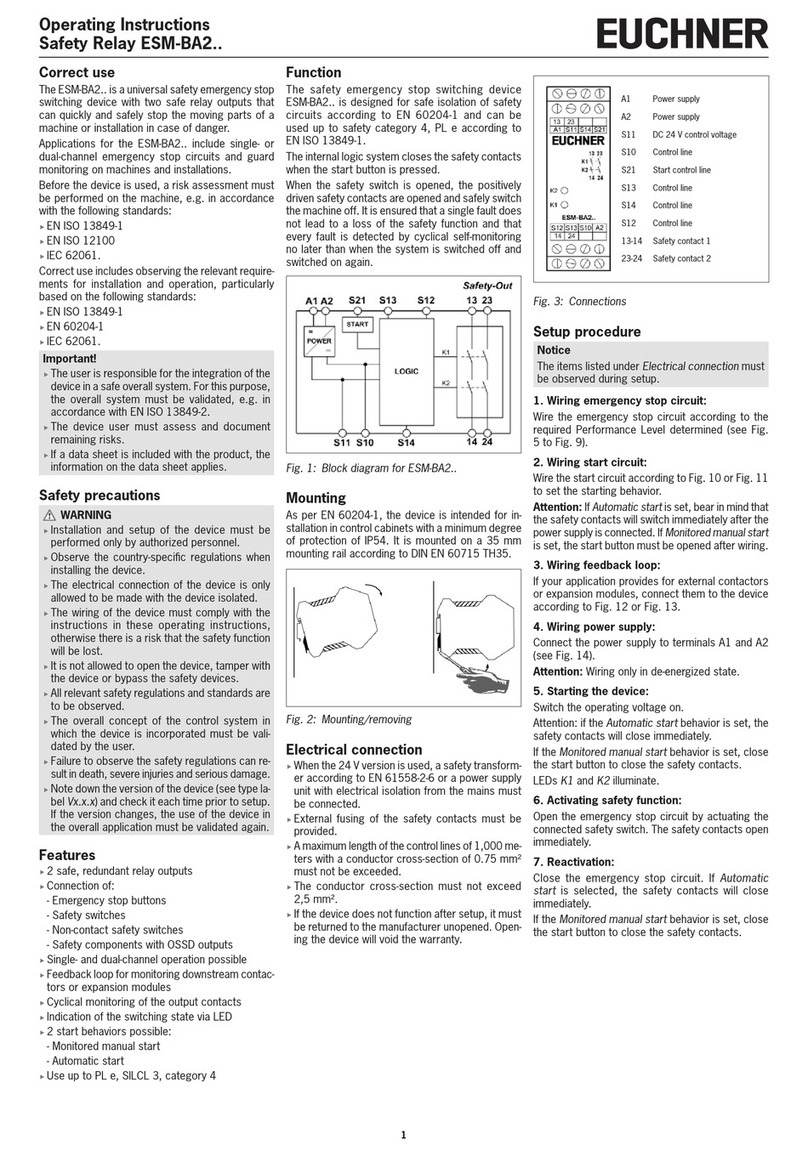
Mounting
As per EN60204-1, the device is intended for in-
stallation in control cabinets with a minimum degree
of protection of IP54. It is mounted on a 35 mm
mounting rail according to DINEN60715TH35.
Fig. 1: Mounting/removing
Electrical connection
fA safety transformer according to EN61558-2-6
or
a power supply unit with electrical isolation from
the mains must be connected.
fExternal fusing of the safety contacts must be
provided.
fA maximum length of the control lines of 1,000m
with a conductor cross-section of 1.5mm², 500m
with a conductor cross-section of 0.75mm² must
not be exceeded.
fThe conductor cross-section must not exceed
2.5mm².
fIf the device does not function after setup, it must
be returned to the manufacturer unopened. Open-
ing the device will void the warranty.
Setup procedure
Notice
The items listed under Electrical connection must
be observed during setup.
1. Wiring emergency stop circuit:
Wire the emergency stop circuit according to the
required Performance Level determined (see Fig.
5 to Fig. 9).
2. Wiring start circuit:
Wire the start circuit according to Fig. 10 or Fig. 11
to set the starting behavior.
Attention: If Automatic start is set, bear in mind that
the safety contacts will switch immediately after the
power supply is connected. If Monitored manual start
is set, the start button must be opened after wiring.
3. Wiring feedback loop:
If your application provides for external contactors
or expansion modules, connect them to the device
according to Fig. 12 or Fig. 13.
4. Wiring power supply:
Connect the power supply to terminals A1 and A2
(see Fig. 14).
Attention: Wiring only in de-energized state.
5. Starting the device:
Switch the operating voltage on.
Attention: If the Automatic start behavior is set, the
safety contacts will close immediately.
If the Monitored manual start behavior is set, close
the start button to close the safety contacts.
LEDs K1, K2 and PWR illuminate.
6. Activating safety function:
Open the emergency stop circuit by actuating the
connected safety switch. The safety contacts open
immediately.
7. Reactivating:
Close the emergency stop circuit. If Automatic
start is selected, the safety contacts will close
immediately.
If the Monitored manual start behavior is set, close
the start button to close the safety contacts.
What to do in case of a fault?
Device does not switch on:
fCheck the wiring by comparing it to the wiring
diagrams.
fCheck the safety switch used for correct function
and adjustment.
fCheck whether the emergency stop circuit is
closed.
fCheck whether the start button (with manual start)
is closed.
fCheck the operating voltage at A1 and A2.
fIs the feedback loop closed?
Device cannot be switched on again after an
emergency stop:
fCheck whether the emergency stop circuit was
closed again.
fWas the start button opened before closing of the
emergency stop circuit (with manual start)?
fIs the feedback loop closed?
If the fault persists, perform the steps listed under
Setup procedure.
If these steps do not remedy the fault either, return
the device to the manufacturer for examination.
Opening the device is impermissible and will
void the warranty.
Maintenance
The device must be checked once per month for
proper function and for signs of tampering and
bypassing of the safety function. The device is
otherwise maintenance-free, provided that it was
installed properly.
Disposal
Pay attention to the applicable national regulations
and laws during disposal.