1
Operating Instructions
2-Hand Safety Relay ESM-2H2..
Correct use
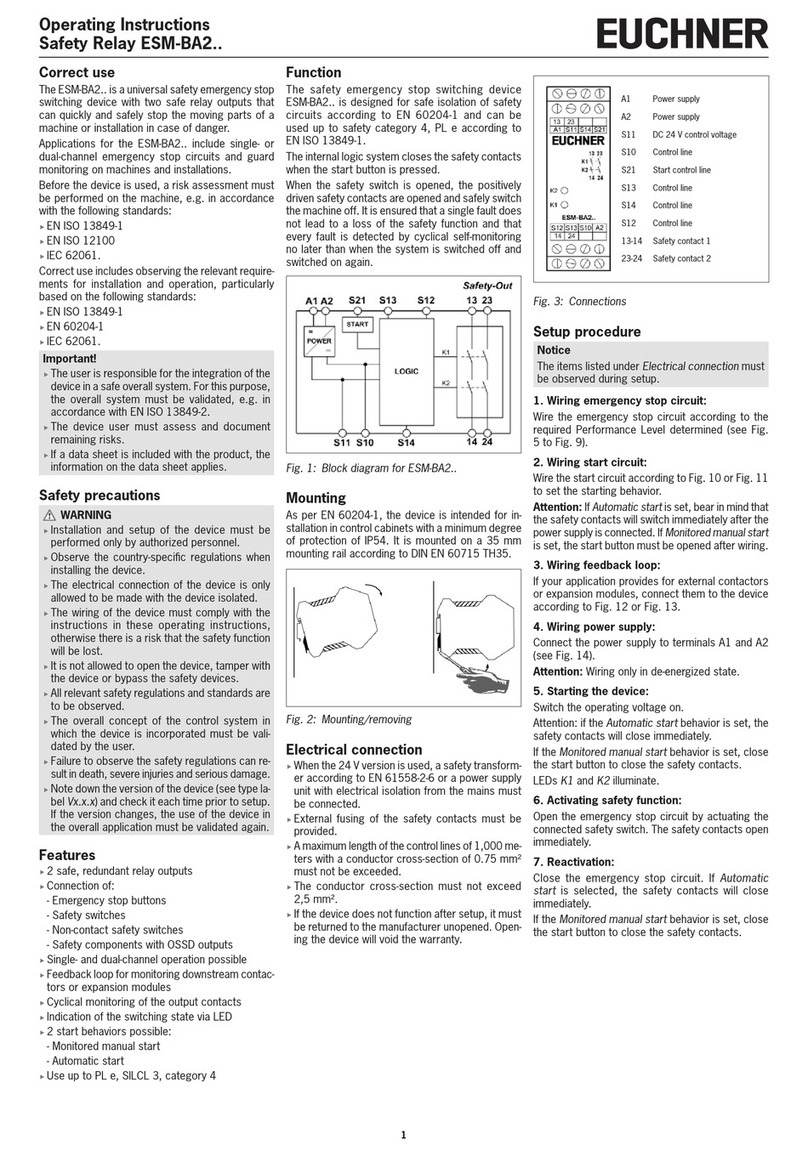
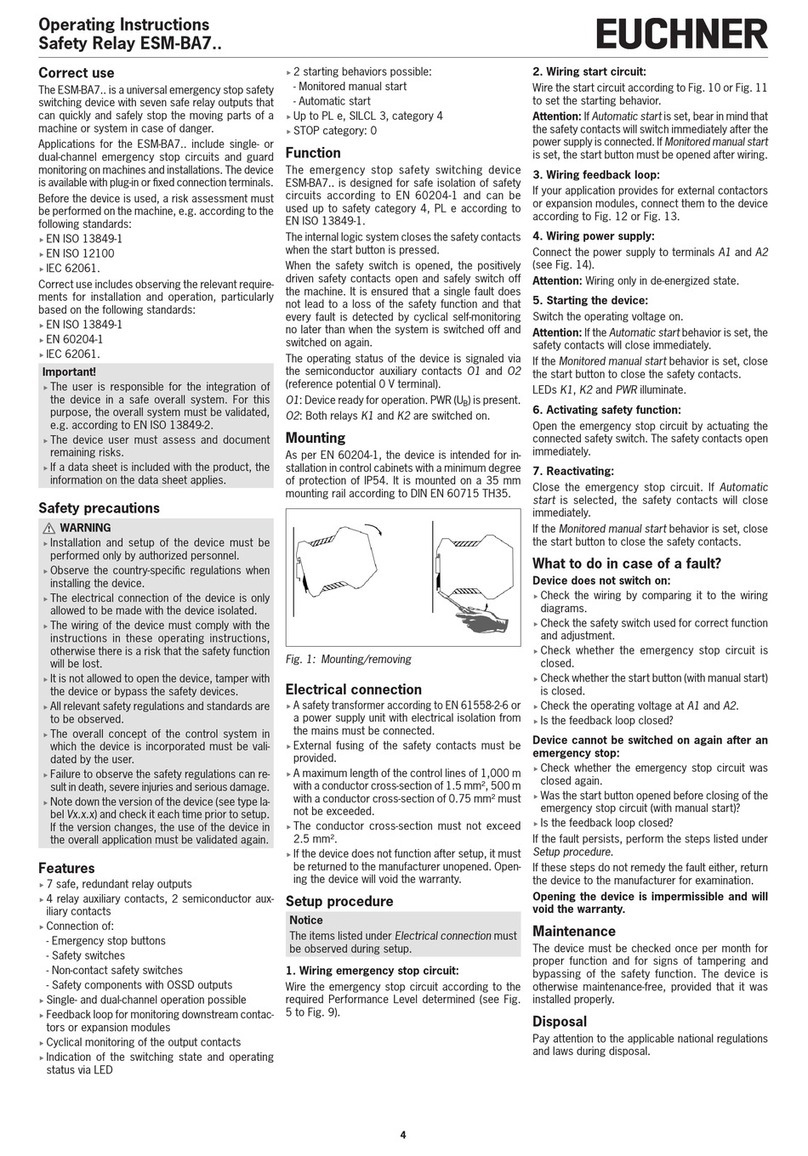
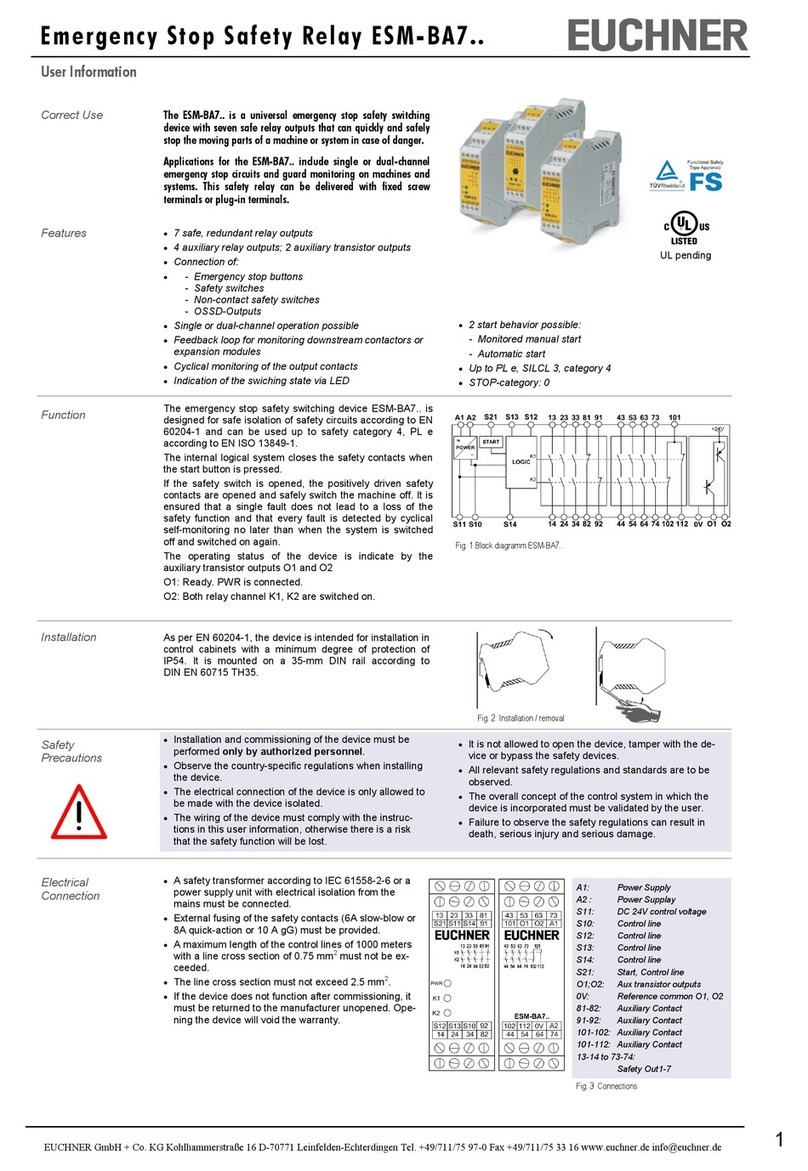
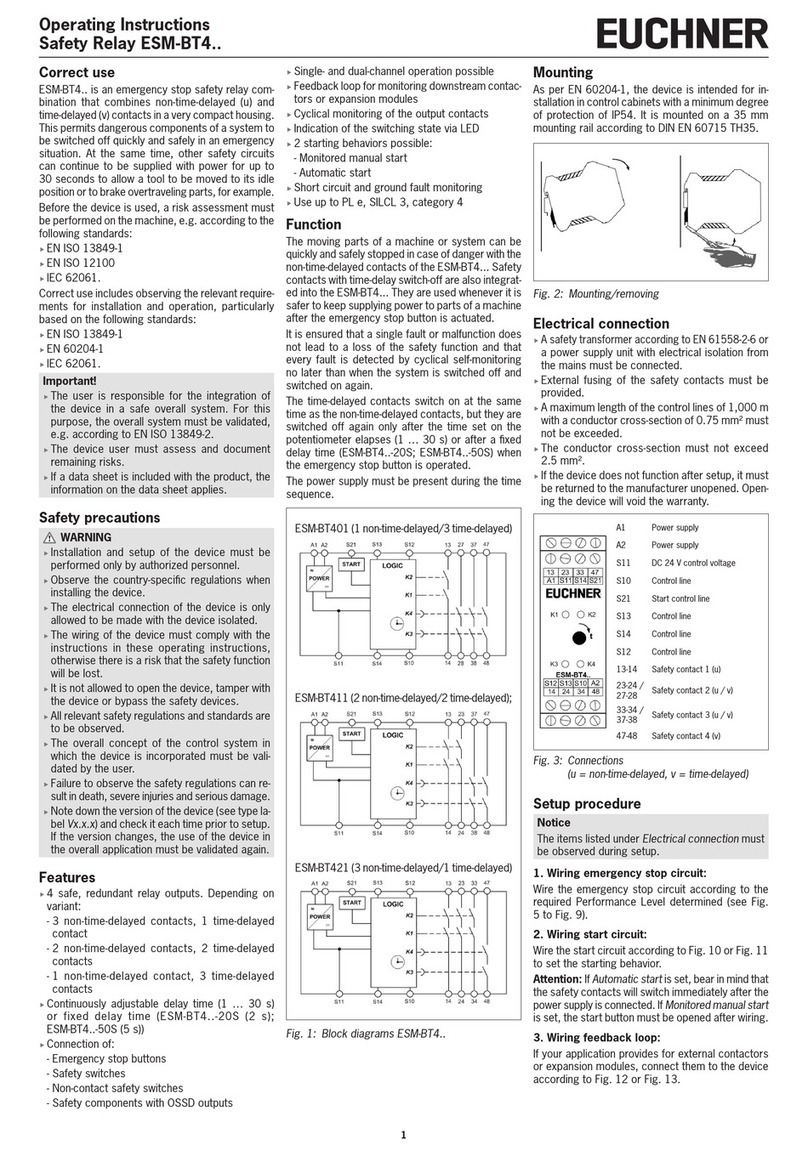
The ESM-2H2.. is an extremely compact, uni-
versal two-hand safety device. It complies with
ENISO13851, typeIIIC, and is intended for use
in safety circuits that are designed according to
EN60204-1, e.g. on presses, punches and bending
tools.
Due to the internal error monitoring, the ESM-2H2..
can, despite its very compact dimensions, be used
for all applications up to the highest category, safety
category4, PLe according to 13849-1, SILCL3
according to EN62061 or typeIII C according to
ENISO13851.
Before the device is used, a risk assessment must
be performed on the machine, e.g. according to the
following standards:
fENISO13849-1
fENISO12100
fIEC62061.
Correct use includes observing the relevant require-
ments for installation and operation, particularly
based on the following standards:
fENISO13849-1
fEN60204-1
fIEC62061.
Important!
fThe user is responsible for the integration of
the device in a safe overall system. For this
purpose, the overall system must be validated,
e.g. according to ENISO13849-2.
fThe device user must assess and document
remaining risks.
fIf a data sheet is included with the product, the
information on the data sheet applies.
Safety precautions
WARNING
fInstallation and setup of the device must be
performed only by authorized personnel.
fObserve the country-specic regulations when
installing the device.
fThe electrical connection of the device is only
allowed to be made with the device isolated.
fThe wiring of the device must comply with the
instructions in these operating instructions,
otherwise there is a risk that the safety function
will be lost.
fIt is not allowed to open the device, tamper with
the device or bypass the safety devices.
fAll relevant safety regulations and standards are
to be observed.
fThe overall concept of the control system in
which the device is incorporated must be vali-
dated by the user.
fFailure to observe the safety regulations can re-
sult in death, severe injuries and serious damage.
fNote down the version of the device (see type la-
bel Vx.x.x) and check it each time prior to setup.
If the version changes, the use of the device in
the overall application must be validated again.
Features
f2 safe, redundant relay outputs
fCyclical monitoring of the output contacts
fFeedback loop for monitoring downstream contac-
tors or expansion modules
fShort circuit and ground fault monitoring
fExtremely compact design
fUse up to PLe, SILCL3, category4 or typeIIIC
according to ENISO13851
Function
The two-hand relay ESM-2H2.. is suitable for setting
up and monitoring two-hand circuits and is used to
protect the operating personnel. Dangerous work
steps can only be triggered when both two-hand
buttons connected are actuated simultaneously,
i.e. within 0.5s.
It is ensured that a single fault or malfunction does
not lead to a loss of the safety function and that
every fault is detected by cyclical self-monitoring
no later than the next actuation.
When the operating voltage is applied to A1 and A2
and the feedback loop X1 and X2 closed, the
ESM-2H2.. is ready for use. To be able to initiate
a switching operation, the output relays must be
de-energized. The output relays only switch to the
energized position when the two-hand buttons T1
and T2 are actuated simultaneously, i.e. within 0.5s.
The output relays are not switched if:
fOnly one two-hand button is actuated or the time
between the actuation of the two two-hand buttons
is >0.5s,
fThe feedback loop is open (error in external con-
tactor or expansion module),
fAnother error (short circuit, cable break, error in
the switching device) has occurred.
When T1 and/or T2 are/is released, the output re-
lays are open (safe) immediately. In order to trigger
a new operation, both two-hand buttons must rst
be released and the feedback loop must be closed.
Fig. 1: Block diagram for ESM-2H2..
Mounting
As per EN60204-1, the device is intended for in-
stallation in control cabinets with a minimum degree
of protection of IP54. It is mounted on a 35 mm
mounting rail according to DINEN60715TH35.
Fig. 2: Mounting/removing
Installation
Prevent unintentional actuation or bypassing
of the safety function
The two-hand buttons must be arranged as per the
standard ENISO 13851 such that unintentional
actuation or simple bypassing of the safety function
is excluded. As such the operation of both buttons
using one hand must be prevented by a sufcient
distance (at least 260mm) or by a separating wall.
Actuation using the forearm, elbow, knee, hip or
other parts of the body can be effectively prevented
by further increasing the distance between the two
buttons, sufcient distance from the oor and/or
covers and/or separating walls.
Distance between the two-hand buttons and
the danger area
It is required that a minimum distance between the
buttons for the two-hand circuit and the danger area
of the machine or installation is maintained so that,
after the release of one or both buttons, the dan-
ger area can only be reached when the dangerous
movement has been interrupted or ended.
According to the standard DIN EN ISO 13855 this
distance is calculated using the following equation:
S = (K x T) + C
S: Minimum distance from the nearest pushbutton
(two-hand button) to the danger area.
K: Parameter in mm/s, derived from data on the
approach speed of the body or parts of the body,
for two-hand circuits 1,600mm/s.
T: The stopping time for the entire system in sec-
onds, that is the time from the release of the
two-hand buttons to the end of the dangerous
movement.
C: Additional distance in mm related to intrusion into
the danger area before the safeguard activates.
For two-hand circuits this distance is 250mm,
if the buttons are covered appropriately it can
also be set to 0mm , however Smust then be
at least 100mm.
Example
The stopping time of the overall system is 90ms.
Then from the above equation the minimum dis-
tance is:
S = (1,600 mm/s x 0.09 s) + 250 mm
S = 144 mm + 250 mm = 394 mm
If a suitable cover is used, Scan be reduced to
144mm.