3.2
Put the blue hose (located at the back of the machine), into a bottle of rinse
aid. Make sure that the filter on the ends of the pipe is fully submerged and the pipe
is not kinked.
3.3
Prepare crockery for washing by removing large bits of food before loading
the crockery into the baskets. Glassware should be washed first. Plates should not
be stacked on top of each other (see Figure 9). Cups and glasses should be washed
upside down. Cutlery should be washed in the yellow cutlery baskets with handles
at the bottom; each yellow basket should contain a mixture of spoons, forks and
knives for optimum washing conditions. The cutlery holders should be put into one
of the baskets.
Figure 9
3.4
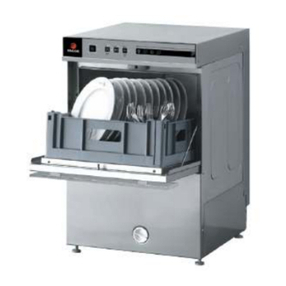
Load the machine with a basket of dirty dishes/cutlery. Close the door and
press the switch button (1 on Figure 10) to turn machine on. Pilot light (2) will come
on and the boiler and wash tank will begin to fill up with water and heat up.
Figure 10
3.5
Wait for water to heat up to required temperature. The thermometer (9)
indicates the rinse temperature and the (10) wash temperature. The machine is
ready when the thermometer (9) indicates 85-9090 an d the thermometer (10) 55-60t
. The dishwasher is fitted with a thermostop to ensure a minimum rinse
temperature of 859C. The temperature of the incomi ng water should be 5090 or
more. Colder water may affect the machine's performance.
3.6
Press P1, P2 or P3 button to select the require length of the wash (60", 90" or
180" respectively). The appropriate LED (4,6 & 8 on Figure 10) will light up.
3.7
When the cycle has finished, the LED will go off. The door can be opened and
the basket removed. Another basket of crockery can be inserted and button P1, P2
or P3 pressed for another wash cycle to start. Never place a basket of washed
dishes on top of the machine; water could drip from the basket and damage the
machine's electrical components.
3.8
The dishwasher drains automatically in each cycle. At the end of each day or
service, or as required, the dishwasher should be completely drained. See details
below: