DO NOT stand close to the Alarm when the horn is sounding.
Exposure at close range may be harmful to your hearing.
When testing, step away when horn starts sounding.
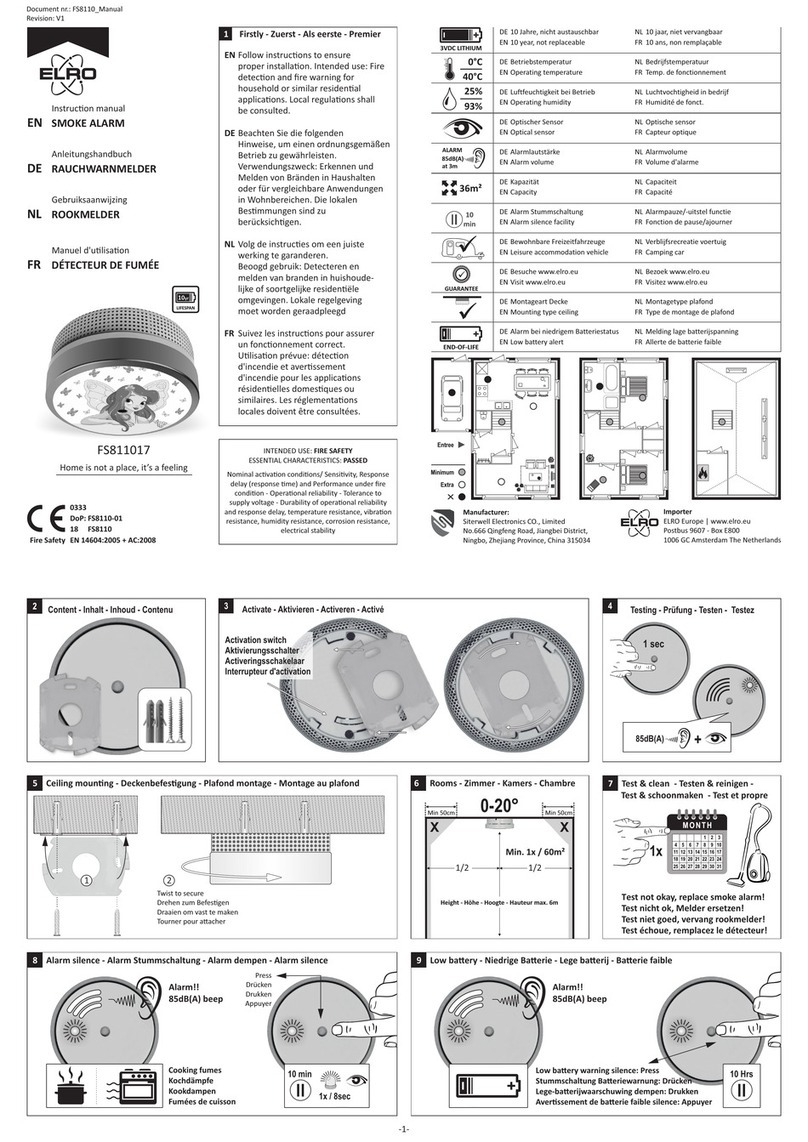
Push and hold the Test/Silence button on the cover until the
LED flashes. The alarm horn will sound 4 beeps, a pause, then
4 beeps. The ALARM (RED) light will flash.
The alarm sequence should last 5-6 seconds. If it does not
alarm, make sure fresh batteries are correctly installed, and
test it again. If the unit still does not alarm, replace it
immediately.
If the alarm does not test properly:
1. Make sure that fresh batteries are installed correctly.
2. Be sure the Alarm is clean and dust-free.
3. Install fresh 9V batteries* and test the Alarm again.
*For a list of acceptable replacement batteries, see
“CHOOSING A REPLACEMENT BATTERY.”
WARNING: DO NOT try fixing the Alarm yourself – this will void
your warranty! If the CO Alarm is still not operating properly,
and it is still under warranty, please see "How to Obtain
Warranty Service" in the Limited Warranty. Install a new CO
Alarm immediately.
The Test/Hush button is the only proper way to test the CO
Alarm. NEVER use vehicle exhaust! Exhaust may cause
permanent damage and voids your warranty.
MAINTAINING YOUR CO ALARM
Your alarm will alert you to potentially hazardous CO
concentrations in your home when maintained properly. To
maintain your alarm in proper working order, it is
recommended that you:
1. Test your alarm at least once a week.
2. Clean your CO alarm regularly to prevent dust build
up. See “CLEAN THE CO ALARM”
BATTERY REPLACEMENT
Replace battery at least once a year or immediately when the
low battery signal sounds once a minute.
This low voltage warning will be given for at least 30 days.
Batteries should be replaced regularly as necessary.
WARNING: Use the recommended batteries as specified in
this manual.
Do not use rechargeable batteries.
CAUTION: Incorrectly fitted batteries may cause an explosion
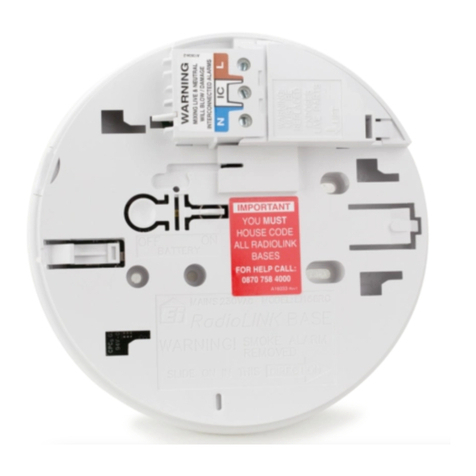
1. Seperate the pin from the CO alarm. Turn the alarm
counterclockwise to detach it from the mounting plate.
2. Gently pull down CO alarm.
3. Remove battery from the compartment.
4. Insert a new 9-volt battery to connector. NOTE POLARITY OF
CONNECTIONS. Ensure the metal tab is fully depressed when
the battery has been fitted.
5. Using the Push-to-Test button, test the CO alarm to verify
the
9
V DC battery. See “TESTING THE CO ALARM”
6. Reattach the CO alarm to the mounting plate by turning
smoke alarm clockwise until it snaps into place.
7. Insert the two tamperproof tabs back into the notch on
edge of CO alarm after alarm is properly positioned in base.
8. Turn on power supply and test the alarm using the
push-to-test button. See “TESTING THE CO ALARM”
Note: If the unit fails to operate when being tested,
Please refer to “TROUBLESHOOTING”.
Do not attempt to remove the cover to solve the problem
yourself. This will void your warranty.
CHOOSING A REPLACEMENT BATTERY:
The unit requires one standard 9V battery.The following
batteries are acceptable as replacements:
Golden Power #6F22, Megaton #6F22; New Leader #6F22; Gold
Peak #1604;Eveready #522, #1222.
CLEAN THE CO ALARM
Clean the CO alarm at least once a month to remove dust, dirt,
or debris. Using the soft brush or wand attachment to a vacuum
cleaner, vacuum all sides and cover of CO alarm. Be sure all the
vents are free of debris. If necessary, use a damp cloth to clean
CO alarm cover.
IMPORTANT: Do not attempt to remove the cover to clean
inside the CO alarm. This will void your warranty.
NOTE:
Never use detergents or solvents to clean the alarm.
Chemicals can permanently damage or temporarily
contaminate the sensor.
Avoid spraying air fresheners, hair spray, paint or other
aerosols near the alarm.
Do not paint the alarm. Paint will seal the vents and interfere
with proper sensor operation.
Move the CO Alarm to a remote location, to prevent possible
damage to or contamination of the sensor if you will be
staining or stripping wood floors or furniture, painting,
wall-papering, or using aerosols or adhesives.
WARNING: Reinstall the CO Alarm as soon as possible to assure
continuous protection.
The following is a list of substances that at high levels can
damage the sensor or cause temporary false alarm that is not a
carbon monoxide alarm.
Ethylene, ethanol, alcohol, iso-propanol, benzene, toluene,
ethyl acetate, hydrogen, hydrogen sulfide and sulfur dioxide.
Also most aerosol sprays, alcohol based products; paint,
thinner, solvent, adhesive, hair spray, after shave, perfume, auto
exhaust (cold start) and some cleaning agents.
WHAT TO DO IF THE ALARM SOUNDS
Actuation of your CO alarm indicates the presence of carbon
monoxide (CO), which can kill quickly. If the alarm sounds:
1. Operate reset button
2. Immediately move to fresh air-outdoors or by an open
door/window. Make sure that all persons are alerted. Do not
re-enter the premises nor move away from the open
door/window until emergency services responders have
arrived, the premises have been aired out, and your alarm
remains in its normal condition.
3. Call your emergency services
4. After following steps 1-3, if your alarm reactivates within a 24
hour period, repeat steps 1-3, and call a qualified appliance
technician to investigate for sources of CO from fuel burning
equipment and appliances, and inspect for proper operation of
this equipment. If problems are identified during this
inspection have the equipment serviced immediately.
Note any combustion equipment not inspected by the
technician and consult the manufacturer’s instructions, or
contact the manufacturers directly for more information about
CO safety and the equipment. Make sure that motor vehicles
are not, or have not been, operating in a garage attached or
adjacent to the residence. Never restart the source of a CO
problem until it has been corrected.
WARNING: Never ignore the sound of the alarm! If the alarm is
sounding, pressing the test/reset button will terminate the
alarm. If the CO condition that caused the alert in the first place
continues, the alarm will reactivate. If the unit alarms again
within six minutes, it is sensing high levels of CO which can
quickly become a dangerous situation.
THREE YEAR LIMITED WARRANTY
Master Distributors Pty Ltd warrants to the original
consumer purchaser each new smoke alarm to be free from
defects in material and workmanship under normal use and
services for a period of three(3) years from the date of
purchase. Master Distributors Pty Ltd agrees to repair or
replace, at its option, any defective CO Alarm provided it is
returned personally or by prepaid delivery with a copy of proof
of purchase. Do not post.
This warranty does not cover damage resulting from accidents,
misuse or abuse or lack of reasonable care of the product. The
purchaser's attention is drawn to rights it may have under the
Trade Practices Act 1974 and similar state and territory
legislation which cannot be excluded.
Subject to those non-excluded rights and provisions and the
above warranty, Master Distributors Pty Ltd, will not be liable
for any injury to persons or damage to property or for any
special direct or indirect or consequential loss or damage
whatsoever and whether as a result of negligence or fault on
the part of Master Distributors Pty Ltd. or its servants, agents,
suppliers and contractors or otherwise arising out of or
resulting from, whether directly or indirectly, the use,
installation or maintenance of the CO alarm and any warranties
or representations are excluded unless given by Master
Distributors Pty Ltd in writing. The 9 volt battery included with
this CO Alarm is excluded from the Master Distributors Pty Ltd,
3 year Limited Warranty. If this CO Alarm is installed for use by
others, please leave this document or a copy for the end user.
2. Secure plate to ceiling or wall with mounting screws.
3. Lift open battery pocket door.
4. Connect new 9-volt battery to battery connector
insidebattery pocket. Be sure battery is securely connected.
Red LED may blink briefly when battery is installed.
5. Close battery pocket door, snapping it into place.
6. Position CO alarm to mounting plate and turn clockwise to
lock into place. To engage tamper-resist feature, insert pin
into notch on edge of CO alarm after alarm is properly
positioned in base.
7. Push test button to test CO alarm. See TESTING THE CO
ALARM.
OPERATING YOUR CO ALARM
Normal Operation
When no carbon monoxide is present, the green light flashes
ONCE A MINUTE and is an indication that your alarm is
powered and functional.
Alarm Condition
When the unit detects dangerous levels of CO, Red LED flashes
rapidly and alarm sounds loudly (repeating 4 beeps,
pause).This will continue as long as there is a dangerous level
of CO present. Should the CO levels return to normal, the unit
will stop beeping.
CO LEVEL (PPM)
RESPONSE TIME (MIN)
50 60-90
100 10-40
300 <3
WARNING: This product may not alarm at low carbon
monoxide levels. Individuals with medical problems may
consider using warning devices which provide audible
concentrations under 30 ppm.
Hush Feature
The Hush Feature is for your convenience only and will not
correct a CO problem. Always check your home for a potential
problem after any alarm. Failure to do so can result in injury or
death.
NEVER remove the batteries from your CO Alarm to silence the
horn. Use the silence feature.Removing the batteries removes
your protection! See “What To Do If The Alarm Sounds” for
details on responding to an alarm.
The Hush Feature is intended to temporarily silence your CO
Alarm’s alarm horn while you correct the problem—it will not
correct a CO problem. While the alarm is silenced it will
continue to monitor the air for CO .When CO reaches alarm
levels the alarm will sound— repeating horn pattern: 4 beeps,
a pause, 4 beeps, etc. Press and hold the Test/Silence button
until the horn is silent. The initial Silence cycle will last
approximately 4 minutes.
NOTE: After initial 4-minute Silence cycle, the CO Alarm
re-evaluates present CO levels and responds accordingly. If CO
levels remain potentially dangerous or start rising higher the
alarm will start sounding again.
While the detector is silenced:
If the CO Alarm...
Is silent for only 4 minutes, then starts sounding loudly, 4
beeps, pause, 4 beeps, pause
This means...
CO levels are still potentially dangerous.
If the CO Alarm...
Remains silent after you pressed the Test/Silence button
This means...
CO levels are dropping.
Low Battery Signal
The light continues to flash (RED) and the horn also “chirps”
once every minute. This warning should last for up to 30 days,
but you should replace the batteries as soon as possible.
NOTE: With normal use the batteries will last for 1 year
minimum. However, battery life will be reduced if either a fault
occurs with the battery or the alarm remains in alarm for long
periods of time.
Unit Malfunction
Your CO alarm performs an internal self-diagnosis to make
sure that it is functioning properly. If the unit has detected an
error, the light flashes (RED) and the horn sounds 3 quick
“chirps” every minute. CO Alarm needs to be replaced.
If your CO alarm sounder is beeping, and you are not sure if it
is a CO alarm or malfunction alert, reset the alarm, open
windows for ventilation, turn off fuel-burning appliance (like
kerosene or oil heaters, furnaces, wood-burning stoves, water
heaters, or other fossil-fuel burning appliances)
Never ignore a CO unit’s alarm. A true alarm is an indication of
potentially dangerous levels of carbon monoxide. CO alarms
are designed to alert you to the presence of carbon
monoxide before an emergency, before most people would
experience symptoms of carbon monoxide poisoning, giving
you time to resolve the problem calmly.
TESTING THE CO ALARM
Test the CO Alarm once a week. If the CO Alarm ever fails to
test correctly, have it replaced immediately! If the CO Alarm is
not working properly, it cannot alert you to a problem.
TROUBLE SHOOTING GUIDE
PROBLEM... THIS MEANS... YOU SHOULD...
The light continues to
flash (RED) and the
horn “chirps” once
every minute.
Low battery
warning.
Install a new
9
V battery.
The light flashes (RED)
and the horn sounds 3
quick “chirps” every
minute.
MALFUNCTION
SIGNAL. CO Alarm
needs to be
replaced.
CO Alarms under
warranty should be
returned to distributor
for replacement.
CO levels indicate a
potentially
dangerous situation.
IF YOU ARE FEELING
SYMPTOMS OF CO
POISONING, EVACUATE
your home and call your
local Fire Authority. If
not, press the Test/Hush
button again and keep
ventilating your home.
CO Alarm sounds
frequently even
though no high levels
of CO are revealed in
an investigation.
The CO Alarm may
be improperly
located. Refer to
“CO ALARM
PLACEMENT.”
Relocate your alarm. If
frequent alarms
continue, have home
rechecked for potential
CO problems. You may
be experiencing an
intermittent CO
problem.
CO Alarm goes back
into alarm 4 minutes
after you press the
Test/Hush button.
31 Dunlop Road Mulgrave Victoria 3170Australia
www.masterdistributors.com.au