V3 STIMULATION MODES
What is a mode?
The mode describes the shape of the electrical signal. At a minimum V3 includes tDCS, tACS, so-
tDCS, tPCS, tRNS and tRCS modes.
Each mode has a set of parameters that control the shape of the electrical output.
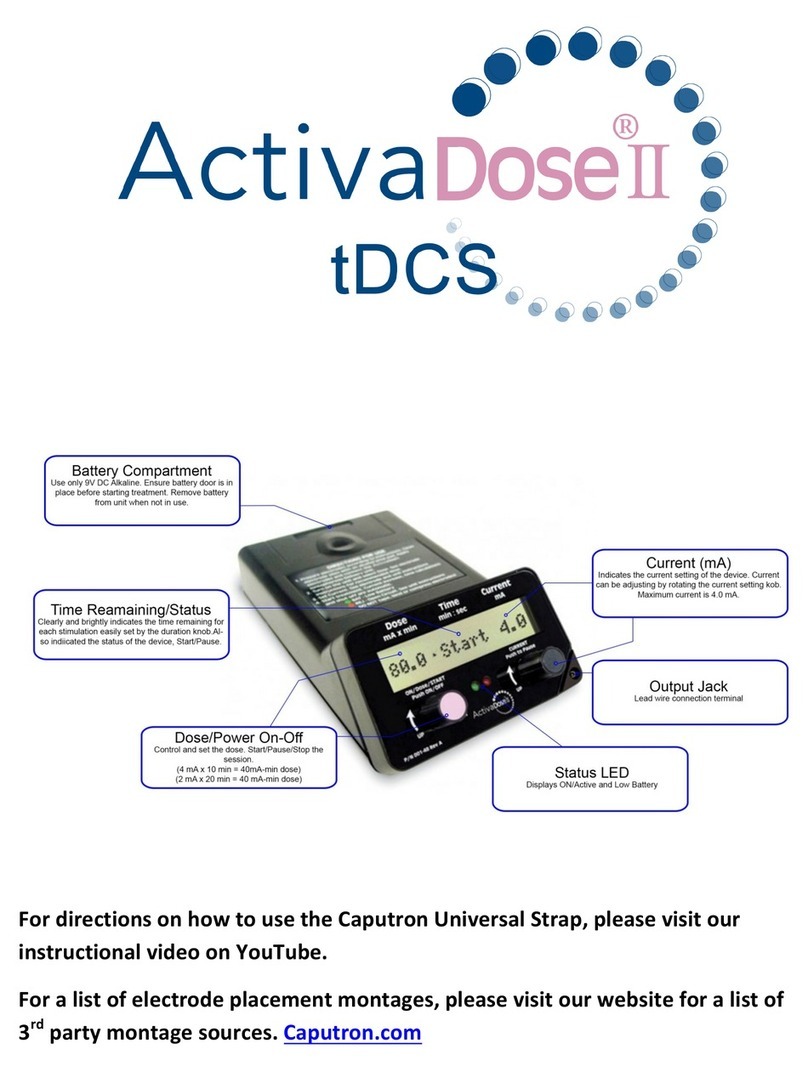
During a stimulation session the display of the V3 functions as an oscilloscope. It shows the real-
time current graphed against time. Use it to visualize the ow of the electrical current.
tDCS provides a steady current over a period of time. An initial ramp will slowly increase the
current at 0.1mA/s until the target current is reached. At the end of the session the current
will be tapered o at the same rate. During the stimulation the internal electronics measure
the resistance in the circuit owing through your head 50,000 times per second and adjust the
voltage to maintain a super-accurate current.
tACS is a sine shaped stimulation wave where the current changes as a function of time. Studies
show that stimulating with particular frequencies can entrain brain oscillations.
so-tDCS is a unipolar slow sine wave. Unipolar means the current always ows in the same
direction. It will oscillate between the oset and target current values.
tPCS is a pulsed wave with frequency and duty cycle control.
tRNS generates a random signal i.e. noise. This can be a random frequency, a random current
or both. Please note that this mode can be the most physically uncomfortable due to likelihood
of fast changes in current levels.
tRCS is an exclusive stimulation mode available only from Foc.us. This dynamic tACS mode uses
rippled frequency changes to entrain and increase brain oscillations. The power, intensity and
gradient of this change can be selected.
What is a program?
A program denes the target current, duration and mode settings to be used during stimulation.
Each program allows you to quickly start a session using the most recent program settings.
You can EDIT the program settings to personalize the programs according to your preference by
using the arrow options when you reach the START screen.
All programs include an advanced PLACEBO option. The default is placebo OFF i.e. stimulate.
When set to ON, the current will ramp up to the target current but then ramp down - you can
see this in the real-time current graph. When PLACEBO is set to BLIND the device will decide
whether to stimulate or not at random. If it decides not to stimulate it will ramp up and provide
a fake real-time graph so you cannot visually determine. This allows you to run double blind
tests with yourself.
You can chose to set a maximum voltage for any program. This may limit the devices ability to
hit the target current according to Ohm’s law.