manuals.online logo
Brands
  1. Home
  2. •
  3. Brands
  4. •
  5. FUTABA
  6. •
  7. Receiver
  8. •
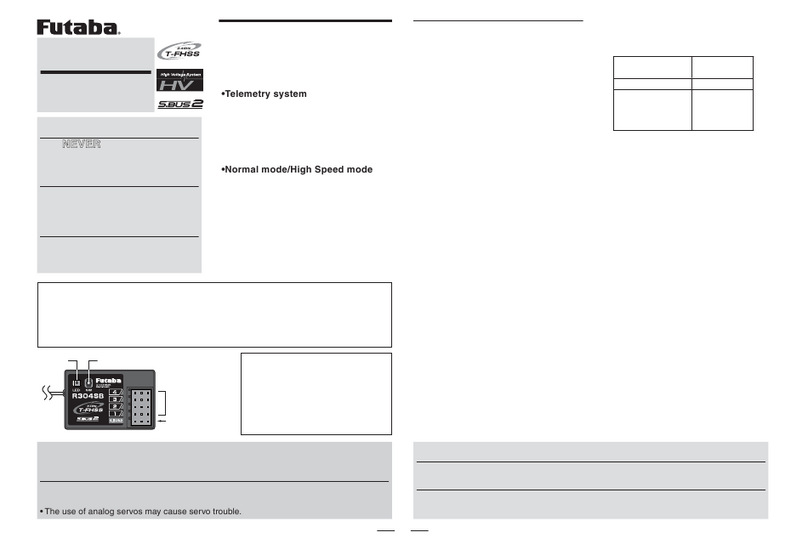
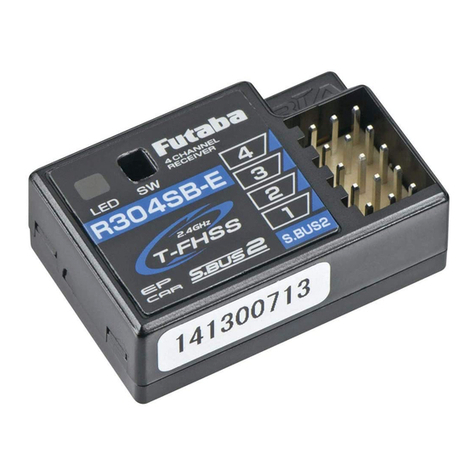
  9. FUTABA R304SB User manual

FUTABA R304SB User manual

Other manuals for R304SB

2

Other FUTABA Receiver manuals

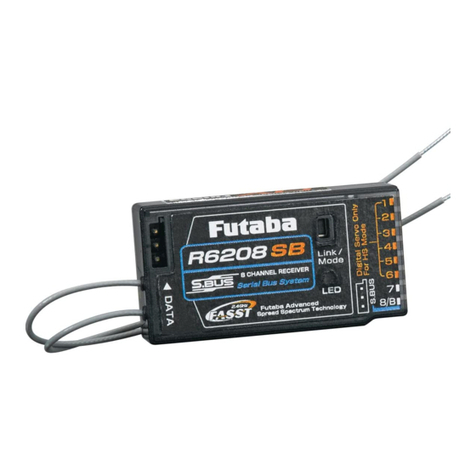
FUTABA R2006GS User manual

FUTABA

FUTABA R2006GS User manual

FUTABA R6202SBW User manual

FUTABA

FUTABA R6202SBW User manual

FUTABA R6203SBE User manual

FUTABA

FUTABA R6203SBE User manual

FUTABA R314SB-E User manual

FUTABA

FUTABA R314SB-E User manual

FUTABA R607FS User manual

FUTABA

FUTABA R607FS User manual

FUTABA R304SB-E User manual

FUTABA

FUTABA R304SB-E User manual

FUTABA R7208SB User manual

FUTABA

FUTABA R7208SB User manual

FUTABA 2PL-FM User manual

FUTABA

FUTABA 2PL-FM User manual

FUTABA 4pls User manual

FUTABA

FUTABA 4pls User manual

FUTABA R3206SBM User manual

FUTABA

FUTABA R3206SBM User manual

FUTABA R6203SB User manual

FUTABA

FUTABA R6203SB User manual

FUTABA FASSTest R7103SB User manual

FUTABA

FUTABA FASSTest R7103SB User manual

FUTABA MCR-4A User manual

FUTABA

FUTABA MCR-4A User manual

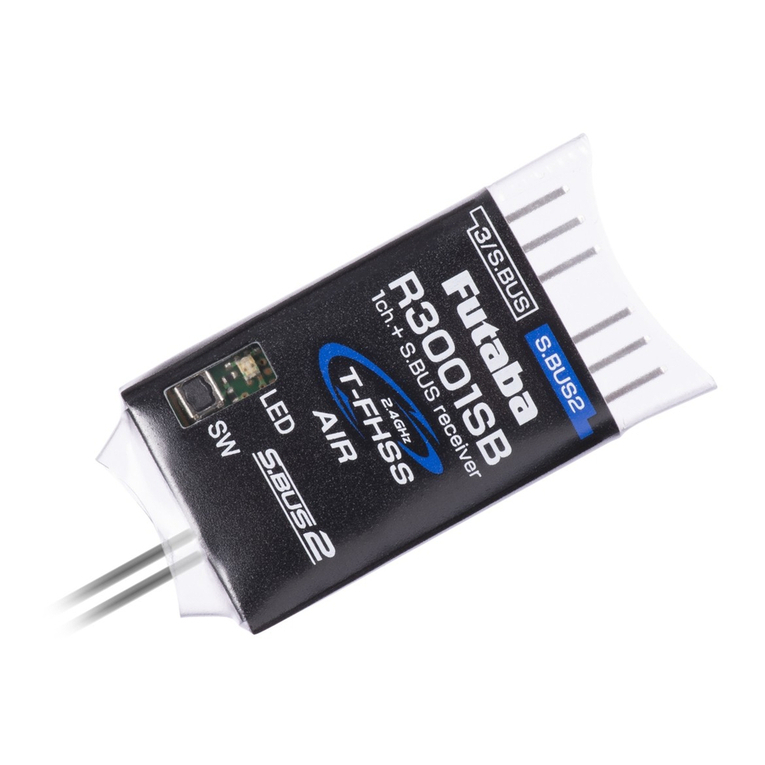
FUTABA T-FHSS Air R3001SB User manual

FUTABA

FUTABA T-FHSS Air R3001SB User manual

FUTABA R314SB User manual

FUTABA

FUTABA R314SB User manual

FUTABA T10PX User manual

FUTABA

FUTABA T10PX User manual

FUTABA R204GF-E User manual

FUTABA

FUTABA R204GF-E User manual

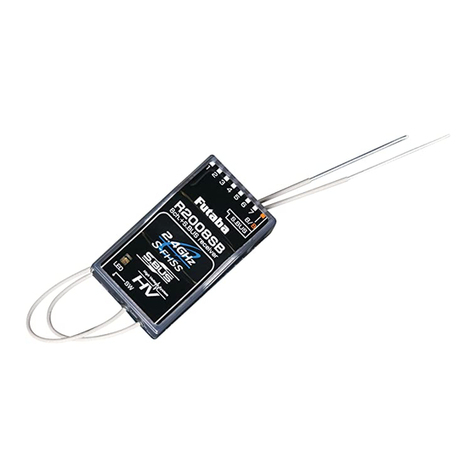
FUTABA R2008SB User manual

FUTABA

FUTABA R2008SB User manual

FUTABA R7008SB User manual

FUTABA

FUTABA R7008SB User manual

FUTABA 4GRS User manual

FUTABA

FUTABA 4GRS User manual

FUTABA R304SB User manual

FUTABA

FUTABA R304SB User manual

FUTABA R6303SBE User manual

FUTABA

FUTABA R6303SBE User manual

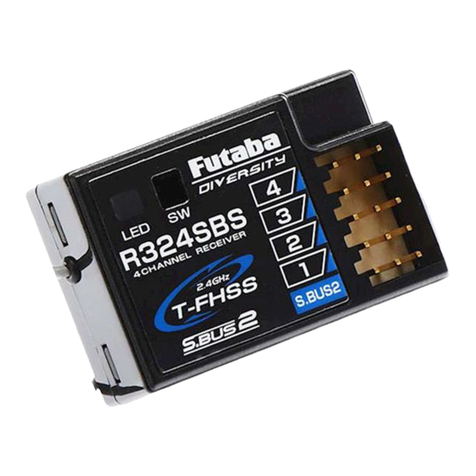
FUTABA R324SBS User manual

FUTABA

FUTABA R324SBS User manual

FUTABA R304SB-E User manual

FUTABA

FUTABA R304SB-E User manual

Popular Receiver manuals by other brands

Televes ZAS HD SAT user manual

Televes

Televes ZAS HD SAT user manual

Realistic DX-75 Operating and service instructions

Realistic

Realistic DX-75 Operating and service instructions

Saris 4620 Assembly instructions

Saris

Saris 4620 Assembly instructions

Mini DTR 206C PVR user manual

Mini

Mini DTR 206C PVR user manual

RF Elements TwistPort manual

RF Elements

RF Elements TwistPort manual

Denon DN-200WS user guide

Denon

Denon DN-200WS user guide

Yamaha RX-V467 owner's manual

Yamaha

Yamaha RX-V467 owner's manual

Russound SaphIR 858 instruction manual

Russound

Russound SaphIR 858 instruction manual

Quasonix RDMS Firmware update procedure

Quasonix

Quasonix RDMS Firmware update procedure

Pioneer XV-HTD1 Service manual

Pioneer

Pioneer XV-HTD1 Service manual

ATZ HDMI-V2-44HE150 manual

ATZ

ATZ HDMI-V2-44HE150 manual

Sony XNV-770BT MyTomTom Specifications

Sony

Sony XNV-770BT MyTomTom Specifications

Grundig STR 7122 TWIN Service manual

Grundig

Grundig STR 7122 TWIN Service manual

Creative Blaster Modem user guide

Creative

Creative Blaster Modem user guide

Panduit ATLONA AT-OME-RX11 installation guide

Panduit

Panduit ATLONA AT-OME-RX11 installation guide

VOLTCRAFT UTPS-40 operating instructions

VOLTCRAFT

VOLTCRAFT UTPS-40 operating instructions

JVC KW-ADV794 instructions

JVC

JVC KW-ADV794 instructions

Litelink VT-1001 operating instructions

Litelink

Litelink VT-1001 operating instructions

manuals.online logo
manuals.online logoBrands
  • About & Mission
  • Contact us
  • Privacy Policy
  • Terms and Conditions

Copyright 2025 Manuals.Online. All Rights Reserved.

L in k Pr o c e du r e
Each transmitter has an individually
assigned, unique ID code. In order to start
operation, the receiver must be linked
with the ID code of the transmitter with
which it is being paired. Once the link is
made, the ID code is stored in the receiver
and no further linking is necessary unless
the receiver is to be used with another
transmitter.
1Plac e the tra n smitt er a nd t he
receiver close to each other within
half (0.5) meter.
2Place the transmitter into the linking
mode, and turn on the receiver.
3During countdown, push the receiver
tact switch for approximately 2
seconds. The LED will begin to blink
red. After the receiver LED switches
from blinking red to green →red
steady light, If the transmitter and
receiver are linked normally, set the
power switch to the OFF position
and then return it to the PWR ON
position. If the receiver LED lights
green, li nking was successful.
Actually check servo operation.
*Please refer to the table below for
LED status and receiver condition.
*Refer to the transmitters operation
manual for complete details on how to
place the transmitter into the linking
mode.
*If there are many T-FHSS systems
turned on in close proximity, your
receiver might have difficulty
establishing a link to your transmitter.
This is a rare occurrence. However,
should another T-FHSS transmitter/
receiver be linking at the same time,
your receiver could link to the wrong
transmitter. This is very dangerous
if you do not notice this situation. In
order to avoid the problem,we strongly
recommend you to double check
whether your receiver is really under
control by your transmitter.
WARNING
After the linking is done, please cycle receiver power and check if the receiver
to be linked is really under the control by the transmitter to be linked.
Do not perform the linking procedure with motor's main wire connected or
with the engine operating as it may result in serious injury.
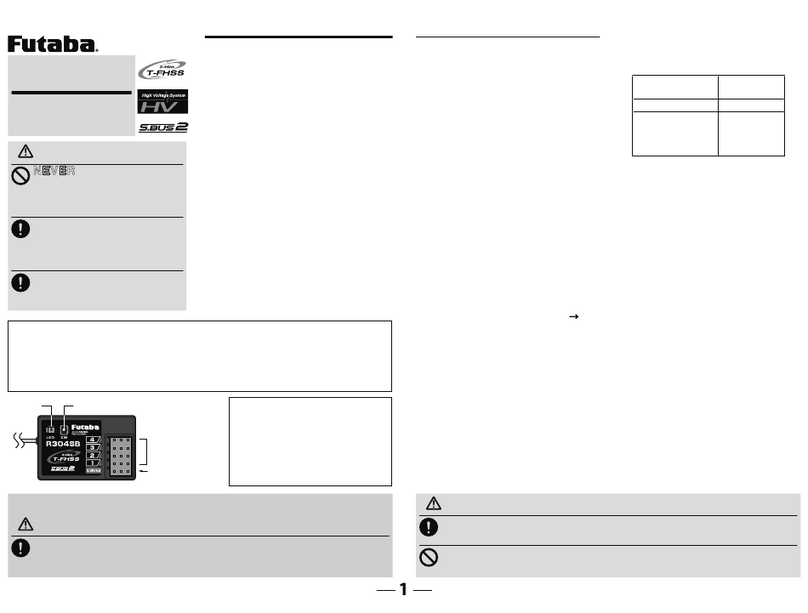
Link switchLED
S.BUS2 / (Battery)
CH output
(1 to 4) / (Battery)
Operating Precautions:
Onc e the R304SB det ect s t h e
T-FHSS normal mode or T-FHSS high
speed mode, the detected mode is
locked as long as the power is ON.
When need to change the mode,
please cycle power.
Note: The R304SB is compatible with the T-FHSS system
transmitters.
The receiver type setting of the transmitter is set inT-FHSS.
*Futaba T-FHSS system does not work with current Futaba S-FHSS/FHSS/FASST-
est/FASST system.
Usa g e c o ndi t i on o n " High Spe e d m od e "
CAUTION
When using the high-speed mode, use a Futaba digital servo (including
brushless servo). Analog servos cannot be used.
• The use of analog servos may cause servo trouble.
1M23N28502
T-FHSS-2.4GHz System
S . B U S2 , 4- C h a n n e l
Receiver for Model Car
Thank you for purchasing the R304SB
receiver. The R304SB is designed for use with
the Futaba T-FHSS system transmitter.
The R304SB receiver has adopted the newly
developed bidirectional communication
system "T-FHSS".
•Telemetry system
With the t el emet r y s y st em, the running
status can be displayed at the transmitter.
The telemetry data can be checked at the
transmitter by connecting the telemetry sensor
sold separately to the S.BUS2 connector of the
R304SB receiver.
•Normal mode/High Speed mode
The "Normal mode" accepts any type of servos
or the peripheral. The "High Speed mode"
only accepts the digital servos, including BLS
series, and most peripheral equipments such
as the brushless ESCs. Please pay special
attention to the information contained within
this manual and transmitter's manual in order
to have a pleasant running experience.
R304SB
WARNING
NEVER use dry batteries for
the power supply of the R304SB
as this may cause difficulties with
the receiver's operation.
W r a p t h e r e c e i v e r w i t h
something soft,such as foam
rubber,to avoid vibration. Do not
splash water over the receiver.
Since the receiver generates a
certain amount of heat, install
the place with good ventilation.
No signal recep-
tion LED: Red
Receiving signals LED: Green
Unrecover-
able failure
(EEPROM,etc.)
LED: Red
and Green
turn on alter-
nately
1

FUTABA CORPORATION
oak kandakajicho 8F 3-4 Kandakajicho, Chiyoda-ku, Tokyo 101-0045, Japan
TEL: +81-3-4316-4820, FAX: +81-3-4316-4823
©FUTABA CORPORATION 2018, 5 (2)
Co m pl i anc e In for m at ion St at e m e n t
(fo r U.S.A.)
This device, trade name Futaba Corporation of America, model number R304SB, complies
with part15 of the FCC Rules. Operation is subject to the following two conditions:
(1) This device may not cause harmful interference, and
(2) This device must accept any interference received, including interference that may cause
undesired operation.
(3) This module meets the requirements for a mobile device that may be used at separation
distances of more than 20cm from human body.
To meet the RF exposure requirements of the FCC this device shall not be co-located with
another transmitting device.
The responsible party of this device compliance is:
FUTABA Corporation of America
2681 Wall Triana Hwy Huntsville, AL 35824, U.S.A.
Phone:1-256-461-9399 FAX:1-256-461-1059 E-mail: [email protected]
R304SB Specifications:
(T-FHSS system, S.BUS2, 4-channel receiver)
• Receiving on 2.4GHz band
• System: T-FHSS system
At Normal/High speed mode (auto detection)
•
Power requirement Rated voltage: 4.8V-7.4V / Usable voltage: 3.5-8.4V
• F/S and Battery F/S function:It is set according to the transmitter used.
• Battery F/S voltage: Set it with the transmitter arbitrarily.
• Size: 1.38x0.91x0.33” (35.1x23.2x8.5mm)
• Weight: 0.23oz. (6.6g)
25HFHLYHU +8%
7HPSHUDWXUH
VHQVRU
530VHQVRU
9ROWDJHVHQVRU
6ZLWFK
%DWWHU\
7HOHPHWU\VHQVRUV
2SWLRQ
6WHHULQJVHUYR
7KURWWOHVHUYR
&+ &+ CollectmanytelemetrysensorsbyHUBandconnectthemtoS.BUS2port.6%86
&+
,WFRQQHFWVZLWKSRUWZKLFKLVQRWXVHGك
:KHQDOOWKHSRUWVDUHXVHGFRQQHFW
DEDWWHU\XVLQJ+8%RU<KDUQHVV
T he Ex am pl e o f Con n ec t io n