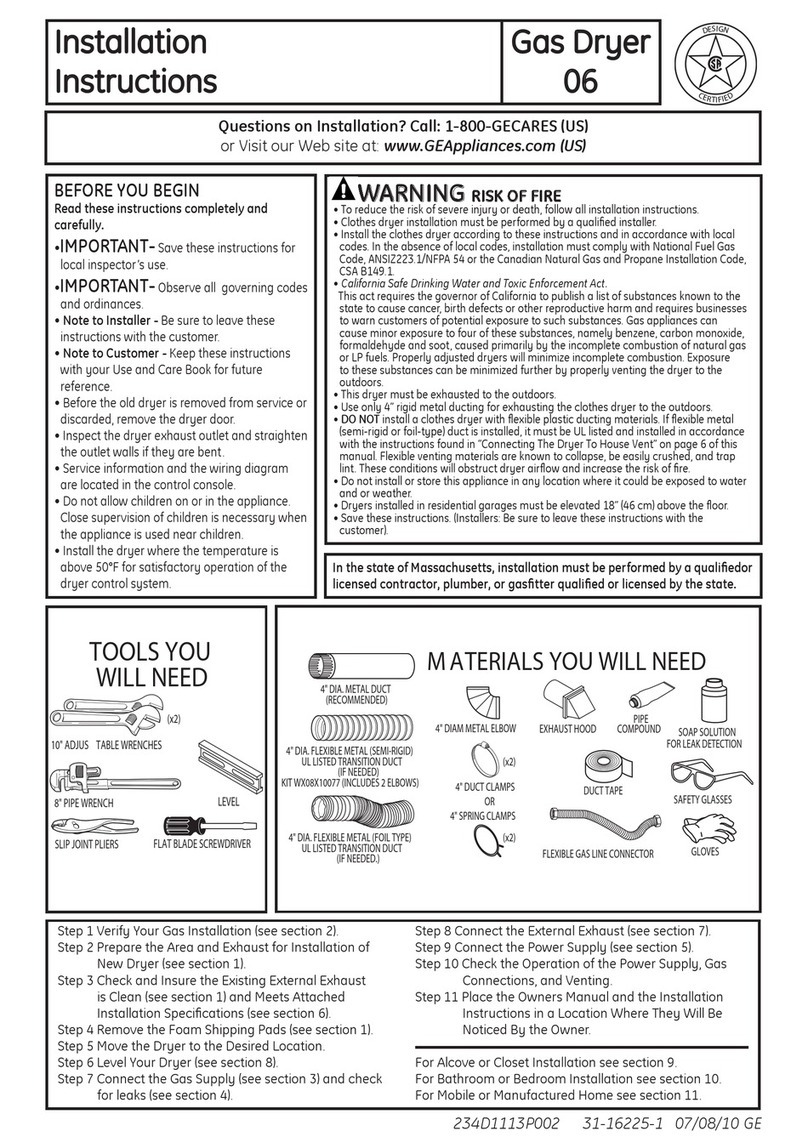
Installation
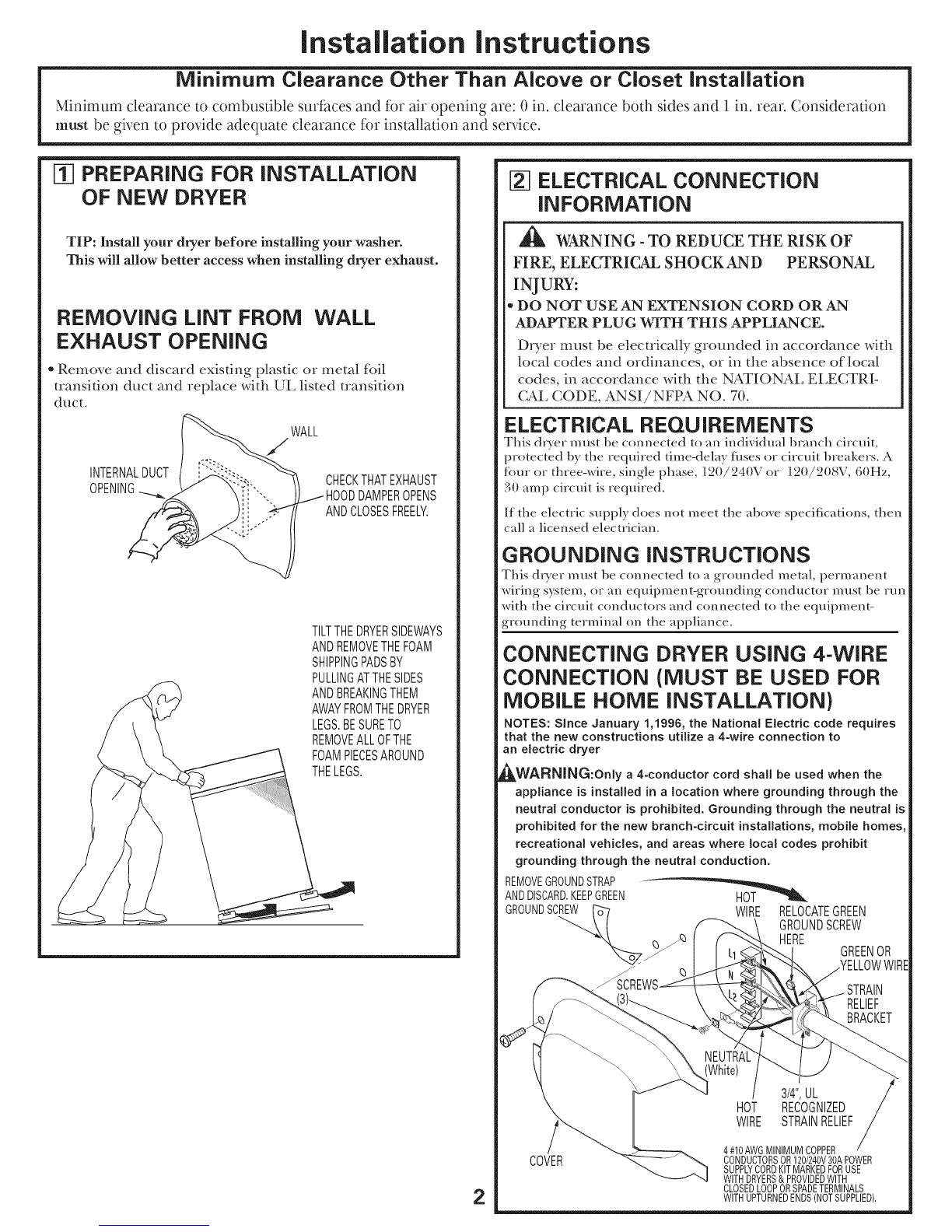
1. Turn off the circuit breaker (s) (30 amp) or remox e tlle chTer's
circuit fuse at the electrical box.
2. Be sure the chTer cord is unplugged from tile wall receptacle.
3. Remox e tile power cord coxer located at the lower back.
4. Remox e and discard ground strap. Keep tlle green
ground screw for step 7.
5. Install 3/4 in. LL recognized strain relief to power
cord entl T hole. Bring power cord through strain relief.
6. Comlect power cord as follows:
A. Comlect the 2 hot lines to tile outer screws of
tlle terminal block (marked L1 and L2).
B. Connect tlle neutral (white) line to tile center of
tile terminal block (marked N).
7. Attach ground wire of power cord with tile green ground
screw (hole aboxe strain relief bracket). Tighten all
terminal block screws (3) completely.
8. Properly secure power cord to strain relief.
9. Reinstall tile co_ er.
_ILWARNING: NEVER LEAVE THE
COVER OFF OF THE TERMINAL BLOCK,
CONNECTING DRYER USING 3-WIRE
CONNECTION
IFREQUIRED,BYLOCALCODE,
INSTALLEXTERNALGROUND
(NOTPROVIDED)TOGROUNDED
METAL,COLDWATERPIPE,OR
OTHERESTABLISHEDGROUND
DETERMINEDBYAQUALIFIED
ELECTRICIAN.
GREEN GROUND
GROUND STRAP
SCREW HOT
WIRE STRAINRELIEF
BRACKET
_ 3/4",UL
RECOGNIZED
RELIEF
NEUTRAL
HOT
(White) WIRE
3#10AWGMINIMUMCOPPER
COVER CONDUCTORSOR120/240V30APOWER
SUPPLYCORDKITMARKEDFORUSE
WITHDRYERS&PROVIDEDWITHCLOSED
LOOPORSPADETERMINALSWITH
UPTURNEDENDS(NOTSUPPLIED).
1. Tm'n off tile circuit breaker(s) (30 amp) or remo_ e tile chTer's
circuit fuse at the electrical box.
2. Be sure the chTer cord is unplugged Kom the wall.
3. Remoxe the power cord coxer located at tile lower back.
4. Install 3/4 in. LL recognized strain relief to power cord
entQ: bole. Bring power cord through strain relief.
5. Connect power cord as follows:
A. Com_ect the 2 hot lines to the outer screws of tile
terminal block (marked L1 and L2).
B. Com_ect the neutral {white) line to tile center of
the terminal block {marked N).
6. Be sure grotmd strap is connected to neutral (center)
terminal of block and to green ground screw on cabinet
rear. Tighten all terminal block screws (3) completely.
7. Properly secure power cord to strain relief.
8. Reinstall tile co_ er.
A
,AHb_WARNING: NEVER LEAVE THE
COVER OFF OF THE TERMINAL BLOCK.
Instructions
EXHAUST INFORMATION
_WARNING - IN CANADA AND IN THE UNITED
STATES, THE REQUIRED EXHAUST DUCT DIAMETER
IS 4 IN (102ram). DO NOT USE DUCT LONGER
THAN SPECIFIED IN THE EXHAUST LENGTH TABLE.
Lsing exhaust longer than specified length wilh
"Increase the drying times and tile energ T cost.
, Reduce the chTer life.
, Accumulate lint, creating a potential fire hazard.
The correct exhaust installation is YOUR RESPONSIBILITY.
Problems due to incorrect installation are not covered
by the warranty.
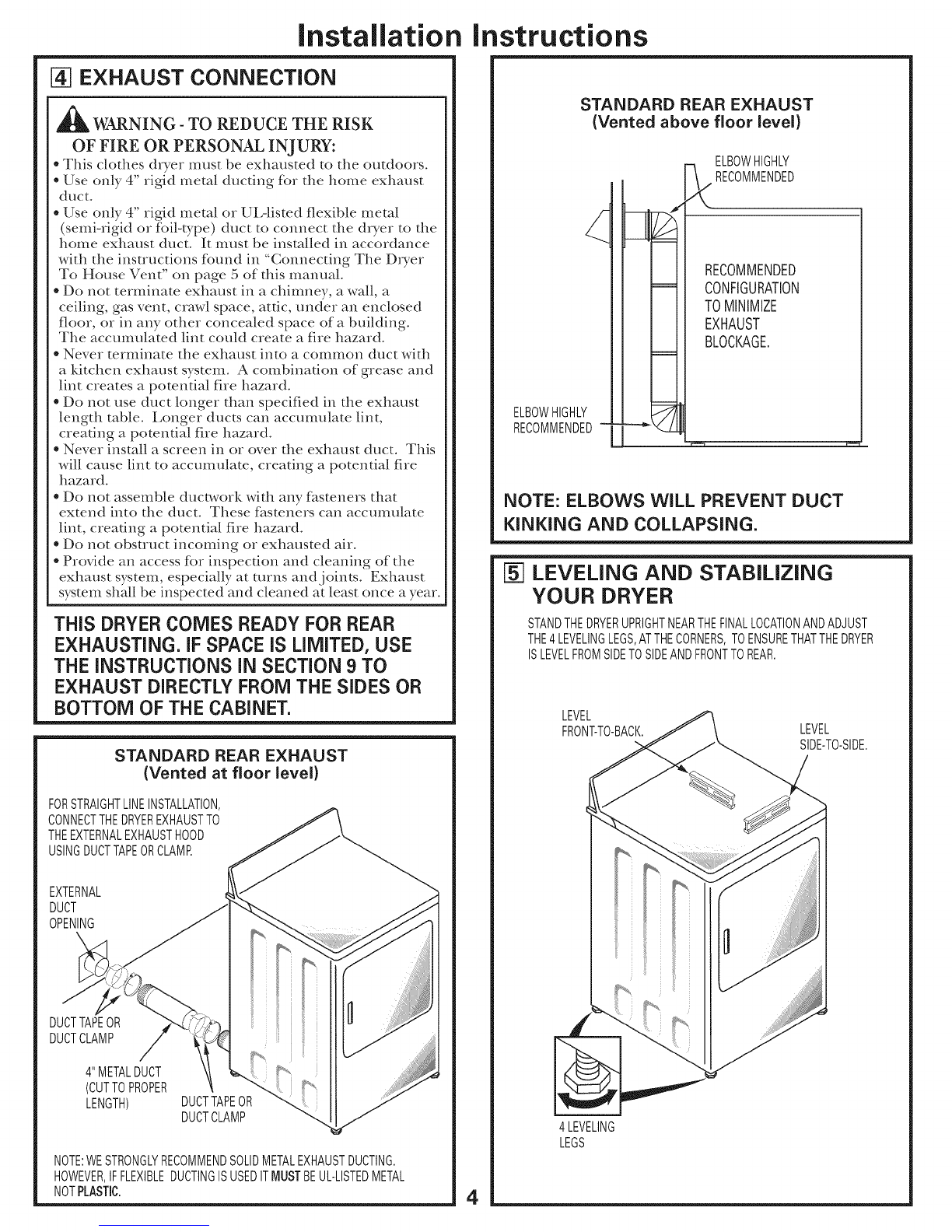
Remove and discard existing plastic or metal foil transition
duct and replace with LL listed transition duct.
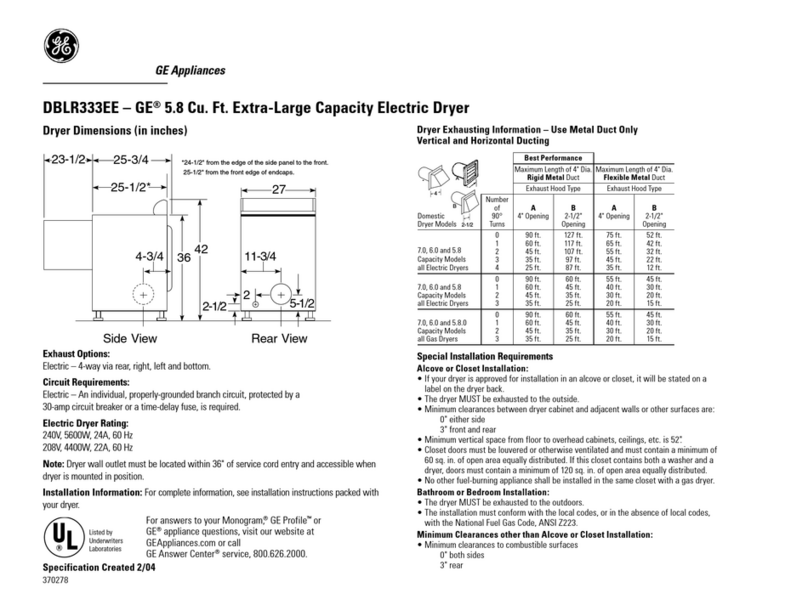
The MAXIML M ALLOWABLE duct length and number of
bends of the exhaust system depends upon the type of duct,
number of turns, the type of exhaust hood (wall cap), and all
conditions noted below. The maximum duct length for rigid
metal duct is shown in the table below.
EXHAUST LENGTH
RECOMMENDED MAXIMUM LENGTH
Exhaust Hood Types
Recommended Use only for short
run installations
/_ 4"DIA
I_2-I/2"
No.of 90-0 Rigid Rigid
Elbows Metal Metal
0 150 Feet 125Feet
1 135 Feet 115Feet
2 125 Feet 105Feet
3 115 Feet 95 Feet
4 105 Feet 85 Feet
5 95 Feet 75 Feet
EXHAUST SYSTEM CHECK LIST
HOOD OR WALL (AP
• Terminate in a manner to prevent back drafts or entry of birds or
other wildlife.
•Termination should present minimal resistance to the exhaust air flow
and should require little or no maintenance to prevent clogging.
• Never install a screen in or over the exhaust duct.This could cause lint build up.
Wall caps llltlst be installed at least 12 in. above ground level or any other
obstruction with the opening pointed down.
SEPARATION OF TURNS
For best perfermance, separate all turns by at least 4 ft. of straight duct,
including distance between last ttHn and exhaust hood.
TURNS OTHER THAN 9!)°
• Oile ttlrn of 45 ° or less may be ignored.
• Two 45° ttwns should be treated as one 90 ° ttwn.
• Each ttlrn over 45 ° should be treated as one 90 ° ttHn.
SEALING OF JOINTS
• Alljoints should be tight to avoid leaks. The male end of each section of
duct must point away flom the dryer.,
• Do not assemble the ductwork with fasteners that extend into the duct.
They will serve as a collection point fer lint.
• Duct joints can be made air and moisture-tight by wrapping the
overlapped joints with duct tape.
1
• Horizontal runs should slope down toward the outdoors ½inch per feot
INSULATION
Duct work that runs through an unheated area or is near air conditioning
should be insulated to reduce condensation and lint build-up.