4-25
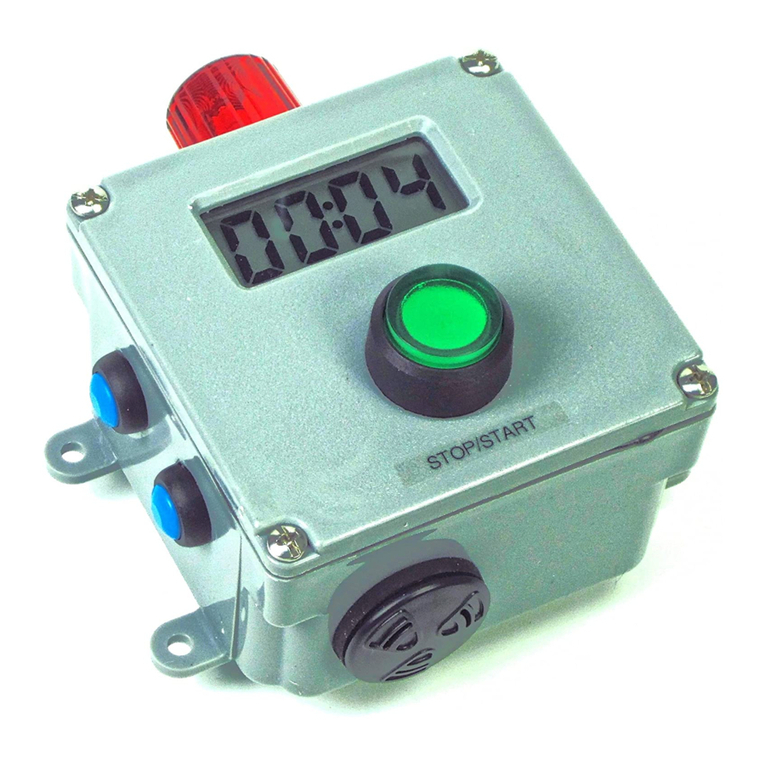
PT32, PT33
— Pulse Timers
INSTALLATION
CAUTION: When this timer is used to control equipment where personal injury or property
damage might occur as a result of timer malfunction, install safeguards which would pro-
tect persons and/or equipment in the event of any unexpected operation or failure of the
equipment.
1. Mount the timer to a solid surface as follows: PT32—Gain access to the screw holes by
removing the front cover. Insert a screw through each of the four corner holes and tighten. PT33—
Three screws are required. Drive the center first, before lifting the unit into place. Leave the head of
the screw extending out slightly. Slide the mounting lug in the center of the back over this screw.
Remove the terminal cover to expose the other two screw holes. Insert screws through these holes
and tighten.
2. Connect meter to the timer. Standard units have a built-in meter connector. The mating
connector on the end of the meter cable can be plugged in and secured by a threaded locking ring.
If additional cable to the meter is necessary, two-conductor 24 AWG is recommended. Shielded
cable is not necessary.
3. Connect load to the timer. On the standard PT32, this can be accomplished by plugging a
power cord from the load into the receptacle on the underside of the unit. The PT33 has dual output
receptacles on the lower terminal cover. The receptacle on the left corresponds to the timer on the
left (Timer 1), and the receptacle on the right serves the timer on the right (Timer 2).
4. Connect power to the timer. The cord from standard units may be plugged into any grounded
115 V receptacle.
CAUTION: Always remove power from the unit before making any terminal connections or
removing the faceplate!
SETTING
1. Determine proper output time(s). For best results, the output time should be no longer than
the shortest expected interval between meter pulses. This interval, in seconds, can be calculated:
60
Max. flow (GPM x Pulse Rate (Pulses/Gallon)
If the output time is set longer than this interval, the output will be on continuously as flow nears its
maximum, and proportional output will be lost in the upper part of the flow range.
2. With the front clear cover opened, set the desired output time(s). As the front panel states,
“Total output time equals sum of the switches turned on.” Note that any time between 1 and 1024
seconds can be set by combining switches. For example, to set 43 seconds, first set the 32 sec.
switch on, followed by the 8, and the 2 and 1 (32 + 8 + 2 + 1 = 43). The advantage of this method
soon becomes apparent. Whatever time is set will be the precise output time. It is not necessary to
time the output with a stopwatch and make adjustments.