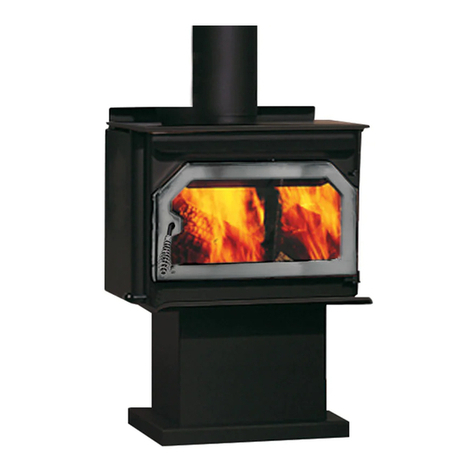
HearthStone Quality Home Heating Products, Inc ® Bari Model 8170
10
OUTSIDE AIR SUPPLY
(Kit #91- 53700)
You can connect an outside air source directly to this
stove using an optional outside air kit. The advantage of
providing outside air directly to the stove is that the air
used by the stove for combustion is taken from outside the
residence rather than from within the room where the
stove is located.
The outside air kit for this stove allows for the direct
connection of the stove's air intake to a minimum 3" (76
mm) diameter duct (supplied by others) which leads to the
outside of the house. When considering placement of the
duct from the outside of the house to the hearth, keep in
mind the need to avoid structural members of the house.
The outside air kit will attach to the back of the stove.
The International Residential Code (IRC) does not allow
the outside air duct to terminate higher than the appliance.
Some building officials also do not like to see any vertical
rise in the duct’s termination. HearthStone recommends
the termination be at the same level, or lower than the air
intake on the stove.
Locate the termination of the duct on the outside wall of
the home in such a manner to avoid the possibility of
obstruction by snow, leaves or other material. Screen the
termination using ¼” x ¼” mesh rodent screen and cover
it with a rain/wind proof hood (flex pipe, outside
termination, mesh, and hood supplied by others) Contact
your dealer for availability).
VENTING COMPONENTS AND CONFIGURATION
REQUIREMENTS
DO NOT CONNECT THIS UNIT TO A
CHIMNEY FLUE USED BY ANOTHER
APPLIANCE
•Single wall connector that is 24 MSG or 25 MSG
blued steel stovepipe.
•Double wall connector (close clearance pipe) which is
used with a listed, factory-built “Type HT" chimney or
with a masonry chimney to reduce clearances, is
available from several manufacturers, your dealer can
help you choose. Some air insulated connector pipe
models available are Simpson Dura Vent DVL and
Metalbestos DS. Security, GSW and Ameritec also
have acceptable close clearance connector pipe.
•When used in a mobile home, a spark arrester is
required. (See page 14)
•The chimney connector cannot pass through a floor or
ceiling, nor any attic or roof space, closet or similar
concealed space. Where venting requires passage
through a wall or partition of combustible
construction, the installation must conform to NFPA
Code 211 or CAN/CSA - B365.
•It is very important to follow minimum clearances for
chimney connectors to combustibles such as walls and
ceilings when installing the stove. Typical chimney
connector clearances are outlined below. The single wall
clearances are generic; the double wall clearances shown
are for Simpson DuraVent DVL. CHECK THE
SPECIFICATIONS FROM THE MANUFACTURER
OF YOUR CONNECTOR.
Components of a Venting System
The complete venting system consists of several
components: chimney connector, wall thimble, wall pass-
through, chimney, and liner. It is absolutely necessary that
you install all of these components and maintain the
clearances to combustibles discussed earlier to ensure a safe
stove installation.
To protect against the possibility of a house fire, you must
properly install and constantly maintain the venting system.
Upon inspection, immediately replace rusted, cracked, or
broken components.
•The chimney connector is the stovepipe from the
woodstove to the chimney. The chimney connector
stovepipe is 6" (152 mm) diameter, 24 MSG or 25 MSG
blued steel connector pipe. Do not use aluminum or
galvanized steel pipe - they cannot withstand the
extreme temperatures of a wood fire.
•The thimble is a manufactured (or site-constructed)
device installed in combustible walls through which the
chimney connector passes to the chimney. It keeps the
walls from igniting. You must use a wall thimble when
installing a chimney connector through a combustible
wall to the chimney.
•A wall pass-through (or chimney support package) also
keeps the walls from igniting. You must use one when
connecting through a wall or ceiling to a prefabricated
chimney.
•Only install this stove to a lined masonry chimney or an
approved high temperature prefabricated residential
type building heating appliance chimney. Do not
connect this stove to a chimney serving another
appliance; you will compromise the safe operation of
both the wood stove and the connected appliance.
WARNING:
DO NOT CONNECT THIS APPLIANCE TO ANY
AIR DISTRIBUTION DUCT OR SYSTEM.
•A liner is the UL 1777 or ULC S635 (for factory built
fireplace or masonry) chimney.
You must connect your stove to a chimney comparable to
those recommended in this manual. Do not use stovepipe as