Page 2Models 423A/8410A
Table 1. Specifications \-l
Frequency Range:
423A: 10 MHz to 12.4 GHz.
84704: 10 MHz to 18 GHz (Below I GH4RF may
leak through the video output connector. It can
be eliminated, if objectionable, with suitable low
pass filter. )
Frequency Response:x
423A: +0.2 dB/octave 10 MHz to I GHz; *0. 5 dB
overall.
84?0.A: +0.2 dB/octave l0 MHz to 8 GHz; t0,5 dB
to 12.4 GHz; +1.0 dB overall.
Maximum Power: 100 mW, peak or average.
Sensitivity:
High Level: < 0.35 mW produces 100 mW ou@ut.
Low Level: ) 0.4 mVdc /pW CW.
Impedance: 50 ohms.
Refl ection Coeff icient:
423.4' and 84704: 10 MHz to 4. 5 GHz, 0. 091 (1.2
SWR); 4.5 GHz to 7.0 GHz, 0. 15 (r.35 SWR);
7.0 GHz to 12.4 GHz, 0.2 (t. S SWR).
84?04': 12.4 GHz to 18.0 GHz, 0.26 (1. ? SWR).
Output Impedance: < 15kO shunted by 10 pF.
Connectors:
4234:
Option 01: Matched pair. Frequency response
characteristics (exclusive of basic sensitivity)
track within +0.2 dB per octave from 10 MEz
to 8 GHz, t0.3 dB from 8 to L2.4 G[lz.
Option 02: Furnished with matched load resistor
(11523A) for optimum square law characteristics
at 2 4" C (?5' F;, * ( +0. 5 dB variation from squar.e
law over a range of at least 30 dB up to 50 mV
peak output working into an external load ) 75k
ohms. Sensitivity typically ) 0, I mY / pW when
Ioad resistor is used. Overall tength 4-l/2 i\.
(144 mm).
Option 03: Positive polarity or/tput.
8470A:
Option 01: Matched pair. Frequency response
characteristics (exclusive of basic sensitivity)
track within t0.2 dB per octave from 10 MHz to
8 GHz,t0.3 dB from 8 to 12.4 GHz, *0.6 dB
from 12.4 to 18 GHz.
Option 02: Furnished with matched load resistor
(11523A) for optimum square law characteristics
at 24" C (?5 "F;,* < +0.5 dB variationfrom square
law over a rillge of at least 30 dB up to 50 mV
peak output working into an exte rnal load ) 7 5kQ.
Sensitivity typically )0.L mY/pW when load
resistor is used. Overall length 4-L/2 n.
(144 mm).
Option 03: Positive polarity output.
Option 12: Furnished with stainless steel type N
male connector.
Option 13: F\rrnished with stainless steel tlpe N
female connector.
Detector Element: Supplied.
- replec e rn enf -a
s se m bl ie s. )
Output Polarity: Negative.
posftiGEfefify units. )
Noise: (200 pVp-p, with CW applied to produce
J00-mVdc output.
*As readon a meter calibrated for square-law de-
tectors (such as HP 4158 SWR Meter).
(Refer to Table 2 for
(Refer to options for t
{t
I
T
C
+
lO. GElrllRAt.
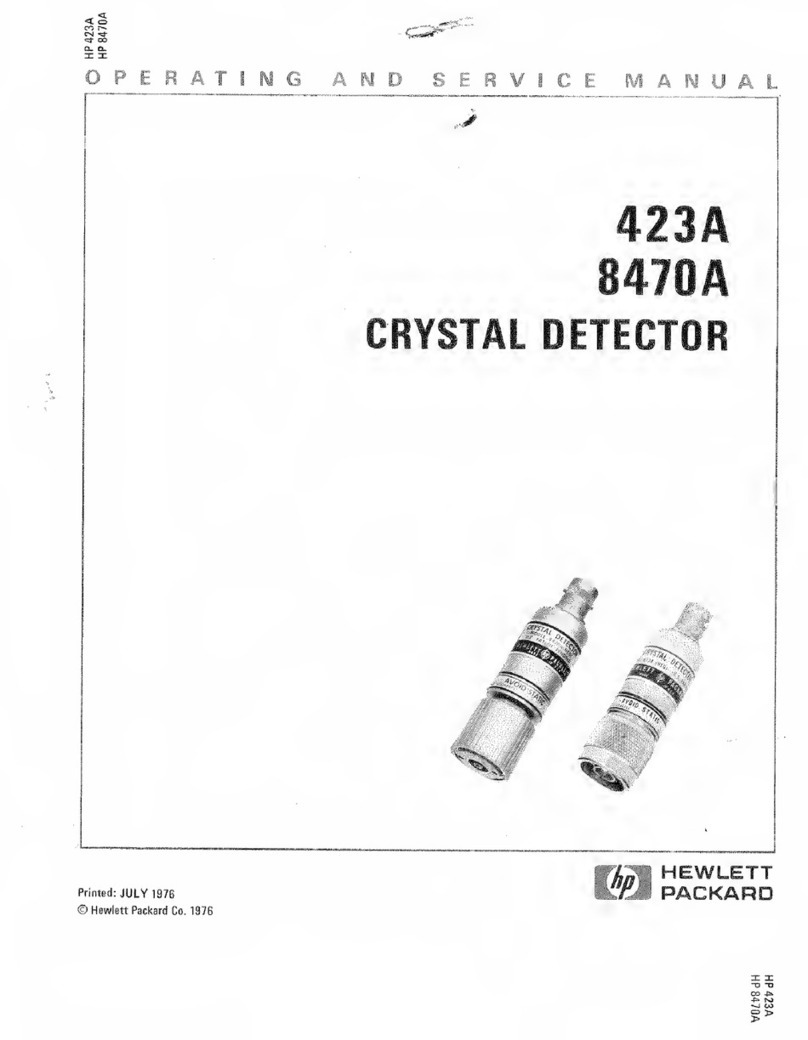
11. The Crystal Detectorcanbeusedas ademodulator
to obtain a pulse envelope which can then be observed
on an oscilloscope. It can also be used as a general
purpose detector.
12. When using the Crystal Detector with an oscillo-
scope and the waveshapes to be observed have rise
times of lessthan 5 psec, the coaxial cable connecting
oscilloscope and detector should be as short as possible
and shunted with a resistor. Ideally, this resistor
should be 50 ohms to terminate the coaxial cable
properly. However, with 50ohms resistance, possibly
the output video pulse maybe too small to drive some
oscilloscopes. Therefore, the cable should be shunted
with the smallest value of resistance that will obtain
suitable deflection on the oscilloscope; typically the
value will lie between 50 and 2k ohms. The larger the
resistance the more degradation of rise time.
13. The power applied to the Detector can be either
modulated or continuous wave (CW). If modulated at
a 1000-cps rate, the sensitive HP Model 4l5B/E can be
used as the indicator. For CW detection, a dc milli-
ammeter ormillivoltmeter zuchasthe HP Model 425A
Microvolt-Ammeter can be used as the indicator.
14. PEAK POWER MEAST]REMENT.
15. The arrangement of equipment f or peak power
measurement is shown in Figure 2. The procedure
involves calibration of an oscilloscope which in furn
is used to calibrate a CWgenerator. The outputof the
calibrated CW generator is meazured with a poril/er
meter; thepeak power of a pulse istherebymeasured.
The procedure is as follows:
a. Connect equipment as shown in Figure 2, step 1.
b. Observe pulse on a dc-coupled oscilloscope.
U sing a marking pencil, mark on the graticule the base -
to-peak amplitude of the pulse envelope.
;!
4
t
{
I.
01613-8