8
ADDITIONAL VENTING REQUIREMENTS: When con-
necting to gas vents or chimneys, vent installations shall
be in accordance with Part 7, Venting of Equipment, of
the National Fuel Gas Code, ANSI Z223.1-latest edition,
or applicable provisions of the local building codes.
Vent connectors serving appliances vented by natural
draft shall not be connected into any portion of mechani-
cal draft systems operating under positive pressure.
When two or more appliances vent into a common flue,
the area of the common flue should be at least equal to
the area of the largest flue plus 50% of the areas of the
additional flue or vent connectors.
When an existing boiler is removed from a common vent-
ing system, common venting system is likely to be too
large for proper venting of appliances remaining connect-
ed to it. At time of removal of existing boiler, following
steps shall be followed with each appliance remaining
connected to the common venting system placed in oper-
ation, while other appliances remaining connected to
common venting system are not in operation:
1. Seal all unused openings in common venting system.
2. Visually inspect the venting system for proper size and
horizontal pitch and determine there is no blockage or
restriction, leakage, corrosion and other deficiencies
which could cause an unsafe condition.
3. Insofar as is practical, close all building doors and win-
dows and all doors between the space in which the appli-
ances remaining connected to the common venting sys-
tem are located and other spaces of the building. Turn on
clothes dryers and any appliance not connected to the
common venting system. Turn on any exhaust fans, such
as range hoods and bathroom exhausts, so they will
operate at maximum speed. Do not operate a summer
exhaust fan. Close fireplace dampers.
4. Place in operation the appliance being in-spected. Fol-
low the lighting instructions. Adjust thermostat so appli-
ance will operate continuously.
5. Test for spillage at draft hood relief opening after 5
minutes of main burner operation. Use the flame of a
match or candle, or smoke from cigarette, cigar or pipe.
6. After it has been determined that each ap-pliance
remaining connected to common venting system properly
vents when tested as outlined above, return doors, win-
dows, exhaust fans, fireplace dampers and any other
gas-burning appliance to previous conditions of use.
7. Any improper operation of the common venting system
should be corrected so installation conforms with the
National Fuel Gas Code, ANSI Z223.1-latest edition.
When resizing any portion of the common venting sys-
tem, the common venting system should be resized to
approach the minimum size as determined using the
appropriate tables in Appendix G in the National Fuel
Gas Code, ANSI Z223.1-latest edition. For Canada, the
provisions of CAN/CGA B149.1 or .2 shall apply.
ADDITIONAL CHIMNEY REQUIREMENTS: Chimney
condition is of paramount importance for a safe and effi-
cient boiler installation. All installations must include a
chimney inspection by a qualified individual or agency.
Chimney construction materials must be compatible with
the fuel being used.
Particular attention should be paid on all oil-to-gas con-
versions.Soot may have accumulated in chimney and/or
degraded chimney liner. Most utilities require complete
chimney cleaning. Others may require installation of new
liner, spill switches or other chimney upgrades. Check
with local utility for required safety precautions.
MAXIMUM
6-FT
APART
PITCH 1/4"
PER FOOT
SECURE
FLUE PIPE
TO VENT
DAMPER
USE VENT SUPPORT(S) AS REQUIRED TO PREVENT SAGGING
INSTALL
FLUSH
WITH
INSIDE
CHIMNEY
LINER
SEAL
WITH
FURNACE
CEMENT
SINGLE WALL
OR TYPE B
FLUE PIPE
HC-65 = 5"
HC-85 = 5"
HC-100 = 5"
HC-120 = 6"
HC-145 = 6"
HC-165 = 7"
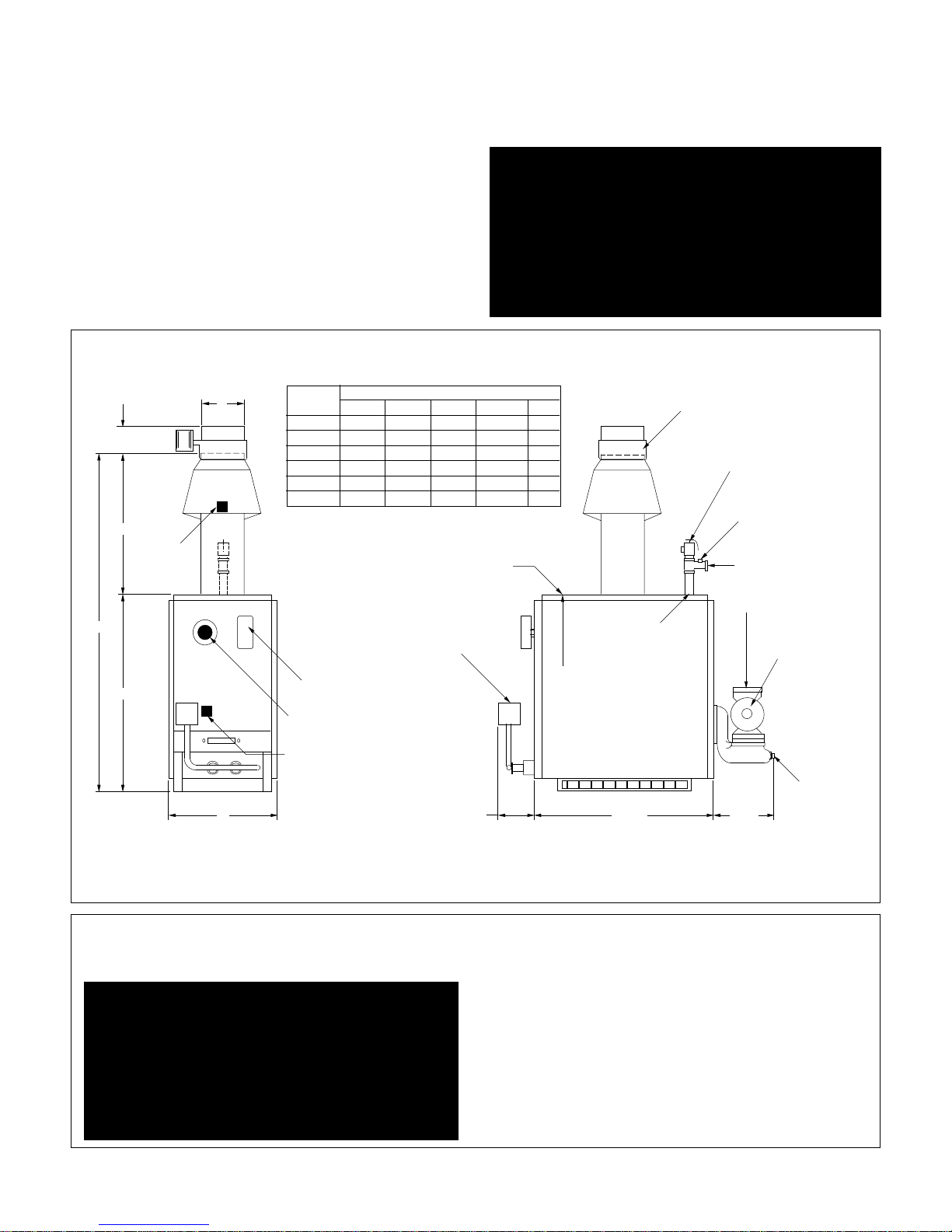
PROCEDURE C: Install flue pipe between vent
damper and chimney (6" minimum clearance
required between flue pipe and combustibles).
FIGURE 1.15
DANGER: A chimney which does not meet modern
safety standards will result in a fire or deadly carbon
monoxide poisoning of the building residents.