5
3. Personal Safety
a. Stay alert, watch what you are doing and use
common sense when operating the power
tool. Do not use a power tool while you are
tired or under the inuence of drugs, alcohol
or medication. A moment of inattention while
operating power tools may result in serious
personal injury.
b. Use personal protective equipment. Always
wear eye protection. Protective equipment
such as dust mask, non-skid safety shoes, hard
hat, or hearing protection used for appropriate
conditions will reduce personal injury.
c. Prevent unintentional starting. Ensure the switch
is in the o-position before connecting the
power source, picking up or carrying the tool.
d. Remove any adjusting key or wrench before
turning the power tool on. A wrench or a key
left attached to a rotating part of the power tool
may result in personal injury.
e. Dress properly. Do not wear loose clothing
or jewellery. Keep your hair, clothing and
gloves away from moving parts. Loose clothes,
jewellery or long hair can be caught in moving
parts.
4. Power tool use and care
a. Use the correct power tool for your application.
The correct power tool will do the job better and
safer at the rate for which it was designed.
b. Do not use the power tool if the switch does not
turn it on and o. Any power tool that cannot
be controlled with the switch is dangerous and
must be repaired.
c. Disconnect the plug from the power source
before making any adjustments, changing
accessories, or storing power tools. Such
preventive safety measures reduce the risk of
starting the power tool accidentally.
d. Store idle power tools out of reach of children
and do not allow persons unfamiliar with the
power tool or these instructions to operate the
power tool. Power tools are dangerous in the
hands of untrained users.
e. Maintain power tools. Check for misalignments
or binding of moving parts, breakage of parts
and any other condition that may aect the
power tools’operation. If damaged, have the
power tool repaired before use. Many accidents
are caused by poorly maintained power tools.
f. Use the power tool, accessories and tool bits,
etc. in accordance with these instructions, taking
into account the working conditions and the
work to be performed. Use of the power tool for
operations dierent from those intended could
result in a hazardous situation.
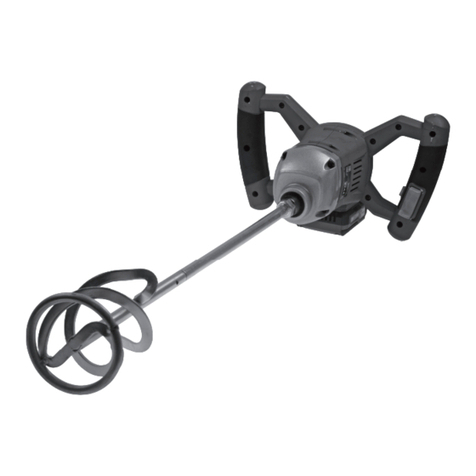
ADDITIONAL SAFETY RULES FOR
CEMENT MIXERS
• Read and understand the owner’s manual and
labels axed to the mixer. Learn its application
and limitations as well as the specic potential
hazards peculiar to it.
• Do not operate the mixer while under the
inuence of drugs, alcohol, or any medication
that could aect your ability to use it properly.
• Check your mixer before turning it on. Keep
guards in place and in working order. Form a
habit of checking to see that keys and adjusting
wrenches are removed from tool area before
turning it on. Replace damaged, missing or
failed parts before using it.
• Always wear safety goggles and/or face shields.
Any mixer may throw foreign objects into the
eyes. This can cause permanent eye damage.
Everyday eyeglasses have only impact resistant
lenses. They are not safety glasses.
• Improper use of extension cords may cause
inecient operation of the mixer which can
result in overheating. Be sure the section of
extension cord is enough to allow sucient
current ow to the motor. Avoid use of free
and inadequately insulated connections.
Connections must be made with protected
material suitable for outdoor use.
• Check that the electric circuit is adequately
protected and that it corresponds with the
power, voltage and frequency of the motor.
CT0016_Kelso-FrontTipMixer-Manual_FA.indd 5 26/06/2015 12:13 pm