Read all instruction.
Save these instructions.
FUNCTIONAL DESCRIPTION
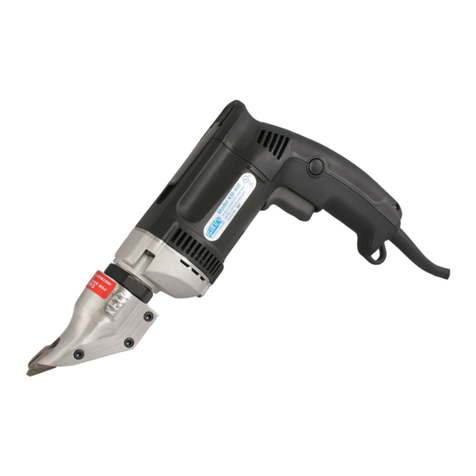
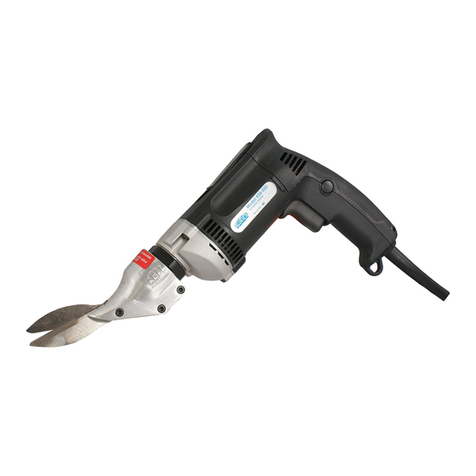
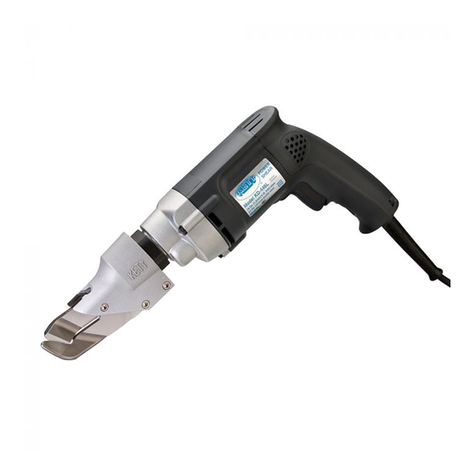
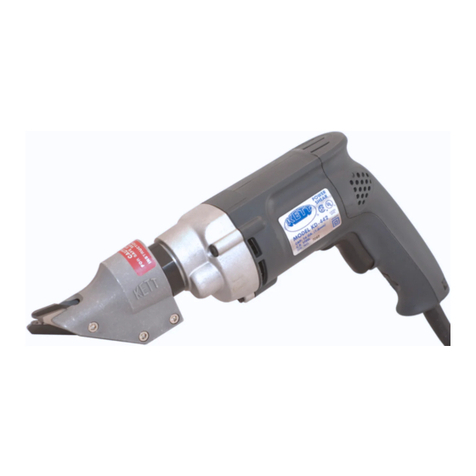
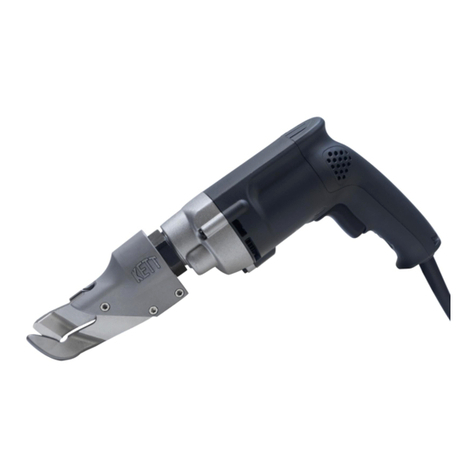
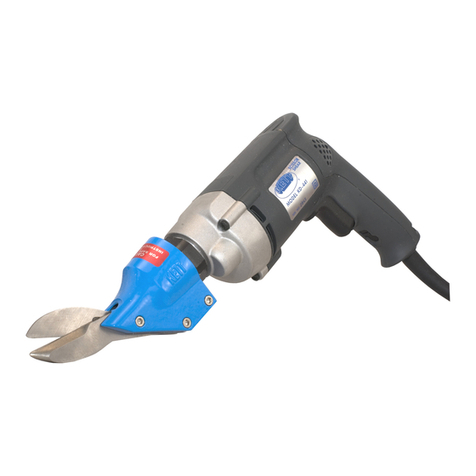
Please read carefully all safety rules and operating instructions. The Model KL-2040 Shear is recommended for CR sheet steel up to 13 gage
Pre-starting procedure (Fig. 1)
Check all fasteners to make sure they are tight.
Check blades to make sure they are sharp.
Check that gap S (Fig. 2) between blades corresponds to thickness (K) of cut material.
Thickness (K) of cut
material, mm 0.5-0.8 0.9-1.3 1.4-1.8 2-2.5
Gauge 26-21 20-17 16-14 13
Gap, S,mm, approx. 0.1 0.2 0.3 0.4
Inches .004 .008 .012 .016
The gap is set at 0.4 mm (.016”) from the factory.
Switching on and off (Fig. 1)
Move the trigger (3) forward to turn the nibbler ON; moving the trigger back turns the nibbler OFF.
Red dot on housing (4) near the trigger (2) shows that switch is in ON position.
Test run
Perform a no-load test run of 10-15 seconds prior to starting cutting.
Working procedure (Fig. 1)
• With the shears ‘ON’, insert it into the cutting sheet between the moving blade (10) and stationary blade (11).
• Begin cutting by putting consistent pressure in the direction of the cut.
• When trimming off a narrow strip off the sheet, place shears so that strip is on the right side and the yoke (8) is down.
• The minimum cutting radius (R) for 13 gauge material is 10 inches. For thinner materials the curved cut can be made tighter.
• Don’t overload the tool when cutting – the temperature of the gear housing (1) and the front motor housing (4) should not exceed accordingly 108°F
and 90°F above ambient. The cooling holes should always be clean and un-obstructed.
Blades adjustment and replacement
To change the gap S (Fig.2) between blades (4):
• Move plunger (8, Fig 2) to the bottom stroke by manually rotating electric motor armature by the fan blades with the wooden or plastic stick through
the opening in the housing (1, Fig.1).
• Loosen up nut (5, Fig.2) by one revolution with an 8-mm wrench
• Loosen up screw (6, Fig. 2) by 1…2 revolutions with a flat screwdriver
• Loosen up screw (7, Fig. 2) by 1…2 revolutions with a 5-mm allen wrench (supplied)
• Place a corresponding to the material thickness adjustment gage (set of 4 gages supplied, see gap S chart above) between blades and tighten
screws (7), then screw (6) and then nut (5). Screw (7) should be very tight to prevent the bottom blade from moving during the cut.
If shears stopped cutting or cutting became difficult, check the blades cutting edges for excessive wear and rotate, if necessary:
• Loosen up nut (5), stop screw (6), then screws (1) and (7) by 1…2 revolutions.
• Turn the blades to a fresh cutting edge (each blade has 4 cutting edges).
• Tighten the screws and adjust gap S, following the above procedure.
• When all cutting edges are worn, it is necessary to replace the blades. Notice that the blades sides are slightly tapered (creating a clearance angle).
They should be placed with the smaller face down, tapering outside.
Maintenance
• Before performing any work, unplug the power cord.
• Any maintenance work should be performed by a qualified specialist.
• For safe and proper operation, always keep the tool and the ventilation slots clean.
• Periodically, depending on operation intensity, check the brushes and change them when their height is lower than 7.5 mm. (Don’t change the brush
position in brush holder).
• After installing brand new brushes, run the tool no-load for several minutes to allow pre-shaping the ends of the new brushes to to the commutator.