INSTRUCTIONS
VIPER2HIGH SPEED HANDPIECE
INSTALLATION AND OPERATION
The Viper2360 swivel handpiece is equipped with a quick connect feature to
facilitate fast connection of additional Kinetic Viper2360 handpieces as well as
easy lubrication and infection control procedures. To disassemble the
handpiece at the 360 quick coupling, simply pull the connecting ring towards the
tubing assembly. To reassemble, seat the handpiece onto the coupling until the
connecting ring automatically locks the handpiece in place.
IMPORTANT FOR SAFETY!
Never pull the connecting ring while the handpiece is turning to avoid the
danger of the handpiece being forcibly disengaged by the air pressure. Before
installing the handpiece, clean and lubricate as explained under
MAINTENANCEAND SERVICING procedures.
Before connecting the handpiece to the light source illumination system tubing,
install a Kinetic swivel lamp module (as shown) into the receptacle on the end
of the tubing. Be certain to align electrical pins to prevent breakage.
Connect the handpiece to the tubing being careful to align all air and water
tubes.
For maximum performance and bearing life, the Viper2360 handpiece should
be operated with clean, filtered, moisture-free air at a pressure of 38-43 psi as
measured at the handpiece coupling.
IMPORTANT OPERATING INFORMATION
1.Bur changing technique may be different than similar handpieces ... follow
instructions to avoid turbine damage.
2.Do not operate the handpiece at pressures in excess of 45 psi to avoid
premature turbine failure.
3.Never pull the 360 Quick Coupling connecting ring while the handpiece
is operating.
4.Never operate the handpiece, even for an instant, without a bur installed to
avoid chuck damage.
5.Avoid prolonged "no load" conditions.
6.When switching handpiece delivery hoses, insure that the recommended air
pressure is not exceeded.
7.Lubricate the handpiece at least twice a day.
8.Never use short shank burs.
CHANGING BUR
The Viper2chucking mechanism is designed to always be operated with a bur
installed. To prevent damage to the handpiece and the danger of an ejected
rotating bur, NEVER depress the PUSH-LOK while the handpiece is rotating.
Aflat wound spring is used to lock the bur jaws in place. When removing a bur,
be sure to depress the push button all the way down. A click may be felt as the
spring is compressed. This is especially important since, under certain heavy
cutting situations, the bur may afterwards seem to be "jammed" in the
handpiece. This is not a defect in the chuck mechanism but is a result of the
increased locking action of the bur jaws under heavy pressure.
The chuck is designed to become tighter as greater pressure is applied,
preventing bur slippage. If this situation is encountered, extra force can be
applied to the push button.
CHUCK MAINTENANCE
In general, the chuck mechanism is not subject to wear and should easily
outlast the turbine and bearing assemblies. However, inadvertent introduction of
oral cavity fluids, chemical disinfecting liquids, or other materials into the chuck
mechanism may possibly produce residues which could easily interfere with the
chucking action. If this situation is encountered and cannot be rectified by
cleaning, the turbine should be returned to the factory for disassembly, cleaning
and possibly a complete rebuilding.
LAMP CHANGING
Using the quick disconnect, remove the handpiece. Holding the smooth front of
the coupling, unscrew the tubing nut and separate the coupling from the tubing.
Unplug the burned out lamp and replace with a new Viper2360 swivel lamp
while carefully aligning the electrical pins. Replace the coupling onto the tubing
assembly and reconnect the handpiece.
INFECTION CONTROL PROCEDURES
AUTOCLAVE: To use an autoclave as an effective means of infection control
requires an autoclave cycle after each patient. Although the Viper2360
handplece is fully autoclavable, the autoclave environment is hostile to any
handpiece and will result in slow physical and operational degradation. Less
frequent autoclaving is not recommended since this would compromise
infection control. If autoclaving is the preferred method, the following directions
should be applied to assure maximum longevity:
1.Thoroughly clean handpiece using brush and detergent.
2.Rinse completely.
3.Allow handpiece to dry and then lubricate (optional).
4.Remove all excess lubricant.
DISINFECTANT SOLUTIONS: Various bactericidal and virucidal solutions are
available which provide high level disinfection and sterilization. In addition to
following the manufacturer's recommendations for use, it is essential to develop
a procedure to remove the solutions after disinfecting. The residues that remain
after evaporation of the solution can easily interfere with all mechanisms in the
handpiece. Do not allow the disinfectant solution to dry on the handpiece. If the
procedures suggest drying, modify them by soaking gauze in the solution and
leave it in contact with the handpiece for the required time duration.
Immediately after disinfecting, wash the handpiece thoroughly with tap water or
sterile water. Complete immersion in water will not harm the handpiece. After
washing, shake the handpiece to remove excess water, blow dry with Triplex
syringe and lubricate.
CHEMICLAVE: Chemiclave may be used for infection control as long as there
are not high levels of residue left on the handpiece after the cycle. Be certain
the chemiclave solution used is compatible with those materials found in high
speed handpieces. A chemiclave is essentially an autoclave and therefore
follow all considerations underAUTOCLAVE.
DRY HEAT STERILIZATION: Do not use dry heat sterilizers for handpieces.
TURBINE CARTRIDGE REPLACEMENT
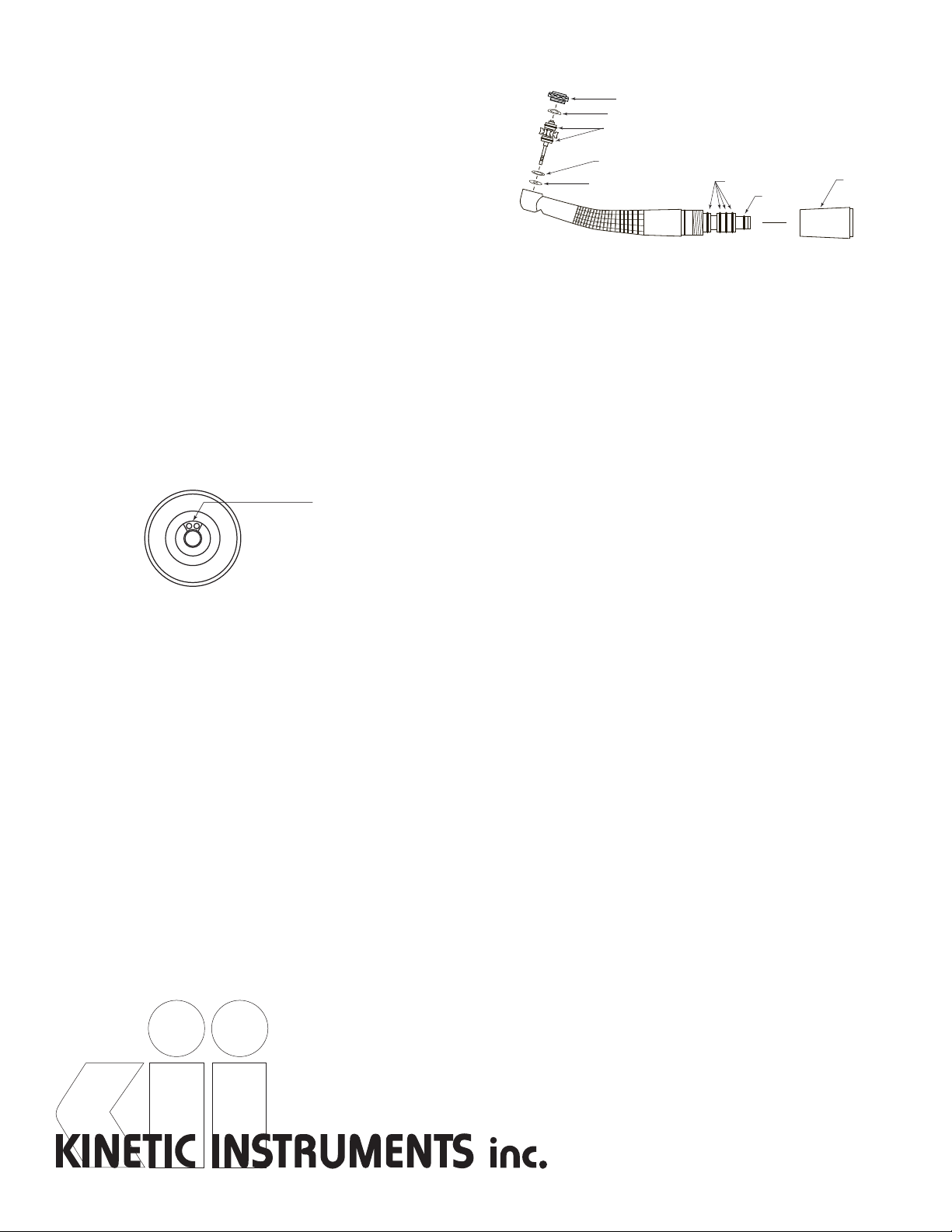
Remove bur from handpiece. Remove handpiece head back end cap using the
cap wrench as illustrated. Push out the turbine cartridge assembly from the
head cavity using a bur or bur blank if necessary.
Note: Although the assembly drawing shows the location of the dust sealing
washer, dust washer retainer and two turbine cartridge o-rings, it is not
recommended that these parts be replaced without prior experience. Therefore,
do not attempt to remove these parts. If unlikely damage has occurred, consult
the factory for further instructions.
Handpiece
Quick
Coupling
Hose
Nut
Lamp
Module
Connecting
Ring
2.