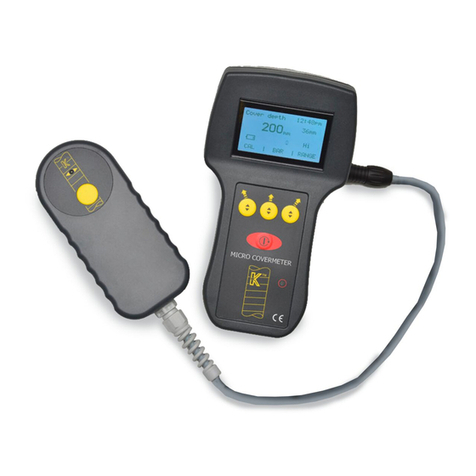
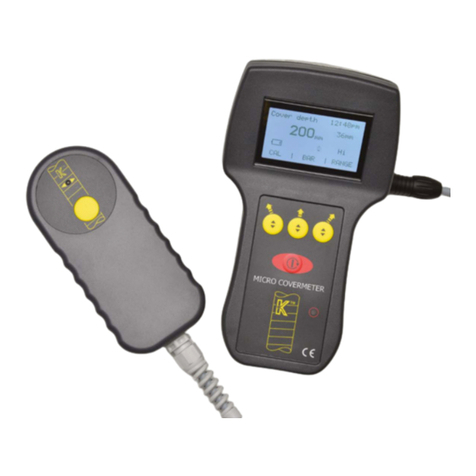
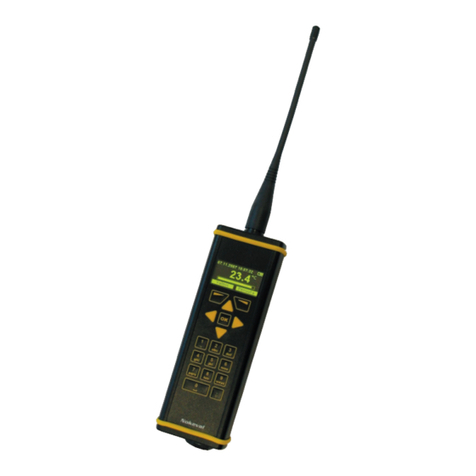
Once you have found a bar and aligned the probe to it, you can read the cover depth from the display.
If you want to log this cover reading, press the yellow button on the probe. This will record the cover
depth, bar size, time and date and can be viewed on the MC8020 or downloaded to a PC later if
required. (See Data logging, below)
For maximum precision follow the same procedure but instead of watching for minimum cover, look
for maximum signal strength reading.
Signal strength is shown below the main cover depth
readout, in smaller numbers –1781 in the picture.
The signal strength reading is at its greatest when the
probe is aligned with the centre line of a bar. When this
position and alignment is found, read the cover as before.
In some situations an alternate method is useful to map out the orientation of bars. First sweep the
probe in a straight line until you find a bar (bar indicator light / lowest cover / maximum signal). Mark
this position. Now perform a second sweep in the same direction but some distance from the first and
again mark the bar position. A line drawn between these marks gives the orientation of the bars.
Keeping the probe parallel to the bar orientation, perform a third sweep to find the centre of the bar.
The location of parallel bars can now be marked by extending the sweep either side of the first bar.
Audio cover mode
MC8020 has an audible indication of detection strength which helps to locate bars without having to
watch the display. To use Audio cover indication, go to the Main menu page, select the Audio menu
and set Mode to “Cover”. You can also adjust the volume from this menu.
Now when you sweep the probe over the search area, you will hear a tone that increases in pitch as
you get closer to a bar and reaches its highest pitch when the probe and bar are aligned.
If the environment is noisy, you can plug the optional earpiece accessory into the left-hand connector
on the instrument.
Set the audio Mode to “Off” to stop the tone.