GB-4
GB
Wiring
▷
Do not reverse phase L1 and neutral conduc-
tor N.
▷Do not install different phases of a three-phase
current system at the inputs.
▷Do not connect voltage to the outputs.
▷
A short-circuit on the outputs causes one of the
replaceable fuses to trip.
▷
Ensure that the inputs at terminals 1 to 4 and
44 are only supplied with 24 V DC.
▷
24 V DC power supply: + at terminal 62, - at
terminal 61.
▷
Ensure that the 24 V DC outputs at terminals
41 and 42 are not connected to mains voltage.
▷Do not set the remote reset so that it operates
automatically in cycles.
▷Wire the safety circuit inputs via contacts (relay
contacts) only.
▷The unit features an output for fan control (termi-
nal58). This single-pole contact can be loaded
with a max. of 3A. The max. start-up current of
the fan motor may not exceed a value of max.
6A for 1s– use an external contactor if required.
▷
The limiters in the safety interlock (linking of all the
relevant safety control and switching equipment
for the use of the application, for example, safety
temperature limiter) must isolate terminal46 from
the voltage supply. If the safety interlock is in-
terrupted, the display shows a blinking
50
as
a warning signal and all of the FCU’s control
outputs are disconnected from the electrical
power supply.
▷
Connected control elements must be equipped
with protective circuits in accordance with the
manufacturer’s instructions. The protective circuit
prevents high voltage peaks which can cause
malfunctioning of the FCU.
▷
Functions of terminals 51, 65, 66, 67 and 68 are
dependent on parameter values:
Terminal Dependent on parameter
51 69
65 70
66 71
67 72
68 73
See page 22 (Parameters and values).
Disconnect the system from the electrical power
supply.
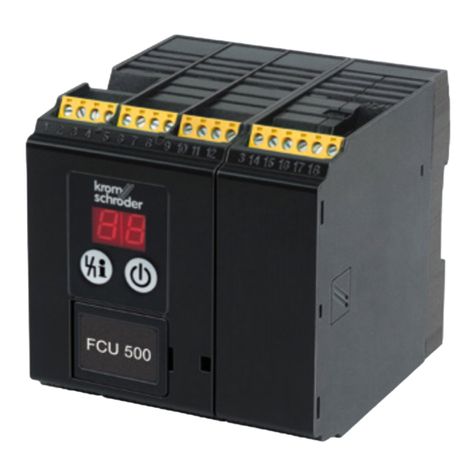
Before wiring the FCU, ensure that the yellow
parameter chip card has been installed in the
FCU– see page3 (Replacing the protective
system/furnace zone control).
▷
Screw terminals or spring force terminals are
available for the FCU– see page25 (Acces-
sories).
Wire as shown on the connection diagram– see
page6 (Connection diagram).
▷Ensure a good PE (ground) wire connection to
the burner control units and burners.
FCU..H
▷
Use type K NiCr-Ni, type N NiCrSi-NiSi or type S
Pt10Rh-Pt Class 1 double thermocouples only.
Thermocouple Temperature range
(°C)
Type K NiCr-Ni -40 to 1000
Type N NiCrSi-NiSi -40 to 1000
Type S Pt10Rh-Pt 0 to 1600
▷
Parameter 22 = 1: Type K double thermocouple
NiCr-Ni
▷
Parameter 22 = 2: Type N double thermocouple
NiCrSi-NiSi
▷
Parameter 22 = 3: Type S double thermocouple
Pt10Rh-Pt
▷STM:
Parameter 20 = 1: High temperature operation
with STM. Position the double thermocouple at
the coldest point in the furnace so that it can
reliably detect whether the spontaneous igni-
tion temperature (>750°C) has been exceeded.
▷STL:
Parameter 20 = 2: Maximum temperature moni-
toring using STL. Position the double thermo-
couple at the warmest point in the furnace so
that it can reliably detect whether the maximum
permitted temperature has been exceeded.
▷STL and STM:
Parameter 20 = 3: High temperature operation
with STM and maximum temperature monitor-
ing with STL. Position the double thermocouple
in the furnace in such a way that it can reliably
detect whether the spontaneous ignition tem-
perature (>750°C) has been exceeded and
also whether the maximum permitted furnace
temperature has been exceeded.
FCU..C
▷
Parameter 51 = 1: Tightness test before furnace
start-up.
▷
Parameter 51 = 2: On; tightness test after fur-
nace shut-down, after a fault lock-out or after
mains on.
▷
Parameter 51 = 3: On; tightness test before
furnace start-up and after furnace shut-down.
▷
Parameter 51 = 4: Permanent via proof of closure
function (POC).