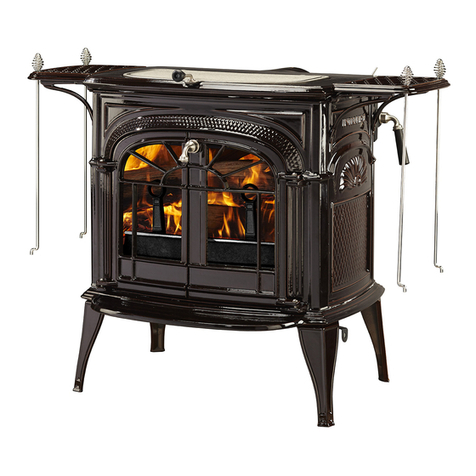
With the escribe set operation, 2 litres of water in a pot with a flat bottom of a iameter of 180
cm with a li shoul start boiling in 30 minutes. Use pots with a flat bottom for best results. If in-
tensive cooking is necessary, supply more layers of fuel so that the fuel being burnt is closer to
the hob top.
During cooking watch out for boiling over. If it happens, remove as much of the spillage imme i-
ately an when you have finishe cooking clean the remain er using a amp towel, etergent an
finally using a ry towel. If the irt bakes in, it is more ifficult to remove later. From time to time
( epen ing on the frequency of operation) wipe the range own with vegetable oil.
The Heat Exchange Unit
The range cooker with built-in heat exchange unit eman s more user attention than a stan ar
cooker or a typical boiler as it requires a more regular supply of soli fuel into the burner, as well
as regular poking/stirring of firebox grates. It is not possible to fix a stable temperature level.
We recommen connection of this mo el to a maximum of two metal ra iators, each up to 1200
mm in length an a heating water tank of 60 litres capacity. Before installation each ra iator
shoul be fitte with an isolation valve.
In view of the limite output of the appliance an in a ition to the variable operating con itions
such as fuel type, chimney raught, ambient temperatures etc, we rec mmend the f ll wing:
- only one heating evice (one ra iator or heating water tank) shoul be turne on uring the
kin ling process. The remain er of the evices can be intro uce later.
- uring the summer setting at least one heating evice shoul be switche on, for example, a
heating water tank (as there sh uld be water in the heat-exchange unit).
Owing to limite space, the hot-water heater is of smaller size an thus of a smaller water capa-
city. Connect it only to a circuit with force water circulation.
(The heat exchange unit incorporate into the range cooker is necessarily of a compact size an
has limite water capacity. We strongly recommen that the unit is only connecte to a pumpe
water fee .)
N te: f r the purp se f taking surplus heat fr m the heat exchange unit, we rec mmend
using an additi nal heating device.
Cleaning f the Furnace and Flue Paths
To maintain optimum, problem-free performance of the appliance it is necessary to clean it regu-
larly. Cleaning of the fire box must always be one with the appliance out of operation.
If igniting the combustion chamber after a longer interruption of operation, it is necessary to check
that flue paths, flue ucts an chimneys are not blocke an no obstructions are present. Regular
maintenance shoul be carrie out once a year by a service engineer.
Remove unburne remnants from the grate by means of the trowel an poker.
Cleaning of the inner walls of the appliance ( raught system) an inner housing of the oven
shoul be one as follows:
Remove the range hob to get access to the irty surfaces insi e, from which you can sweep the
soot easily own to the bottom of the appliance. From there you can sweep them into the ashtray
through the sweeping hole. Once clean put the range hob back ensuring that in ivi ual parts fit
tightly an seal perfectly.
TYPE 9114-HEU 01/2016