manuals.online logo
Brands
  1. Home
  2. •
  3. Brands
  4. •
  5. Lewmar
  6. •
  7. Fishing Equipment
  8. •
  9. Lewmar CPX User manual

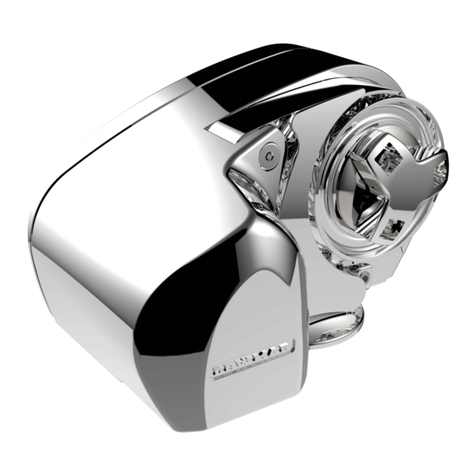
Lewmar CPX User manual

This manual suits for next models

1

Other Lewmar Fishing Equipment manuals

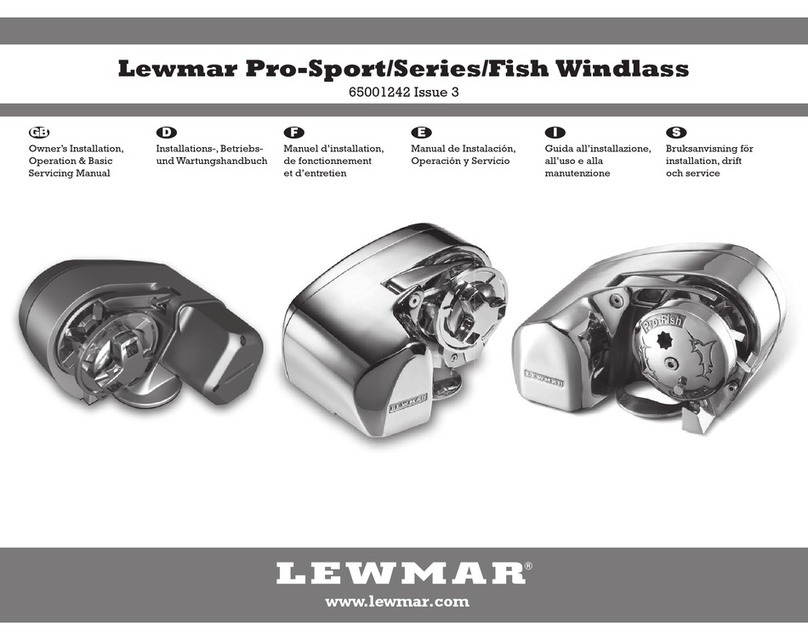
Lewmar pro-sport series User manual

Lewmar

Lewmar pro-sport series User manual

Lewmar Pro Series User manual

Lewmar

Lewmar Pro Series User manual

Lewmar pro-sport series Quick start guide

Lewmar

Lewmar pro-sport series Quick start guide

Lewmar Fish 700 User manual

Lewmar

Lewmar Fish 700 User manual

Popular Fishing Equipment manuals by other brands

Kongsberg Simrad SY50 installation manual

Kongsberg

Kongsberg Simrad SY50 installation manual

Jiffy Pro4 Lite Operating manual/parts guide

Jiffy

Jiffy Pro4 Lite Operating manual/parts guide

Fishmaster Pro Series Installation instructions and owner's manual

Fishmaster

Fishmaster Pro Series Installation instructions and owner's manual

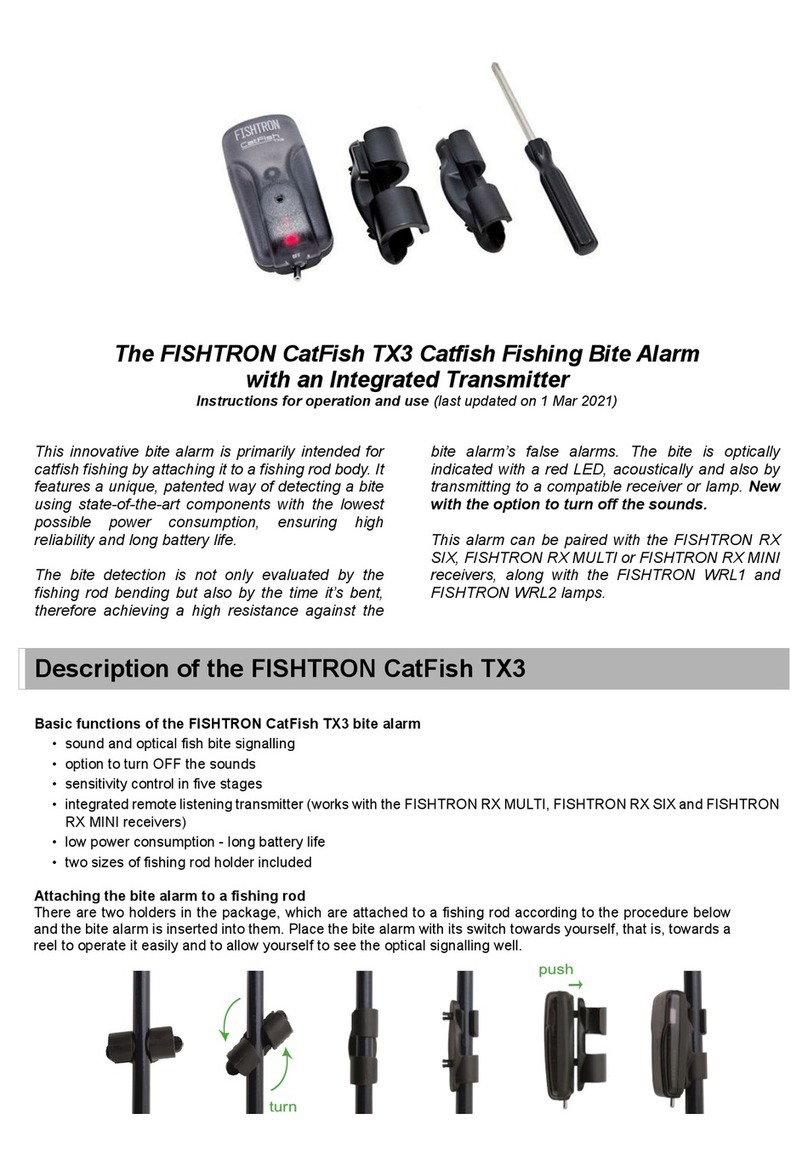
FLAJZAR FISHTRON CatFish TX3 Instructions for operation and use

FLAJZAR

FLAJZAR FISHTRON CatFish TX3 Instructions for operation and use

Milwaukee 2873-20 Operator's manual

Milwaukee

Milwaukee 2873-20 Operator's manual

Fishmaster Casting Platform Instructions and owner's manual

Fishmaster

Fishmaster Casting Platform Instructions and owner's manual

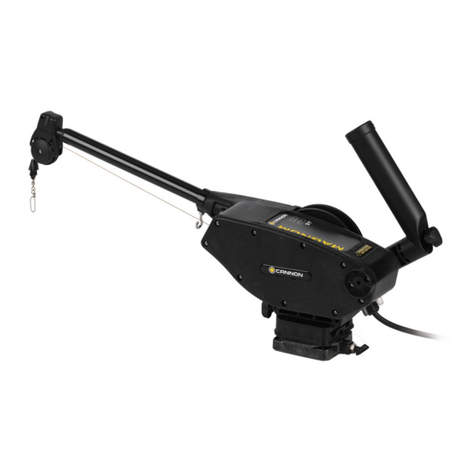
Cannon Magnum 5 ST owner's manual

Cannon

Cannon Magnum 5 ST owner's manual

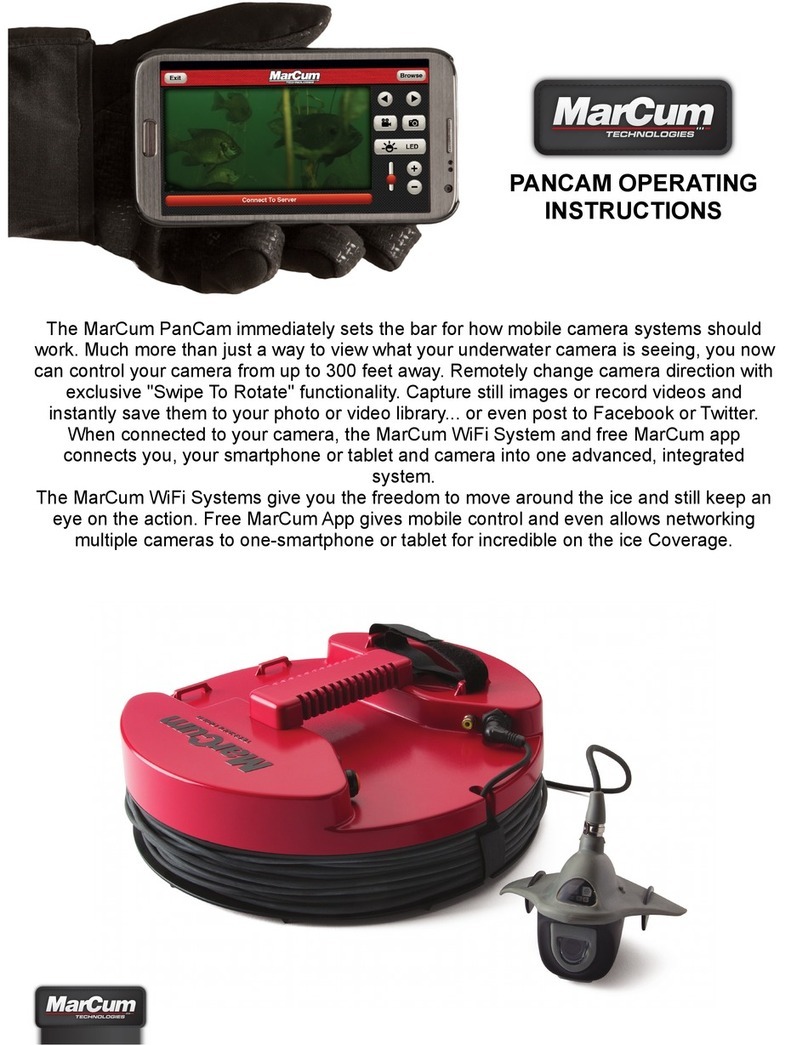
Marcum Technologies PanCam operating instructions

Marcum Technologies

Marcum Technologies PanCam operating instructions

Harmony SlideTrax 8023061 installation instructions

Harmony

Harmony SlideTrax 8023061 installation instructions

Quantum Baitcast Reel owner's manual

Quantum

Quantum Baitcast Reel owner's manual

MINN KOTA i-Pilot quick start guide

MINN KOTA

MINN KOTA i-Pilot quick start guide

Ronco Pocket Fisherman instruction sheet

Ronco

Ronco Pocket Fisherman instruction sheet

Jiffy 4G LITE Operating manual/parts guide

Jiffy

Jiffy 4G LITE Operating manual/parts guide

Daiwa TanacomBull 1000 operating manual

Daiwa

Daiwa TanacomBull 1000 operating manual

Husqvarna 159LEB Operator's manual

Husqvarna

Husqvarna 159LEB Operator's manual

Eskimo HC40Q8 Operator's manual

Eskimo

Eskimo HC40Q8 Operator's manual

LOOP Q REEL Series manual

LOOP

LOOP Q REEL Series manual

Cannon Mag 20 Dt/Hs owner's manual

Cannon

Cannon Mag 20 Dt/Hs owner's manual

manuals.online logo
manuals.online logoBrands
  • About & Mission
  • Contact us
  • Privacy Policy
  • Terms and Conditions

Copyright 2025 Manuals.Online. All Rights Reserved.

Lewmar CPX Vertical Windlass
66300104 Iss. 5
2
GB
1. Introduction
Dear Customer,
Thank you for choosing Lewmar. Lewmar products are world renowned for their quality, technical innovation and
proven performance. With a Lewmar product you will be provided with many years of outstanding service.
Product support
Lewmar products are supported by a worldwide network of distributors and Authorised Service Representatives.
If you encounter any difficulties with this product, please contact your national distributor, or your local Lewmar
dealer.
CE Approvals
For CE approval certificates contact Lewmar.
Important information about this manual
Throughout this manual, you will see safety and product damage warnings. You must follow these warnings
carefully to avoid possible injury or damage.
The type of warnings, what they look like, and how they are used in this manual are explained as follows:.
 WARNING!
This is a warning against anything which may
cause injury to people if the warning is ignored.
You are informed about what you must or must
not do in order to reduce the risk of injury to
yourself and others.
SAFETY SYMBOL
When you see the safety symbol it
means: “Do not...”; “Do not do this”; or
“Do not let this happen”.
Lewmar CPX Vertical Winlass ref 66300104 Iss. 5 | 3
2. Safety Notice
IMPORTANT: Read these notes before continuing.
2.1 Windlass general
Classification Societies and Lewmar require that a vessel at anchor must have its chain/rode held by a chain
stopper or equivalent strong point at all times
At all times it is the responsibility of the boat operator to ensure that the anchor and rode are properly stowed
for the prevailing sea conditions. This is particularly important with high-speed powerboats, because an anchor
accidentally deploying while under way can cause considerable damage. An anchor windlass is mounted in the
most exposed position on a vessel and is thus subject to severe atmospheric attack resulting in a possibility of
corrosion in excess of that experienced with most other items of deck equipment. As the windlass may only be
used infrequently, the risk of corrosion is further increased. It is essential that the windlass is regularly
examined, operated and given any necessary maintenance.
Please ensure that you thoroughly understand the operation and safety requirements of the windlass before
commencing the installation. Only persons who are completely familiar with the controls and those who have
been fully made aware of the correct use of the windlass should be allowed to use it. If there is any doubt of how
to install or operate this unit please seek advice from a suitably qualified engineer.
 Windlasses used incorrectly could cause harm to equipment or crew.
 Windlasses should be used with care and treated with respect.
 Boating, like many other activities can be hazardous. Even the correct selection, maintenance and use of
proper equipment cannot eliminate the potential for danger, serious injury or death.
 Lewmar windlasses are designed and supplied for anchor control in marine applications and are not to be used
in conjunction with any other use.
 Keep limbs, fingers, clothing and hair clear of windlass, rode and anchor during operation. Severe bodily harm
could result.
 Ensure there are no swimmers or divers nearby when dropping anchor.
 Windlasses must not be used as the sole means of securing the anchor to the bow fitting especially under
storm conditions. Anchors should be independently secured to prevent accidental release.
 Classification Societies require that a vessel lying at anchor must have its anchor rope/chain secured to a
chain stopper or other suitable independent strong point.
 A windlass should never be used as a mooring bollard, the anchor rode MUST be secured to a mooring cleat,
chain stopper or other designated strong point. Using the windlass to secure the rode will damage the
windlass.
 Do not use windlass for ANY purpose other than deployment and recovery of anchor.
 The circuit breaker in this product must never be deactivated or otherwise bypassed, it is intended to protect
the motor and cables from overheating and damage.
 Always switch off this windlass at the circuit breaker/isolator when not in use.
 It is the unavoidable responsibility of the owner, master or other responsible party to assess the risk of any
operation on the vessel.
 Windlass must not be operated whilst under the influence of alcohol or drugs.
2.2 Fitting
 This equipment must be installed and operated in accordance with the instructions contained in this manual.
Failure to do so could result in poor product performance, personal injury and/or damage to your boat.
 Consult the boat manufacturer if you have any doubt about the strength or suitability of the mounting
location.
2.3 Electrical
 Make sure that the boat’s battery power supply has been switched off before starting the installation.
 This product requires installation by a suitably qualified electrical engineer.
 WARNING!
4
3.4-1
GB
3. Installation
Use only genuine Lewmar parts and accessories to ensure top performance and eliminate the risk of voiding
your warranty.
Gypsies fitted to the CPX range of windlasses are ideally suited to handling our factory made Rope/Chain
combination rodes, which consist of rope spliced to a chain tail. See Specifications section for details.
Ropes used must be windlass grade, medium lay nylon. Ropes from different manufacturers have wide variations
in stretch and consistency in diameter. Therefore, rope and chain from other manufacturers may require some
experimentation to determine the optimum size.
Should you have difficulty in matching a gypsy to your chain please consult your local agent or our international
network of distributors.
3.4 Above deck preparation
IMPORTANT - Plan location carefully and allow for the following:
3.2 Accessories
3.1 Basic requirements
Each installation requires the following tools:
Wiring Installation
 Crimping Pliers / Wire Stripper
 Suitable electrical cable and crimp terminals
Windlass Installation
An appropriate marine sealant and the following:
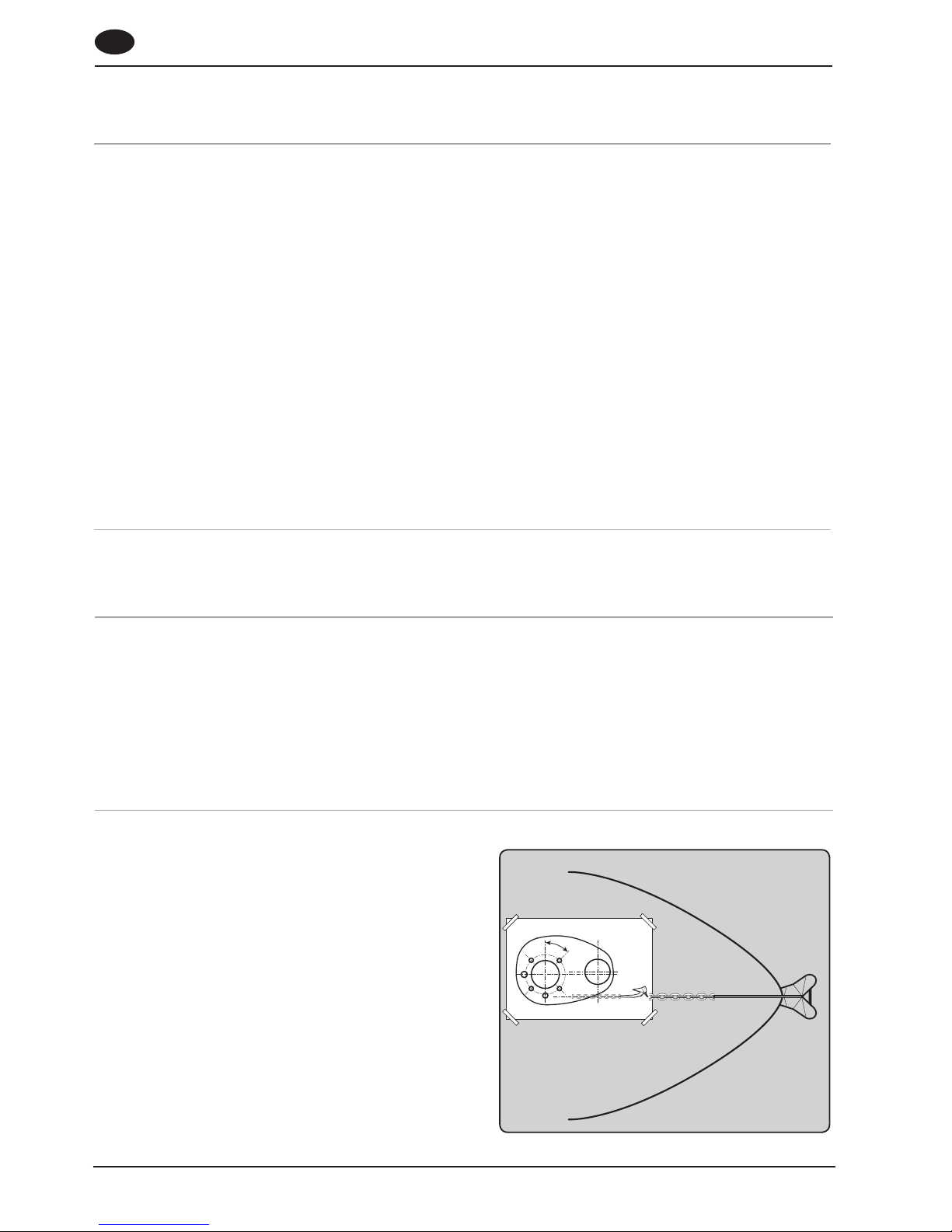
1. Make an accurate drilling template using the prod-
uct dimensions from the dimension template and
decide upon a position for it with reference to the
vessel’s bow roller and the chain locker below and
the rotation of manual operating handle.
If possible, select a flat area of deck.
CPX 1-3
 10 mm (⅜”) Drill
 12 mm (¹⁵/₃₂”) Drill
 14 mm (⁹/₁₆”) Drill
 63 mm (2 ½”) Hole Saw
 57 mm (2 ¼”)Hole Saw
CPX 4-5
 12 mm (¹⁵/₃₂”) Drill
 14 mm (⁹/₁₆”) Drill
 77 mm (3”)Hole Saw
 70 mm (2¾”) Hole Saw
Lewmar CPX Vertical Winlass ref 66300104 Iss. 5 | 5
3.4-2
3.4-1b
3.4-1a
3.5-1
40 - 50 mm
11/2” - 2”
Notes
 if in doubt about the suitable construction of the
pad consult a qualified marine engineer.
 Decks that are thin, or of foam or balsa laminate
construction, will require reinforcement in order to
spread the loads that will be applied to the deck while
the windlass is in use
2. If a pad is required for these models, care must be
taken to ensure that the windlass base is parallel
to the motor/gearbox mounting flange. Shims may
be used, before the motor/gearbox is installed, to
correct minor misalignment.
Note: For thicker deck, a longer
sha main be required
(not standard). Contact your
Lewmar representative for more
information
3.5 Deck thickness
The deck is an integral component of the windlass it has to secure the windlass and be strong enough to cope
with the high torque stresses involved in recovering the anchor.
 Lewmar recommends a minimum deck thickness of 40mm (1½”)
 M10 studs suit deck and packing thickness of 40-50mm (1½”- 2”)
6
3.6-1
300 mm
(12”)
3.6-2
GB
3.6 Below deck preparation
IMPORTANT:
The positioning of the windlass must be checked prior to cutting for deck/hull and bulkhead clearance.
 WARNING!
Failure to provide minimum vertical fall
will cause jamming.
1.The motor/gearbox is bolted via the through deck mounting bolts.
NOTE: Do not position motor/gearbox below rode/chain pipe fall area.
2. There must be sufficient vertical fall for the chain or rope when hauling in.
Lewmar CPX Vertical Winlass ref 66300104 Iss. 5 | 7
±5°
3.7-1
3.7-2
3.7-3
3.7-4
3.7 Above deck fitting
2. Using your template and aer you have checked all
the above and below deck requirements cut the
following holes.
CPX 1-3
Using a 10mm (⅜”) diameter drill, make the 4 holes
for the mounting studs, 12mm (¹⁵/₃₂”) and 14mm
(⁹/₁₆”) for the sensors. With a 63mm (2 ½”) and 57mm
(2 ¼”) diameter hole saw, make two holes for the
mainsha and rode to pass through.
CPX 4-5
Using a 12 mm (¹⁵/₃₂”) diameter drill, make the 4 holes
for the mounting studs, 12mm (¹⁵/₃₂”) and 14mm (⁹/₁₆”)
for the sensors. With a 77mm (3”) and 70mm (2¾”)
diameter hole saw, make two holes for the mainsha
and rode to pass through.
1. Lead from the roller should be fed horizontally back
to the top of the gypsy and along its centre line
within ±5˚.
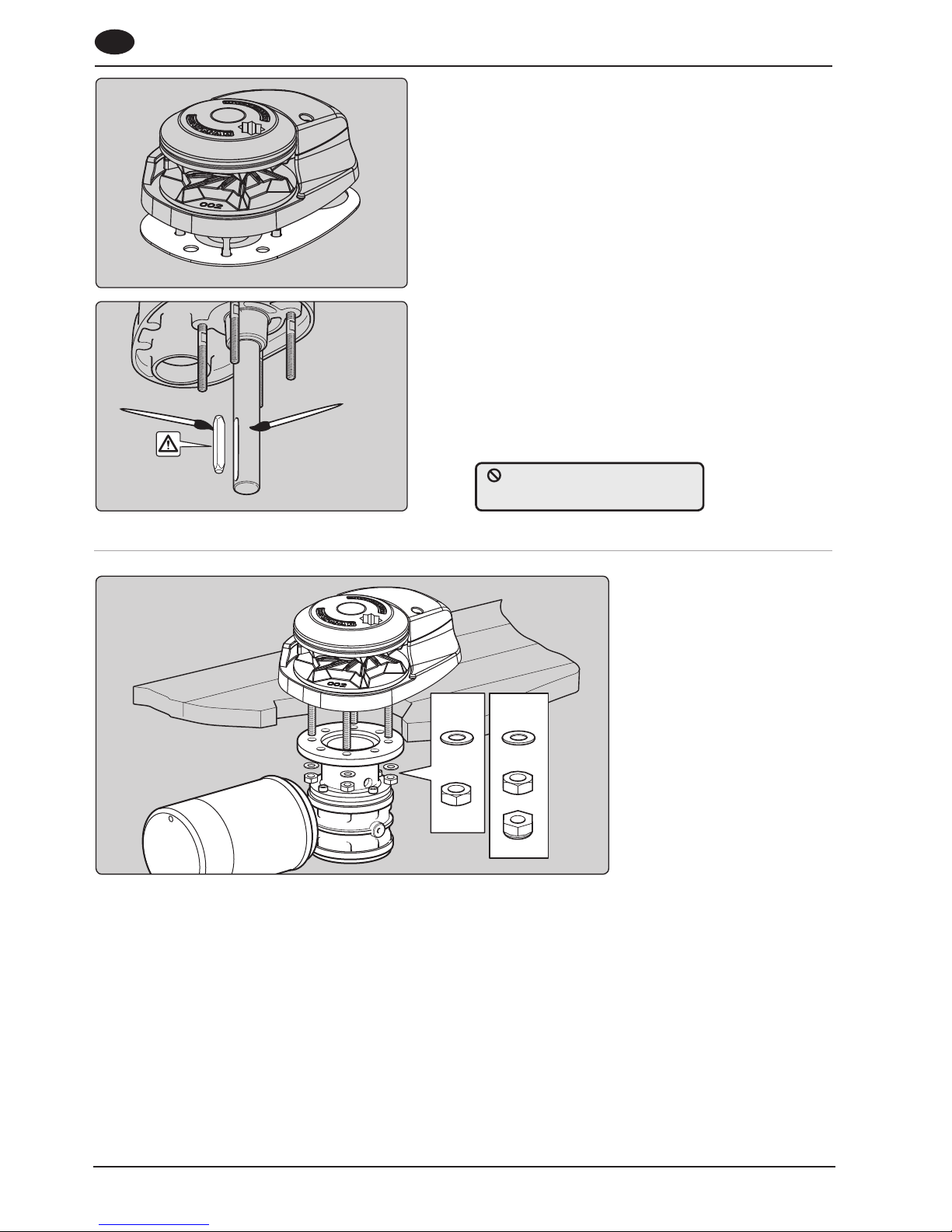
3. When all the holes have been made, remove the
template. To help avoid water absorption by the
deck, apply an appropriate marine sealant to the
freshly cut hole edges.
4. Assemble and tighten studs into base until they
bottom out in their holes. Some studs have a flat.
Position the flats of the studs nearest the base of
the windlass.
 CPX 1-3 - Studs 21Nm
 CPX 4-5 - Studs 43Nm
8
3.7-5
3.7-4
CPX
1-3
M8
5
/
16
”
Washer
CPX
4/5
M8 Nut
M10
3
/
8
”
Washer
M10 Nut
M10 Nyloc
3.8-1
GB
Lightly grease all moving parts.
1. Ensure drive key is in place then gently slide the motor/gearbox up the drive sha until it contacts the deck.
NOTE: Position the motor/gearbox away from the rope/chain pipe fall.
2. Check the motor/gearbox and windlass mounting surfaces are parallel.
 CPX 1-3 - Assemble the washer then the M8 nut, secure with Loctite® threadlock to 21Nm torque.
 CPX 4-5 - Assemble the washer then the M10 nut, secure with Loctite® threadlock to 43Nm torque. Lock
tightened nut with spanner and then secure with the M10 Nyloc nut.
NOTE: If using silicone or other rubbery type sealant, it is advisable to allow curing of the sealant before final
tightening of the mounting nuts.
4. Place the base mat in position on the deck.
Optionally, apply a suitable sealant to the base of
the windlass, any mounting pad or around the studs.
NOTE: If using silicone or other rubbery type sealant,
it is advisable to allow curing of the sealant before
final tightening of the mounting nuts.
5. Lightly coat the sha with grease and ensure the
drive key is in place before assembly to
motor/gearbox.
DO NOT use a permanent
adhesive/sealant eg.5200
3.8 Under deck fitting
Lewmar CPX Vertical Winlass ref 66300104 Iss. 5 | 9
3.9-5
3.9-2 3.9-3
3.9-4
3.9-1
 WARNING!
Isolate the windlass using
circuit breaker/isolator.
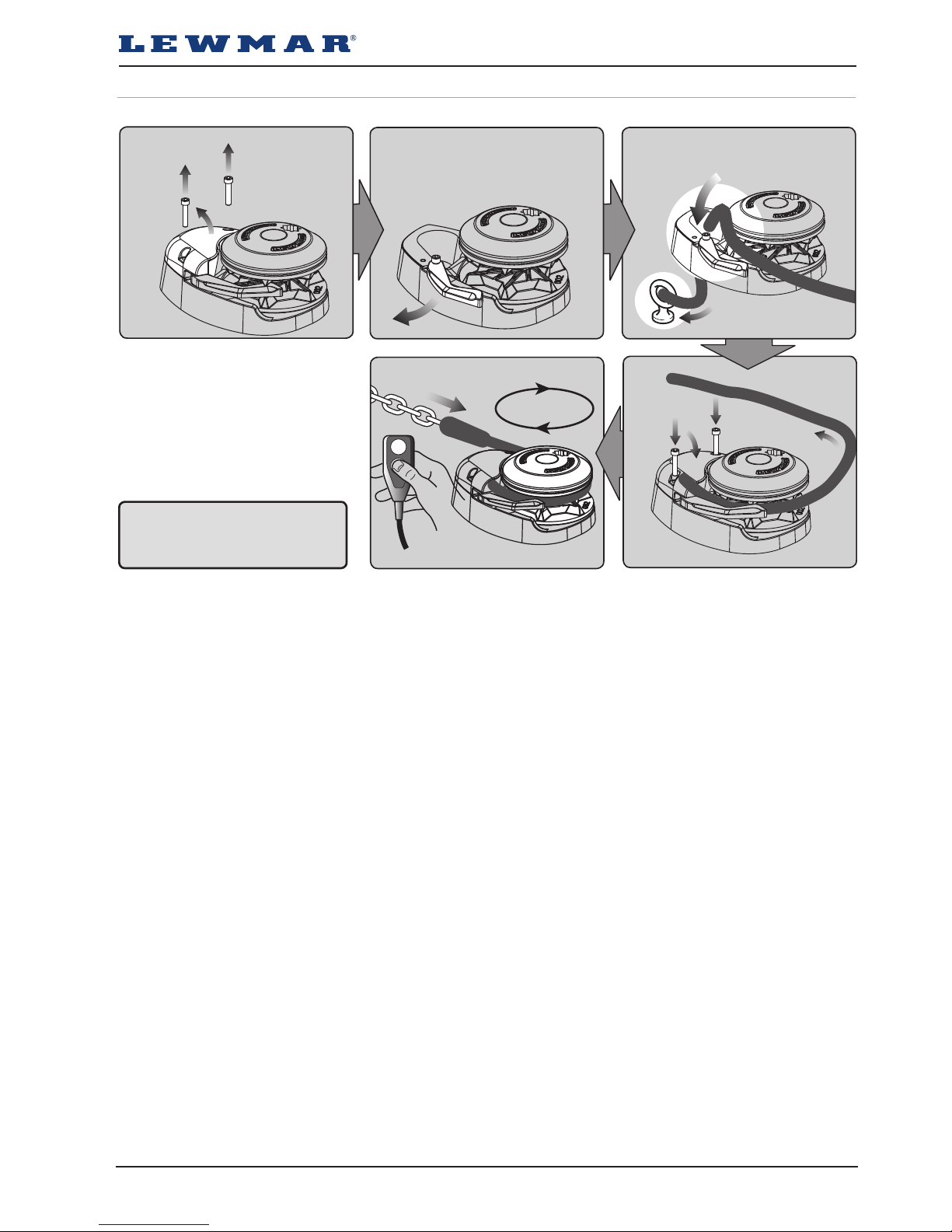
For safety and performance Lewmar recommends the use of matched Lewmar anchor rodes.
1. Remove cover.
2. Pull out control arm.
3. Feed anchor rope/chain into entry hole. Tie off to suitable strong point.
4. Replace cover. Release control arm and wrap rope/chain around gypsy.
5. Power load rest of anchor rope/chain.
3.9 Loading rope/chain
10
GB
4. Electrical wiring
4.1 Electric cable selection
Plan the installation to suit the controls and give the operator a full view of the windlass. The wiring system
should be of the fully insulated type, which avoids possible electrolytic corrosion problems. We recommend the
use of type III stranded, tinned copper wire with copper crimp terminals. Most modern installations are negative
return (negative ground) but polarity should be checked.
Overload protection, in the form of the circuit breaker/fuse supplied, must be built into the windlass wiring
circuit.
DO NOT confuse cable length
with the length of the vessel
NOTE: The circuit breaker should be positioned close to the battery in a dry, readily accessible place.
 WARNING!
The breaker must be manually reset should an overload occur that causes it to trip to the off position.
If you are not sure you understand these guidelines, seek professional help. Ensure that the installation
complies with USCG, ABYC, NMMA or other local regulations.
4.2 Wiring
Lewmar recommends the installer source and install cable that meets the requirements of the standards and
regulations relevant to the installation and codes of practice. The cable table gives recommended cable sizes
based on total length of cable required, from the battery, following the route of the cables.
Windlass performance is directly related to cable size and length. Voltage drop over the complete wiring run
must not exceed 10%.
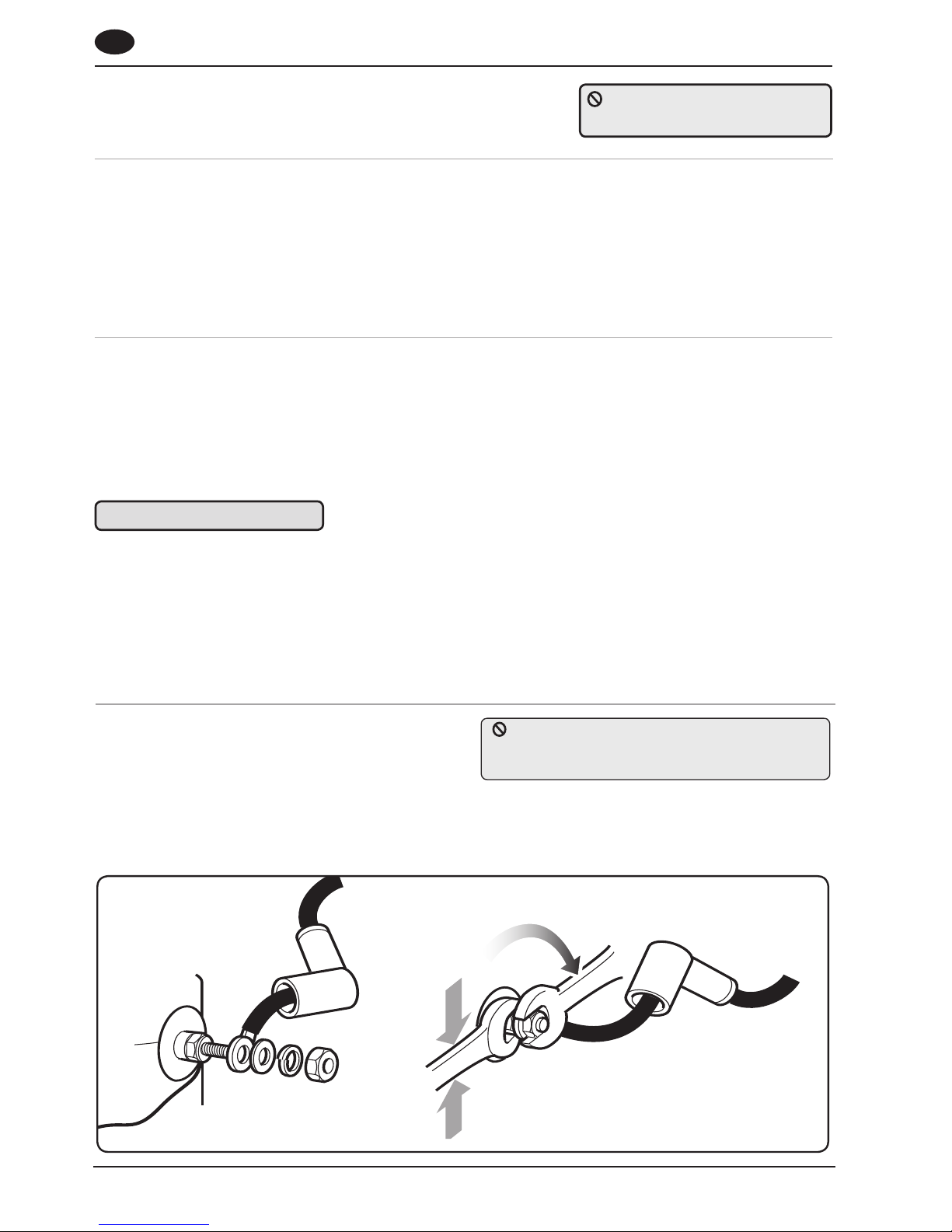
 When wiring Lewmar electric motor into the ship’s
electrical system the following caution must be taken.
 When tightening the front nut hold the back nut with
a separate wrench to make sure the back nut does
not turn. If the back nut turns, serious damage will
occur, voiding Lewmar’s warranty on the electric
motor.
4.3 Electric motor terminal connections
DO NOT overtighten electric motor
terminal nuts.