manuals.online logo
Brands
  1. Home
  2. •
  3. Brands
  4. •
  5. LG
  6. •
  7. LCD TV
  8. •
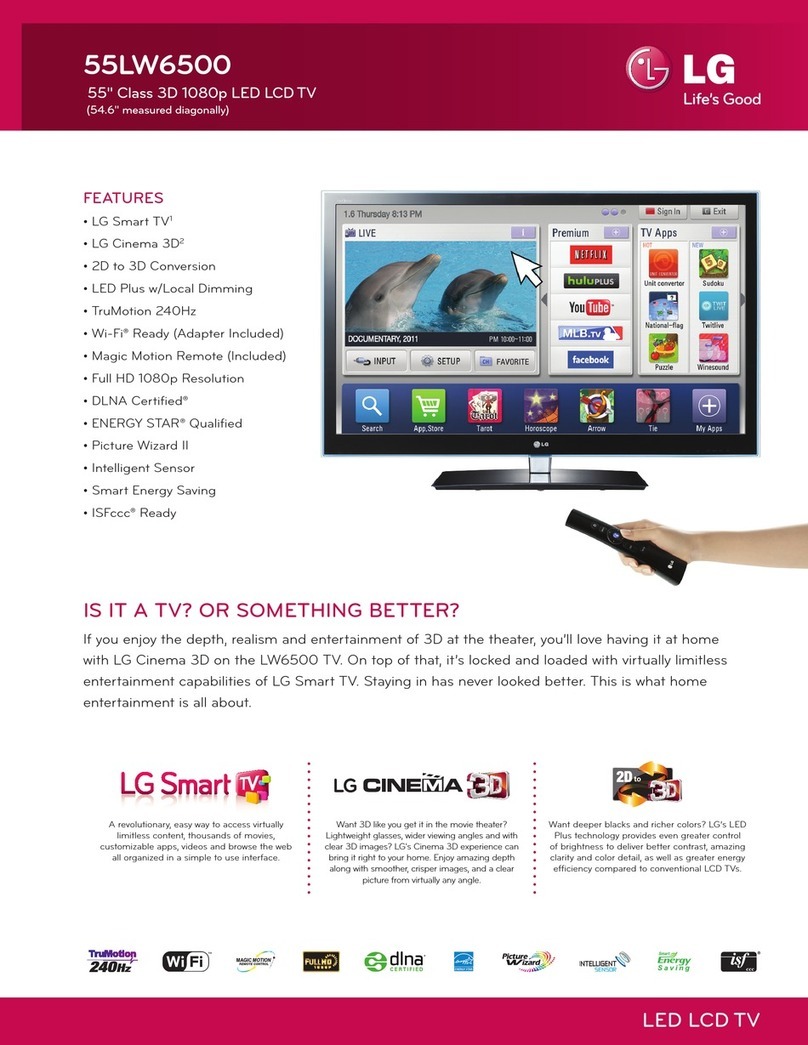
  9. LG Infinia 47LW5700 User manual

LG Infinia 47LW5700 User manual

This manual suits for next models

1

Other LG LCD TV manuals

LG 42LH90QR User manual

LG

LG 42LH90QR User manual

LG L3700TC User manual

LG

LG L3700TC User manual

LG 42LM4600 User manual

LG

LG 42LM4600 User manual

LG LY53 Series User manual

LG

LG LY53 Series User manual

LG 32LP1DA User manual

LG

LG 32LP1DA User manual

LG 4230DC -  - 42" LCD TV User manual

LG

LG 4230DC - - 42" LCD TV User manual

LG 22LG3DCH User manual

LG

LG 22LG3DCH User manual

LG DU-42LZ30 User manual

LG

LG DU-42LZ30 User manual

LG 47LM8600-UA User manual

LG

LG 47LM8600-UA User manual

LG 47LT760H User manual

LG

LG 47LT760H User manual

LG 17LS5R-TA User manual

LG

LG 17LS5R-TA User manual

LG RT-15LA31 User manual

LG

LG RT-15LA31 User manual

LG HealthView 32LD360L User manual

LG

LG HealthView 32LD360L User manual

LG 42LC2RH User manual

LG

LG 42LC2RH User manual

LG 26LC2R Series User manual

LG

LG 26LC2R Series User manual

LG 55LH400C User manual

LG

LG 55LH400C User manual

LG 26LH200C -  - 26" LCD TV User manual

LG

LG 26LH200C - - 26" LCD TV User manual

LG 32LN54 User manual

LG

LG 32LN54 User manual

LG M2631D User manual

LG

LG M2631D User manual

LG 2LD450 User manual

LG

LG 2LD450 User manual

LG 19LD330 User manual

LG

LG 19LD330 User manual

LG 32LP1DC User manual

LG

LG 32LP1DC User manual

LG 26LX2R Series User manual

LG

LG 26LX2R Series User manual

LG 23LS7DC -  - 23" LCD TV User manual

LG

LG 23LS7DC - - 23" LCD TV User manual

Popular LCD TV manuals by other brands

Panasonic Vieta TX-26LX600P null

Panasonic

Panasonic Vieta TX-26LX600P null

Philips BDL323I null

Philips

Philips BDL323I null

Samsung LA32E420 E-manual

Samsung

Samsung LA32E420 E-manual

Dell W1900 19 Setting up

Dell

Dell W1900 19 Setting up

Samsung LN40C670M1F user manual

Samsung

Samsung LN40C670M1F user manual

Toshiba 57X3000A owner's manual

Toshiba

Toshiba 57X3000A owner's manual

Runco CX-52HD Owner's operating manual

Runco

Runco CX-52HD Owner's operating manual

Sharp LC-32AX3H Service manual

Sharp

Sharp LC-32AX3H Service manual

Philips 47PFL7704D Specifications

Philips

Philips 47PFL7704D Specifications

Vizio VO42LFHDTV10A user manual

Vizio

Vizio VO42LFHDTV10A user manual

Philips 42PF7520D/79 user manual

Philips

Philips 42PF7520D/79 user manual

Insignia NS-LCD32-09 Service manual

Insignia

Insignia NS-LCD32-09 Service manual

Sony WEGA KLV-27HR3 operating instructions

Sony

Sony WEGA KLV-27HR3 operating instructions

Nexus NX32031 owner's manual

Nexus

Nexus NX32031 owner's manual

Zenith Z32LC2D Specifications

Zenith

Zenith Z32LC2D Specifications

Sony KDL-32S3000R - 32" Class Bravia S-series Digital Lcd... Specifications

Sony

Sony KDL-32S3000R - 32" Class Bravia S-series Digital Lcd... Specifications

Medion MEDION LIFE X14330 quick start guide

Medion

Medion MEDION LIFE X14330 quick start guide

Vizio HDTV30A VW32L Service manual

Vizio

Vizio HDTV30A VW32L Service manual

manuals.online logo
manuals.online logoBrands
  • About & Mission
  • Contact us
  • Privacy Policy
  • Terms and Conditions

Copyright 2025 Manuals.Online. All Rights Reserved.

LED LCD TV
SERVICE MANUAL
CAUTION
BEFORE SERVICING THE CHASSIS,
READ THE SAFETY PRECAUTIONS IN THIS MANUAL.
CHASSIS : LJ12C
MODEL : 47LW5700 47LW5700-SA
North/Latin America http://aic.lgservice.com
Europe/Africa http://eic.lgservice.com
Asia/Oceania http://biz.lgservice.com
Internal Use Only
Printed in KoreaP/NO : MFL66981612 (1103-REV00)
LGE Internal Use OnlyCopyright LG Electronics. Inc. All right reserved.
Only for training and service purposes
- 2 -
CONTENTS
CONTENTS .............................................................................................. 2
SAFETY PRECAUTIONS ......................................................................... 3
SPECIFICATION ....................................................................................... 6
ADJUSTMENT INSTRUCTION .............................................................. 12
EXPLODED VIEW .................................................................................. 20
SVC. SHEET ...............................................................................................
LGE Internal Use OnlyCopyright LG Electronics. Inc. All right reserved.
Only for training and service purposes
- 3 -
SAFETY PRECAUTIONS
Many electrical and mechanical parts in this chassis have special safety-related characteristics. These parts are identified by in the
Schematic Diagram and Exploded View.
It is essential that these special safety parts should be replaced with the same components as recommended in this manual to prevent
Shock, Fire, or other Hazards.
Do not modify the original design without permission of manufacturer.
General Guidance
An isolation Transformer should always be used during the
servicing of a receiver whose chassis is not isolated from the AC
power line. Use a transformer of adequate power rating as this
protects the technician from accidents resulting in personal injury
from electrical shocks.
It will also protect the receiver and it's components from being
damaged by accidental shorts of the circuitry that may be
inadvertently introduced during the service operation.
If any fuse (or Fusible Resistor) in this TV receiver is blown,
replace it with the specified.
When replacing a high wattage resistor (Oxide Metal Film Resistor,
over 1W), keep the resistor 10mm away from PCB.
Keep wires away from high voltage or high temperature parts.
Before returning the receiver to the customer,
always perform an AC leakage current check on the exposed
metallic parts of the cabinet, such as antennas, terminals, etc., to
be sure the set is safe to operate without damage of electrical
shock.
Leakage Current Cold Check(Antenna Cold Check)
With the instrument AC plug removed from AC source, connect an
electrical jumper across the two AC plug prongs. Place the AC
switch in the on position, connect one lead of ohm-meter to the AC
plug prongs tied together and touch other ohm-meter lead in turn to
each exposed metallic parts such as antenna terminals, phone
jacks, etc.
If the exposed metallic part has a return path to the chassis, the
measured resistance should be between 1MΩ and 5.2MΩ.
When the exposed metal has no return path to the chassis the
reading must be infinite.
An other abnormality exists that must be corrected before the
receiver is returned to the customer.
Leakage Current Hot Check (See below Figure)
Plug the AC cord directly into the AC outlet.
Do not use a line Isolation Transformer during this check.
Connect 1.5K/10watt resistor in parallel with a 0.15uF capacitor
between a known good earth ground (Water Pipe, Conduit, etc.)
and the exposed metallic parts.
Measure the AC voltage across the resistor using AC voltmeter
with 1000 ohms/volt or more sensitivity.
Reverse plug the AC cord into the AC outlet and repeat AC voltage
measurements for each exposed metallic part. Any voltage
measured must not exceed 0.75 volt RMS which is corresponds to
0.5mA.
In case any measurement is out of the limits specified, there is
possibility of shock hazard and the set must be checked and
repaired before it is returned to the customer.
Leakage Current Hot Check circuit
1.5 Kohm/10W
To Instrument's
exposed 
METALLIC PARTS
Good Earth Ground
such as WATER PIPE,
CONDUIT etc.
AC Volt-meter
IMPORTANT SAFETY NOTICE
0.15uF
LGE Internal Use OnlyCopyright LG Electronics. Inc. All right reserved.
Only for training and service purposes
- 4 -
CAUTION: Before servicing receivers covered by this service
manual and its supplements and addenda, read and follow the
SAFETY PRECAUTIONS on page 3 of this publication.
NOTE: If unforeseen circumstances create conflict between the
following servicing precautions and any of the safety precautions on
page 3 of this publication, always follow the safety precautions.
Remember: Safety First.
General Servicing Precautions
1. Always unplug the receiver AC power cord from the AC power
source before;
a. Removing or reinstalling any component, circuit board
module or any other receiver assembly.
b. Disconnecting or reconnecting any receiver electrical plug or
other electrical connection.
c. Connecting a test substitute in parallel with an electrolytic
capacitor in the receiver.
CAUTION: A wrong part substitution or incorrect polarity
installation of electrolytic capacitors may result in an
explosion hazard.
2. Test high voltage only by measuring it with an appropriate high
voltage meter or other voltage measuring device (DVM,
FETVOM, etc) equipped with a suitable high voltage probe.
Do not test high voltage by "drawing an arc".
3. Do not spray chemicals on or near this receiver or any of its
assemblies.
4. Unless specified otherwise in this service manual, clean
electrical contacts only by applying the following mixture to the
contacts with a pipe cleaner, cotton-tipped stick or comparable
non-abrasive applicator; 10% (by volume) Acetone and 90% (by
volume) isopropyl alcohol (90%-99% strength)
CAUTION: This is a flammable mixture.
Unless specified otherwise in this service manual, lubrication of
contacts in not required.
5. Do not defeat any plug/socket B+ voltage interlocks with which
receivers covered by this service manual might be equipped.
6. Do not apply AC power to this instrument and/or any of its
electrical assemblies unless all solid-state device heat sinks are
correctly installed.
7. Always connect the test receiver ground lead to the receiver
chassis ground before connecting the test receiver positive
lead.
Always remove the test receiver ground lead last.
8. Use with this receiver only the test fixtures specified in this
service manual.
CAUTION: Do not connect the test fixture ground strap to any
heat sink in this receiver.
Electrostatically Sensitive (ES) Devices
Some semiconductor (solid-state) devices can be damaged easily
by static electricity. Such components commonly are called
Electrostatically Sensitive (ES) Devices. Examples of typical ES
devices are integrated circuits and some field-effect transistors and
semiconductor "chip" components. The following techniques
should be used to help reduce the incidence of component
damage caused by static by static electricity.
1. Immediately before handling any semiconductor component or
semiconductor-equipped assembly, drain off any electrostatic
charge on your body by touching a known earth ground.
Alternatively, obtain and wear a commercially available
discharging wrist strap device, which should be removed to
prevent potential shock reasons prior to applying power to the
unit under test.
2. After removing an electrical assembly equipped with ES
devices, place the assembly on a conductive surface such as
aluminum foil, to prevent electrostatic charge buildup or
exposure of the assembly.
3. Use only a grounded-tip soldering iron to solder or unsolder ES
devices.
4. Use only an anti-static type solder removal device. Some solder
removal devices not classified as "anti-static" can generate
electrical charges sufficient to damage ES devices.
5. Do not use freon-propelled chemicals. These can generate
electrical charges sufficient to damage ES devices.
6. Do not remove a replacement ES device from its protective
package until immediately before you are ready to install it.
(Most replacement ES devices are packaged with leads
electrically shorted together by conductive foam, aluminum foil
or comparable conductive material).
7. Immediately before removing the protective material from the
leads of a replacement ES device, touch the protective material
to the chassis or circuit assembly into which the device will be
installed.
CAUTION: Be sure no power is applied to the chassis or circuit,
and observe all other safety precautions.
8. Minimize bodily motions when handling unpackaged
replacement ES devices. (Otherwise harmless motion such as
the brushing together of your clothes fabric or the lifting of your
foot from a carpeted floor can generate static electricity
sufficient to damage an ES device.)
General Soldering Guidelines
1. Use a grounded-tip, low-wattage soldering iron and appropriate
tip size and shape that will maintain tip temperature within the
range or 500°F to 600°F.
2. Use an appropriate gauge of RMA resin-core solder composed
of 60 parts tin/40 parts lead.
3. Keep the soldering iron tip clean and well tinned.
4. Thoroughly clean the surfaces to be soldered. Use a mall wire-
bristle (0.5 inch, or 1.25cm) brush with a metal handle.
Do not use freon-propelled spray-on cleaners.
5. Use the following unsoldering technique
a. Allow the soldering iron tip to reach normal temperature.
(500°F to 600°F)
b. Heat the component lead until the solder melts.
c. Quickly draw the melted solder with an anti-static, suction-
type solder removal device or with solder braid.
CAUTION: Work quickly to avoid overheating the circuit
board printed foil.
6. Use the following soldering technique.
a. Allow the soldering iron tip to reach a normal temperature
(500°F to 600°F)
b. First, hold the soldering iron tip and solder the strand against
the component lead until the solder melts.
c. Quickly move the soldering iron tip to the junction of the
component lead and the printed circuit foil, and hold it there
only until the solder flows onto and around both the
component lead and the foil.
CAUTION: Work quickly to avoid overheating the circuit
board printed foil.
d. Closely inspect the solder area and remove any excess or
splashed solder with a small wire-bristle brush.
SERVICING PRECAUTIONS

LGE Internal Use OnlyCopyright LG Electronics. Inc. All right reserved.
Only for training and service purposes
- 5 -
IC Remove/Replacement
Some chassis circuit boards have slotted holes (oblong) through
which the IC leads are inserted and then bent flat against the
circuit foil. When holes are the slotted type, the following technique
should be used to remove and replace the IC. When working with
boards using the familiar round hole, use the standard technique
as outlined in paragraphs 5 and 6 above.
Removal
1. Desolder and straighten each IC lead in one operation by gently
prying up on the lead with the soldering iron tip as the solder
melts.
2. Draw away the melted solder with an anti-static suction-type
solder removal device (or with solder braid) before removing the
IC.
Replacement
1. Carefully insert the replacement IC in the circuit board.
2. Carefully bend each IC lead against the circuit foil pad and
solder it.
3. Clean the soldered areas with a small wire-bristle brush.
(It is not necessary to reapply acrylic coating to the areas).
"Small-Signal" Discrete Transistor
Removal/Replacement
1. Remove the defective transistor by clipping its leads as close as
possible to the component body.
2. Bend into a "U" shape the end of each of three leads remaining
on the circuit board.
3. Bend into a "U" shape the replacement transistor leads.
4. Connect the replacement transistor leads to the corresponding
leads extending from the circuit board and crimp the "U" with
long nose pliers to insure metal to metal contact then solder
each connection.
Power Output, Transistor Device
Removal/Replacement
1. Heat and remove all solder from around the transistor leads.
2. Remove the heat sink mounting screw (if so equipped).
3. Carefully remove the transistor from the heat sink of the circuit
board.
4. Insert new transistor in the circuit board.
5. Solder each transistor lead, and clip off excess lead.
6. Replace heat sink.
Diode Removal/Replacement
1. Remove defective diode by clipping its leads as close as
possible to diode body.
2. Bend the two remaining leads perpendicular y to the circuit
board.
3. Observing diode polarity, wrap each lead of the new diode
around the corresponding lead on the circuit board.
4. Securely crimp each connection and solder it.
5. Inspect (on the circuit board copper side) the solder joints of
the two "original" leads. If they are not shiny, reheat them and if
necessary, apply additional solder.
Fuse and Conventional Resistor
Removal/Replacement
1. Clip each fuse or resistor lead at top of the circuit board hollow
stake.
2. Securely crimp the leads of replacement component around
notch at stake top.
3. Solder the connections.
CAUTION: Maintain original spacing between the replaced
component and adjacent components and the circuit board to
prevent excessive component temperatures.
Circuit Board Foil Repair
Excessive heat applied to the copper foil of any printed circuit
board will weaken the adhesive that bonds the foil to the circuit
board causing the foil to separate from or "lift-off" the board. The
following guidelines and procedures should be followed whenever
this condition is encountered.
At IC Connections
To repair a defective copper pattern at IC connections use the
following procedure to install a jumper wire on the copper pattern
side of the circuit board. (Use this technique only on IC
connections).
1. Carefully remove the damaged copper pattern with a sharp
knife. (Remove only as much copper as absolutely necessary).
2. carefully scratch away the solder resist and acrylic coating (if
used) from the end of the remaining copper pattern.
3. Bend a small "U" in one end of a small gauge jumper wire and
carefully crimp it around the IC pin. Solder the IC connection.
4. Route the jumper wire along the path of the out-away copper
pattern and let it overlap the previously scraped end of the good
copper pattern. Solder the overlapped area and clip off any
excess jumper wire.
At Other Connections
Use the following technique to repair the defective copper pattern
at connections other than IC Pins. This technique involves the
installation of a jumper wire on the component side of the circuit
board.
1. Remove the defective copper pattern with a sharp knife.
Remove at least 1/4 inch of copper, to ensure that a hazardous
condition will not exist if the jumper wire opens.
2. Trace along the copper pattern from both sides of the pattern
break and locate the nearest component that is directly
connected to the affected copper pattern.
3. Connect insulated 20-gauge jumper wire from the lead of the
nearest component on one side of the pattern break to the lead
of the nearest component on the other side.
Carefully crimp and solder the connections.
CAUTION: Be sure the insulated jumper wire is dressed so the
it does not touch components or sharp edges.
LGE Internal Use OnlyCopyright LG Electronics. Inc. All right reserved.
Only for training and service purposes
1. Application range
This spec sheet is applied all of the 32”,42”,47”,55”,60”, 72”
LCD TV with LJ12C/D/E/N chassis.
2. Requirement for Test
Each part is tested as below without special appointment.
1) Temperature: 25 ºC ± 5 ºC, CST : 40 ± 5 ºC
2) Relative Humidity: 65 ± 10 %
3) Power Voltage : Standard input voltage(100-240V~, 50/60Hz)
* Standard Voltage of each product is marked by models
4) Specification and performance of each parts are followed
each drawing and specification by part number in
accordance with BOM.
5) The receiver must be operated for about 20 minutes prior to
the adjustment.
3. Test method
1) Performance: LGE TV test method followed
2) Demanded other specification
- Safety : CE, IEC specification
- EMC: CE,IEC
- 6 -
SPECIFICATION
NOTE : Specifications and others are subject to change without notice for improvement.
4. General Specification(TV)
No Item Specification Remark
1 Receivable System 1) Digital : SBTVD /
2) Analog : NTSC / PAL-M / PAL-N
2 Available Channel 1) VHF : 02 ~ 13
2) UHF : 14 ~ 69
3) DTV : 02 ~ 69
4) CATV : 01 ~ 135
3 Input Voltage 1) AC 100 - 240V~ 50/60Hz
4 Market Central and South AMERICA
5 Screen Size 32 inch Wide(1920x1080) 32LV5500, 32LW5700
37 inch Wide(1920x1080)
42 inch Wide(1920x1080) 42LV5500, 42LW5700
47 inch Wide(1920x1080)
47LV5500, 47LW5700 , 47LW9500
55 inch Wide(1920x1080) 55LV5500, 55LW9500
72 inch Wide(1920x1080) 72LZ9700
6 Aspect Ratio 16:9
7 Tuning System FS
8 LCD Module LC320EUD-SDA1 (Vitiaz 6) 32LV5500-SD
LC420EUF-SDA1 (Vitiaz 6) 42LV5500-SD
LC470EUF-SDA1 (Vitiaz 6) 47LV5500-SD
LC550EUF-SDA1 (Vitiaz 6) 55LV5500-SD
LC320EUD-SDF1 (Vitiaz 6) 32LW5700-SA
LC420EUD-SDF1 (Vitiaz 6) 42LW5700-SA
LC470EUD-SDF1 (Vitiaz 6) 47LW5700-SA
LC470DUT-SDA1 (Vitiaz 6) 47LW9500-SA
LC550DUT-SDA1 (Vitiaz 6) 55LW9500-SA
LC470DUT-SDA1 (Vitiaz 5) 47LZ9600-SA
LC550DUT-SDA1 (Vitiaz 5) 55LZ9600-SA
LC720DUC-SCM1 (Vitiaz 5) 72LZ9700-SA
9 Operating Environment Temp : 0 ~ 40 deg
Humidity : ~ 80 %
10 Storage Environment Temp : -20 ~ 60 deg
Humidity : -85 %
- 7 - LGE Internal Use OnlyCopyright LG Electronics. Inc. All right reserved.
Only for training and service purposes
5. Chrominance & Luminance
5.1 LJ12C(32/42/47LW5700-SA)
No Item Min Typ Max Unit Remark
1 Max Luminance
Module
360 450 cd/m2
(Center 1-point / 2D 320 400 cd/m2
Full White Pattern) 3D 48 61
DCR 4M:1 5M:1
2 Luminance uniformity 77
2 Color coordinate RED X Typ. 0.648 Typ. 32LW5700-SA
Y -0.03 0.334 +0.03
GREEN X 0.307
Y 0.606
BLUE X 0.152
Y 0.058
WHITE X 0.279
Y 0.292
RED X Typ. 0.650 Typ. 42LW5700-SA
Y -0.03 0.333 +0.03
GREEN X 0.307
Y 0.604
BLUE X 0.150
Y 0.059
WHITE X 0.279
Y 0.292
RED X Typ. 0.648 Typ. 47LW5700-SA
Y -0.03 0.332 +0.03
GREEN X 0.306
Y 0.606
BLUE X 0.150
Y 0.058
WHITE X 0.279
Y 0.292
3. Contrast ratio 1100 1600 NORMAL
4. Color Temperature Cool 0.267 0.269 0.271 <Test Condition>
0.271 0.273 0.275 * The W/B Tolerance is ± 0.015 for
Standard 0.283 0.285 0.287 Adjustment
0.291 0.293 0.295
** In the case of LED Model, Measure the color
Warm 0.311 0.313 0.315
temperature at the warm mode after heat run
0.327 0.329 0.331
T.V more than 60 minutes at Cinema mode.
- 8 - LGE Internal Use OnlyCopyright LG Electronics. Inc. All right reserved.
Only for training and service purposes
6. Component Video Input (Y, CB/PB, CR/PR)
No Resolution H-freq(kHz) V-freq.(kHz) Pixel clock Proposed
1. 720*480 15.73 60 13.5135 SDTV ,DVD 480I
2. 720*480 15.73 59.94 13.5 SDTV ,DVD 480I
3. 720*480 31.50 60 27.027 SDTV 480P
4. 720*480 31.47 59.94 27.0 SDTV 480P
5. 720*576 15.625 50* 13.5 SDTV 576I
6. 720*576 31.25 50* 13.5 SDTV 576P
7. 1280*720 37.5 50* 74.25 HDTV 720P
8. 1280*720 45.00 60.00 74.25 HDTV 720P
9. 1280*720 44.96 59.94 74.176 HDTV 720P
10. 1929*1080 28.125 50* 74.25 HDTV 1080I
11. 1920*1080 33.75 60.00 74.25 HDTV 1080I
12. 1920*1080 33.72 59.94 74.176 HDTV 1080I
13. 1920*1080 56.25 50* 148.5 HDTV 1080P
14. 1920*1080 67.500 60 148.50 HDTV 1080P
15. 1920*1080 67.432 59.94 148.352 HDTV 1080P
16. 1920*1080 27.000 24.000 74.25 HDTV 1080P
17. 1920*1080 26.97 23.976 74.176 HDTV 1080P
18. 1920*1080 33.75 30.000 74.25 HDTV 1080P
19. 1920*1080 33.71 29.97 740176 HDTV 1080P
7. RGB Input (PC)
No Resolution H-freq(kHz) V-freq.(kHz) Pixel clock Proposed
PC DDC
1. 640*350 31.468 70.09 25.17 EGA X
2. 720*400 31.469 70.08 28.32 DOS O
3. 640*480 31.469 59.94 25.17 VESA(VGA) O
4. 800*600 37.879 60.31 40.00 VESA(SVGA) O
5. 1024*768 48.363 60.00 65.00 VESA(XGA) O
6. 1360*768 47.712 60.015 85.50 VESA(WXGA) X
7. 1600*1200 75.00 60.00 162 VESA (UXGA) O
8. 1920*1080 67.50 60.00 148.5 HDTV 1080P O
• RGB PC Monitor Range Limits
Min Vertical Freq - 56 Hz
Max Vertical Freq - 62 Hz
Min Horiz. Freq - 30 kHz
Max Horiz. Freq - 80 kHz
Pixel Clock - 170 MHz
(* Except Brazil)
LGE Internal Use OnlyCopyright LG Electronics. Inc. All right reserved.
Only for training and service purposes
- 9 -
8. HDMI input (PC/DTV)
No Resolution H-freq(kHz) V-freq.(kHz) Pixel clock Proposed
PC DDC
1. 640*350 31.468 70.09 25.17 EGA X
2. 720*400 31.469 70.08 28.32 DOS O
3. 640*480 31.469 59.94 25.17 VESA(VGA) O
4. 800*600 37.879 60.31 40.00 VESA(SVGA) O
5. 1024*768 48.363 60.00 65.00 VESA(XGA) O
6. 1280*768 47.776 59.870 79.5 CVT(WXGA) O
7. 1360*768 47.712 60.015 85.50 VESA (WXGA) O
8. 1280*1024 63.981 60.020 108.00 VESA (SXGA) O
9. 1600*1200 75.00 60.00 162 VESA (UXGA) O
10. 1920*1080 67.500 60.000 148.50 HDTV 1080P O
DTV
1 720*480 31.50 60 27.027 SDTV 480P
2 720*480 31.47 59.94 27.00 SDTV 480P
3 720*576 31.25 50* 13.5 SDTV 576P
4 1280*720 37.5 50* 74.25 HDTV 720P
5 1280*720 45.00 60.00 74.25 HDTV 720P
6 1280*720 44.96 59.94 74.176 HDTV 720P
7 1929*1080 28.125 50* 74.25 HDTV 1080I
8 1920*1080 33.75 60.00 74.25 HDTV 1080I
9 1920*1080 33.72 59.94 74.176 HDTV 1080I
10 1920*1080 56.25 50* 148.5 HDTV 1080P
11 1920*1080 67.500 60 148.50 HDTV 1080P
12 1920*1080 67.432 59.939 148.352 HDTV 1080P
13 1920*1080 27.000 24.000 74.25 HDTV 1080P
14 1920*1080 26.97 23.976 74.176 HDTV 1080P
15 1920*1080 33.75 30.000 74.25 HDTV 1080P
16 1920*1080 33.71 29.97 74.176 HDTV 1080P
(* Except Brazil)
• HDMI Monitor Range Limits
Min Vertical Freq - 56 Hz
Max Vertical Freq - 62 Hz
Min Horiz. Freq - 30 kHz
Max Horiz. Freq - 80 kHz
Pixel Clock - 170 MHz
- 10 - LGE Internal Use OnlyCopyright LG Electronics. Inc. All right reserved.
Only for training and service purposes
* Only 3DTV
9. HDMI Input(1.4a)
10. HDMI Input(1.3a)
No Resolution H-freq(kHz) V-freq.(kHz) Pixel clock Proposed 3D input proposed mode
1 1920*1080 53.95 / 54 23.98 / 24 148.35/148.5 HDTV 1080P Frame packing
2 1280*720 89.9 / 90 59.94/60 148.35/148.5 HDTV 720P Frame packing
3 1280*720 75 50 148.5 HDTV 720P Frame packing
4 1920*1080 67.5 60 148.5 HDTV 1080P Side by Side(half), Top and bottom
5 1920*1080 56.250 50 148.5 HDTV 1080P Side by Side(half), Top and bottom,
6 1280*720 45 60 74.25 HDTV 720P Side by Side(half), Top and Bottom
7 1280*720 37.5 50 74.25 HDTV 720P Side by Side(half), Top and Bottom
8 1920*1080 33.75 60 74.25 HDTV 1080i Side by Side(half), Top and Bottom
9 1920*1080 28.125 50 74.25 HDTV 1080i Side by Side(half), Top and Bottom
10 1920*1080 27 24 74.25 HDTV 1080P Side by Side(half), Top and Bottom
11 1920*1080 33.75 30 89.1 HDTV 1080P Side by Side(half), Top and Bottom
No Resolution H-freq(kHz) V-freq.(kHz) Pixel clock Proposed 3D input proposed mode
1 1280*720 45.00 60.00 74.25 HDTV 720P Side by Side, Top & Bottom
2 1280*720 37.500 50 74.25 HDTV 720P Side by Side, Top & Bottom
3 1920*1080 33.75 60.00 74.25 HDTV 1080I Side by Side, Top & Bottom
4 1920*1080 28.125 50.00 74.25 HDTV 1080I Side by Side, Top & Bottom
5 1920*1080 27.00 24.00 74.25 HDTV 1080P Side by Side, Top & Bottom, Checkerboard
6 1920*1080 33.75 30.00 74.25 HDTV 1080P Side by Side, Top & Bottom, Checkerboard
7 1920*1080 67.50 60.00 148.5 HDTV 1080P Side by Side, Top & Bottom, Checkerboard
Single Frame Sequential
8 1920*1080 56.250 50 148.5 HDTV 1080P Side by Side, Top & Bottom, Checkerboard
Single Frame Sequential