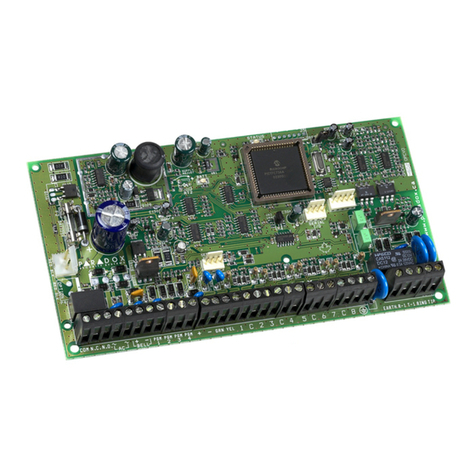
Fitters must make the connections of the 50 Hz 230 Vac electricity supply, and the various automation devices.
Connections between the control unit, motor, encoder and transformer have already been performed by the Manufacturer.
• Once the connections to the control unit have been made, the Fitter must use bands to join adjacent wires into groups of 2, 3 or 4 in order to prevent
them coming away from the terminal board: bands must be attached as close as possible to the terminals, no more than 10mm away, taking care not
to damage wire insulation. No cable may remain unpaired.
• The bands are only for unsheathed cables (sheathed cables are held in place by the sheath).
• Pay careful attention not to pair wires with voltages higher than 50 Volt RMS with lower voltage wires.
• The wiring performed internally by the manufacturer is already equipped with clamping bands.
ATTENTION: the connections pre-wired by the manufacturer may not be altered under any circumstances.
1.1.1 Indicator LEDs
T
here is a row of 5 LEDs on the right hand side of the board, under the terminals.
These LEDs are lit when the corresponding signal is present.
For N.C. inputs STOP and PHOTO, the corresponding LEDs L7 and L11 are normally
o
n, for the RESISTIVE input corresponding LED L8 is normally on if jumpered with
8.2kΩ resistance.
F
or the N.O. inputs CLOSE and STEP, the corresponding LEDs L9 and L10 will
be switched off. These LEDs therefore indicate any malfunction of the connected devices.
1.2 List of electric cables
The cables needed may vary depending on the installation and type and quantity of devices installed.
The cables used in the installation must be IEC 60335 compliant.
ATTENTION: the cables used must be suited to the type of installation.
It is the Fitter’s responsibility to choose appropriate material.
• Use the power supply cable provided with the operator only
.
• The power cable provided may not be extended or shortened.
•
All wires must be unsheathed as little as possible (6mm at the most), as close
a
s possible to the connection terminals, in order to prevent accidental contact
with live parts should the cables disconnect from the terminals.
• Do not pre-seal cables to be fastened to the terminals using screws.
• If it is possible that wires subject to voltage higher than 50 Volt RMS and very
l
ow voltage safety wires may come into contact with one another, wires with
voltage higher than 50 volt RMS must be insulated with a sheath; or the very
low voltage safety wire must have an insulating sheath at least 1mm thick.
• No external connection cables must be of the at twin tinsel cord type.
1.3 Setting up the electric system and connection to the mains supply
This manual does not describe how the electrics system should be prepared for connection to the mains. It does, however, give the following warnings:
• The electricity supply line must be installed and connected by an authorised electrician or professional tter.
• The electricity supply must be adequately protected against short circuits and static discharge.
• T
he power supply network must contain an omnipolar circuit breaker with a contact opening distance equal to or greater than 3.5 mm that assures
the complete disconnection of the power supply.
2