www.litehawk.ca
R
LiteHawk STORM Instruction Manual 2
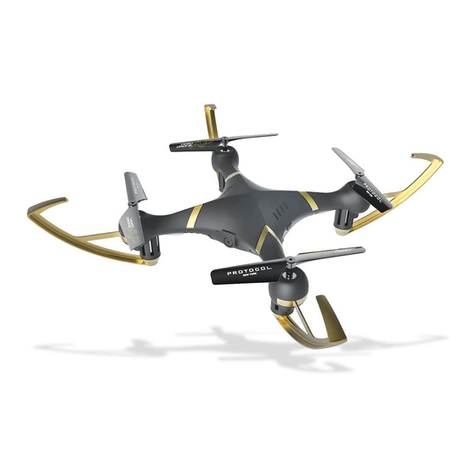
LITEHAWK STORM PRECAUTIONS - The LiteHawk STORM is not intended for children under the age
of 14 unless closely supervised by an adult. Improper use may cause serious injury. Please read LiPo Bat-
tery section before use. Do not fly in areas close to high voltage lines or crowds. Do not fly when windy.
Do not fly in rain, snow or if there is lightning and/or thunder. Do not touch ANY moving parts while the
model is powered.
WARNING: CHOKING HAZARD - Small parts. Not For Children under 3 years
CAUTION: Do not touch the running propeller! Do not play above someone’s head! Adult supervi-
sion is required!
CAUTION: Never insert any sharp objects, pins or screws into the model as this may puncture the
internal battery!
SAFETY PRECAUTIONS
- Keeps hands, hair and loose clothing away from the rotor blades when power switch is turned ON.
- Turn offcontroller/charger and STORM when not in use.
- Remove battery from controller/charger when not in use.
- Parental guidance is recommended for the flight.
- Keep your STORM in your sight so that you can supervise it at all times.
- New alkaline batteries are recommended for use in controller to obtain maximum performance.
- Your charger is tailor made for the Li-Poly battery used in your LiteHawk STORM. Do not use it to charge
any battery other than that in the LiteHawk STORM.
BATTERY SAFETY INFORMATION
- Requires 6 x 1.5V AA batteries (included).
- Batteries are small objects.
- Replacement of batteries must be done by adults.
- Follow the polarity (+/-) diagram.
- Promptly remove dead batteries from the toy.
- Dispose of used batteries properly.
- Remove batteries for prolonged storage.
- DO NOT incinerate used batteries
- DO NOT dispose of batteries in fire, as batteries may
explode or leak.
- DO NOT mix old and new batteries or different types
of batteries (i.e. alkaline/standard)
- Always replace the whole set of batteries at one
time.
- DO NOT short-circuit the supply terminals
CARE AND MAINTENANCE
- Always remove batteries from the toy when it is not being used for a long period of time (controller/char-
ger only).
- Keep the toy away from direct heat or extreme cold.
- Do not expose the toy to water. This can damage the electronic assemblies.
Special Lipo Battery Instructions:
- Never charge battery unattended.
- Charge battery in isolated area. Keep away from
flammable materials.
- Do not expose to direct sunlight. There is a risk of
the batteries exploding, overheating or igniting.
- Do not disassemble, modify, heat or short circuit
the batteries. Do not place them in fires or leave
them in hot places.
- Do not allow the batteries to get wet.
- Only charge the batteries with the specified battery
charger.
- Only use the batteries in the device specified by
LiteHawk.
- In the unlikely event of leakage or explosion use
sand or a chemical fire extinguisher for the battery.
- Batteries must be recycled or disposed of properly.
Your LiteHawk STORM is equipped with a Lithium Polymer battery.
Before charging the LiteHawk STORM please read the following!
- DO NOT leave the battery unattended during charging.
- DO NOT leave the battery plugged into the charger any longer than 2 hours. If the Red light does not go
out in this time, the charger or battery could be faulty - unplug immediately!
- DO NOT drain the battery to the point at which you can no longer lift off. Stop using the STORM when
you begin to lose significant power.
- DO NOT install another battery without letting the motors cool first! 5-10 minutes is sufficient.
- DO NOT recharge the battery until it is cool to the touch! 10 minutes is sufficient.
- DO NOT store battery for longer than 24 hours without recharging to at least 65% capacity.
DO NOT FULLY DISCHARGE THE BATTERY! STOP AND RECHARGE WHEN YOUR STORM
BEGINS TO LOSE POWER! FAILING TO DO SO WILL RESULT IN IRREPARABLE DAMAGE TO
THE BATTERY!
This device complies with Industry Canada licence-exempt RSS standard(s). Operation is subject to the
following two conditions: (1) this device may not cause interference, and (2) this device must accept any
interference, including interference that may cause undesired operation of the device.