Startco Engineering Ltd. Page 1
SE-325 Neutral-Grounding-Resistor Monitor Rev. 8
Pub. SE-325-M, May 6, 2008.
1. GENERAL
1.1 MODERN RESISTANCE-GROUNDED SYSTEMS
A high-resistance-grounded system uses a neutral-
grounding resistor (NGR) with a low let-through current
to limit ground-fault current. High-resistance grounding
is gaining popularity because a ground-fault flash hazard
exists in low-resistance- or solidly grounded systems and
a ground-fault can result in substantial point-of-fault
damage. High-resistance grounding eliminates these
problems and modern ground-fault protection operates
reliably at these levels. Furthermore, the probability of an
arc-flash incident is significantly reduced in a high-
resistance-grounded system.
NGR selection depends on system charging current and
whether the system is an alarm-only or a tripping system.
Alarm-only systems are usually restricted to system
voltages up to 5 kV with NGR let-through currents of 5 A
or less. Occasionally, alarm-only systems up to 15 kV
and up to 10 A are used; however, they are not common
because a ground fault on such a system tends to escalate
to a phase-to-phase fault before the ground fault can be
located and cleared.
System charging current is the capacitive current that
flows to ground when a bolted ground fault occurs. This
current can be calculated or measured. For small systems,
the magnitude of charging current is typically ½ A per
1,000 kVA on low-voltage systems and 1 A per
1,000 kVA on medium-voltage systems.
In an alarm-only system or in a tripping system without
selective coordination, choose an NGR with a let-through
current larger than the system charging current and set
the pick-up current of ground-fault devices at or below
50% of the NGR let-through current.
In a tripping system with selective coordination, use
ground-fault devices with a definite-time characteristic to
achieve time coordination. Use the same pick-up current
for all ground-fault devices—this value must be larger
than the charging current of the largest feeder. Select an
NGR with a let-through current between five and ten
times the pick-up current of the ground-fault devices.
Do not use a grounding transformer with a low-voltage
resistor:
•The combined cost of a transformer and a low-
voltage resistor is more than the cost of a resistor
rated for line-to-neutral voltage.
•A transformer saturated by a ground fault through a
rectifier can make ground-fault protection
inoperative.
•Transformer inrush current up to twelve times rated
current can cause a ground-fault voltage larger than
expected.
•A parallel transformer winding makes it difficult to
monitor NGR continuity.
•A transformer can provide the inductance necessary
to cause ferroresonance if the NGR opens.
Following these guidelines will reduce the flash
hazard, reduce point-of-fault damage, achieve reliable
ground-fault protection, and ensure a stable system not
subject to ferroresonance.
1.2 SE-325 NGR MONITORING
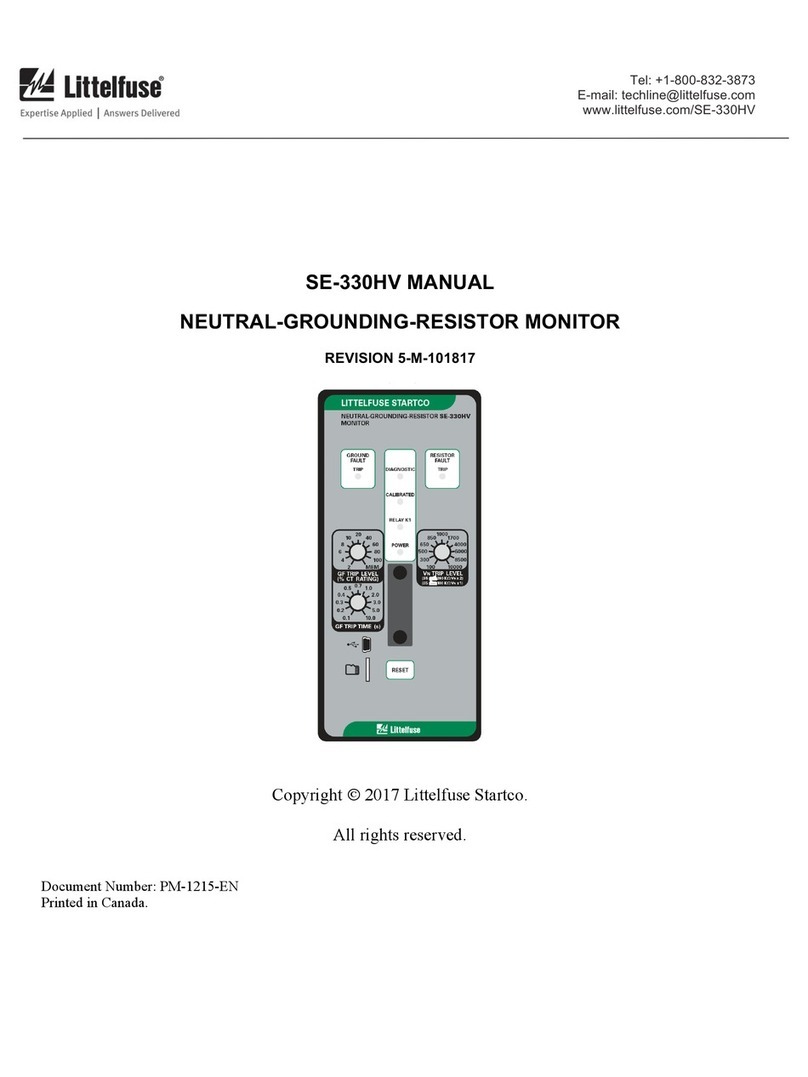
The SE-325 is a neutral-grounding-resistor monitor for
resistance-grounded systems up to 25 kVac. It measures
current in a transformer or generator neutral, neutral-to-
ground voltage, and continuity of the neutral-grounding
resistor. The SE-325 coordinates these three measurements
to detect a failed NGR or a ground fault and provides one
output contact for shunt or undervoltage operation in a
main-breaker trip circuit. Trips are latched and indicated by
LED’s.
Ground-fault current is sensed by a CT200 window-type
current transformer. Either CT input can be grounded to
meet electrical codes. A trip level of 0.5, 2.0, or 4.0 A is
switch selectable for use with a 5-, 15-, or 25-A grounding
resistor. Trip time is adjustable from 0.1 to 2.0 seconds.
Neutral-to-ground voltage and continuity of the neutral-
grounding resistor are continuously measured through an
ER-series external sensing resistor connected to the neutral.
A resistor fault will be detected if ground-fault current is not
detected and neutral-to-ground voltage exceeds the trip-level
setting, or if NGR resistance exceeds the trip resistance. A
resistor-fault hold-off circuit prevents nuisance trips in
alarm-only systems.
For additional information on neutral-grounding-resistor
monitoring, see “Monitoring Neutral-Grounding Resistors”
at www.startco.ca.
2. OPERATION
2.1 SETTINGS
2.1.1 GF TRIP TIME
Ground-fault trip time is adjustable from 0.1 to 2.0
seconds. Time-coordinated ground-fault protection requires
this setting to be longer than the trip times of downstream
ground-fault devices.
For the extended trip-time option, trip time is adjustable
from 0.1 to 5.0 seconds.
2.1.2 GF
The ground-fault-circuit trip level is 0.5, 2.0, or 4.0 A
when current is sensed with a CT200 current transformer.
Since the ground-fault-circuit trip level should not be greater
than 20% of the grounding resistor let-through current, these
levels are appropriate for use with 5-, 15-, or 25-A
grounding resistors. See Table 1. For other applications, the
trip level of the ground-fault circuit is 0.25, 1.0, or 2.0% of
the primary rating of the 5-A-secondary current transformer.