18 19
MAINTENANCE
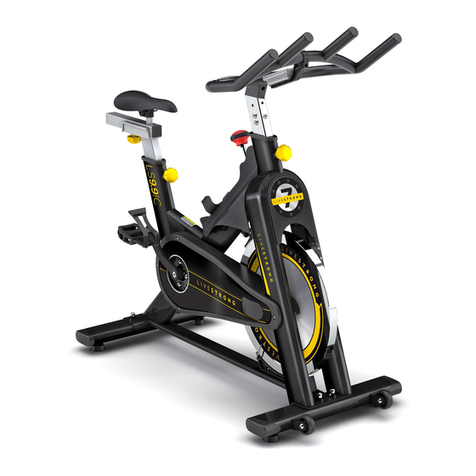
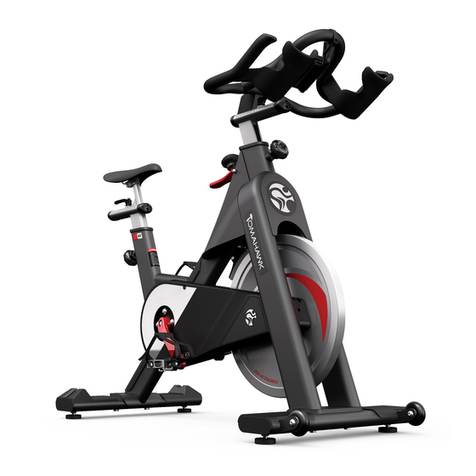
Regular maintenance must be performed on the Indoor Cycle for optimal performance and longevity. Please read and follow all
instructions below. If the Indoor Cycle is not maintained as described, components may wear excessively and the Indoor Cycle may
become damaged. Improper maintenance will void the warranty terms. If you have questions about maintenance, contact your local
distributor.
Note: Many maintenance procedures require lubricant spray. Manufacturer recommends WD40, Brunox or a similar solvent free lubricant.
DAILY MAINTENANCE
1. Make sure that the Indoor Cycle is level. If the indoor cycle rocks on your floor, turn the levelling feet underneath the front or rear
stabilizer until the rocking motion is eliminated.
2. After exercising, the Indoor Cycle should be disinfected and cleaned to maintain a hygienic environment. First, apply a disinfectant
spray to the handlebars and the saddle. Using a lint-free cloth, dry the handlebars and the saddle. Next, apply a small amount of
disinfectant to a lint-free cloth and clean the adjustment knobs and the adjustment handles. Avoid using strong detergents on the
Indoor Cycle frame.
WEEKLY MAINTENANCE
1. Apply a small amount of the lubrication spray to a lint-free cloth, and thoroughly clean the frame, the handlebar slider and seat
sliders the flywheel and the plastic parts of the Indoor Cycle.
2. (Pictured right) For optimal performance of the resistance system, and to minimize
wear on the brake pad, the solvent free lubricant spray should be applied to the brake
pad using the lubrication holes on the plastic part of the brake pad. If fuzz or lint appears
on the brake pad, the brake pad has become too dry—lubricant spray should be applied
more frequently. Make sure the brake pad is thoroughly soaked from end to end with
lubricant spray. Then, wipe the excess off.
BI-WEEKLY MAINTENANCE
1. (Picture right) The Indoor Cycle should not be used if the Emergency Brake System is not working
properly. While sitting on the saddle and pedalling, test the brake by pushing down the brake knob.
The flywheel should come to a quick and complete stop.
Belt driven Bike
Important: A loose belt as well as an over-tightened belt will cause damage to the belt and drive system.
Checking Belt Tension:
To check for a loose belt, sit on the saddle, place your feet on the pedals, move the pedals until the
crank arms are horizontal. Next, push down the emergency brake handle and hold it. Then, stand on
the pedals and rock forward and backward. There should be no more than 1/8th inch (2–3 mm) of
play in the belt. If there is too much play in the belt, this indicates that the belt is too loose.
Correcting Belt Tension:
To correct a loose belt: To adjust the belt, pull off the right and the left maintenance covers (A).
Loosen the axle nut (B) on both ends of the flywheel axle two full turns.
Loosen the Outer Adjustment Nut (C) facing the head of the Allen bolt on each side of the flywheel.
Then, turn both (right and left sides) of the Inner Adjustment Nuts (D) on the inside of the flywheel
bracket 1/4 of a turn at a time (upward on the R side and downward on L side) until the belt is
properly adjusted. Make sure to turn both adjustment screws exactly the same amount to avoid
misalignment of the flywheel. Re-check the amount of play in the belt as described at the beginning of
this step. If necessary, readjust the belt.
Finally, retighten the two Outer Adjustment Nuts (C) and the two axle nuts (B), and reattach the
maintenance covers.
To avoid damage to the flywheel bearings, do not over tighten the axle nuts (B). Unusual noises
or vibrations are indications that the belt has been over tightened or that the flywheel is at
a wrong angle.