manuals.online logo
Brands
  1. Home
  2. •
  3. Brands
  4. •
  5. Long-run
  6. •
  7. Inverter
  8. •
  9. Long-run 100LP User manual

Long-run 100LP User manual

This manual suits for next models

2

Popular Inverter manuals by other brands

Omnik New Energy Omniksol-1.5k-TL user manual

Omnik New Energy

Omnik New Energy Omniksol-1.5k-TL user manual

Agilent Technologies 33250A user guide

Agilent Technologies

Agilent Technologies 33250A user guide

4-noks ZR-SWITCH-RC instruction manual

4-noks

4-noks ZR-SWITCH-RC instruction manual

V&T V5 Series user manual

V&T

V&T V5 Series user manual

Hon Turing HT-T-S1000-12 introduction

Hon Turing

Hon Turing HT-T-S1000-12 introduction

Metabo E 140 SP Plus Original operating instructions

Metabo

Metabo E 140 SP Plus Original operating instructions

BARRON EXITRONIX Tucson Micro Series installation instructions

BARRON

BARRON EXITRONIX Tucson Micro Series installation instructions

Baumer HUBNER TDP 0,2 Series Mounting and operating instructions

Baumer

Baumer HUBNER TDP 0,2 Series Mounting and operating instructions

electroil ITTPD11W-RS-BC Operation and Maintenance Handbook

electroil

electroil ITTPD11W-RS-BC Operation and Maintenance Handbook

Silicon Solar TPS555-1230 instruction manual

Silicon Solar

Silicon Solar TPS555-1230 instruction manual

Mission Critical Xantrex Freedom SW-RVC owner's guide

Mission Critical

Mission Critical Xantrex Freedom SW-RVC owner's guide

HP 3312A Operating and service manual

HP

HP 3312A Operating and service manual

Hoymiles HM-500T user manual

Hoymiles

Hoymiles HM-500T user manual

Nitecore SPM10 user manual

Nitecore

Nitecore SPM10 user manual

AEG Protect PV installation manual

AEG

AEG Protect PV installation manual

On Board TruePower Plus 1200MS owner's manual

On Board

On Board TruePower Plus 1200MS owner's manual

Plugreen PGM-200P-230 Installation and operation manual

Plugreen

Plugreen PGM-200P-230 Installation and operation manual

Fourgroup Easy use and Programming Handbook

Fourgroup

Fourgroup Easy use and Programming Handbook

manuals.online logo
manuals.online logoBrands
  • About & Mission
  • Contact us
  • Privacy Policy
  • Terms and Conditions

Copyright 2025 Manuals.Online. All Rights Reserved.

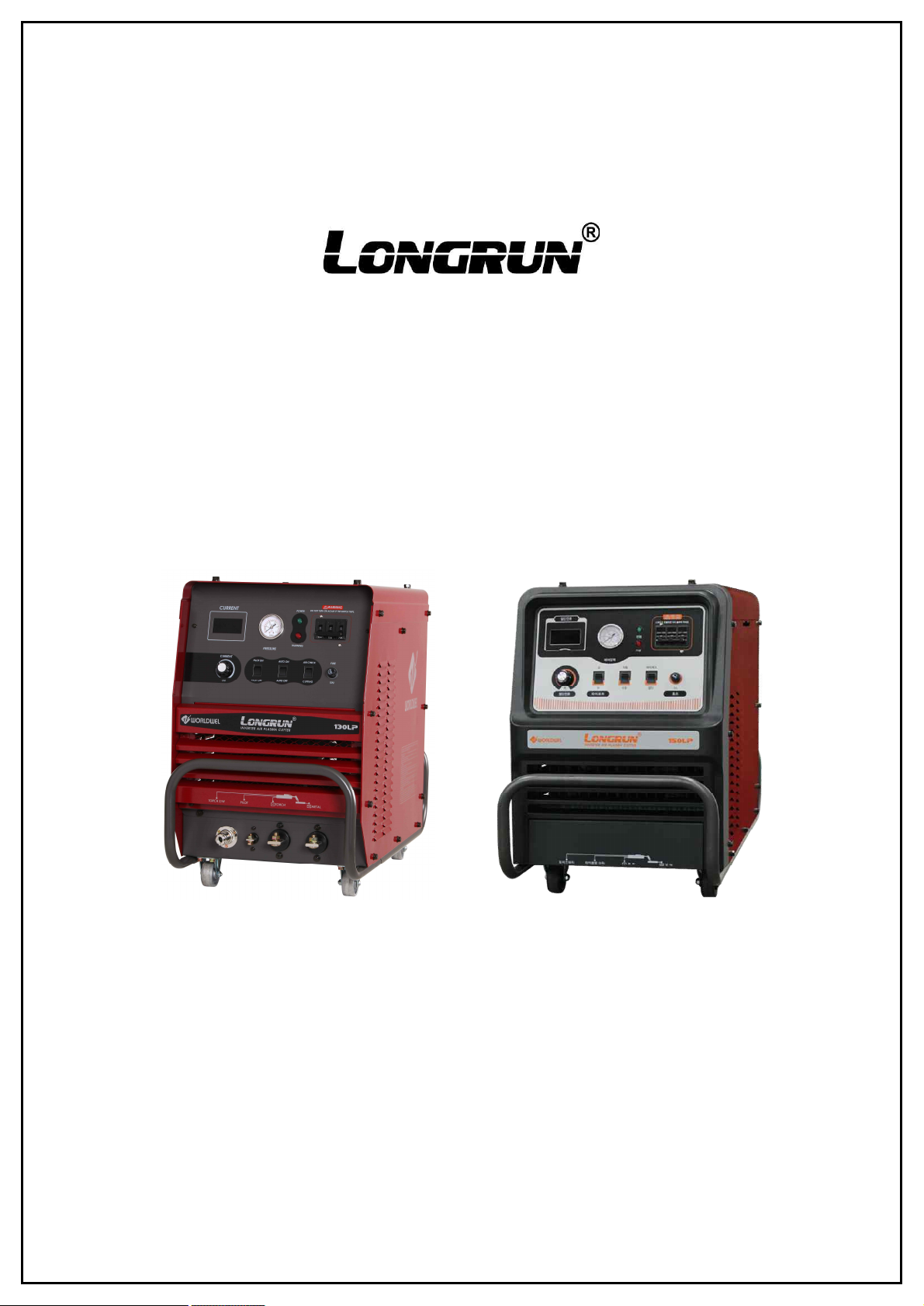
INVERTER AIR PLASMA CUTTING MACHINE
100LP, 130LP, 150LP
OPERATION MANUAL
DO NOT INSTALL, OPERATE OR MAINTAIN THIS MACHINE WITHOUT
READING THIS MANUAL AND PLEASE ALWAYS THINK BEFORE YOU ACT.
www.worldwel.com
■ TECHNICAL SPECIFICATIONS
- Usable at any plant by easy to change input voltage 220V, 380V, 440V
- Easy to verify cutting current by digital ammeter during cutting
- Cutting with air only, no need other gas
- Non contact arc starting by pilot circuit
- No need keeping to push torch switch during cutting by turning AUTO switch On which
is on front panel of power source
ITEM UNIT 100LP 130LP 150LP
Input Voltage V
220, 380, 440
Single Phase or Three Phase
Switchable
Frequency Hz 50/60
Rated Output Current A 100 130 150
Input Current @ rated output KVA 12 23 27
No Load Voltage V 280
Output Current Range A 25 ~ 100 35 ~ 130 50 ~ 150
Output Voltage V 110 120 130
Duty Cycle @ rated output % 60
Dimension (W×D×H) mm 330×680×530 385×780×610 385×825×610
Weight kg 44 62 69
General Safe Practices
■ Wear approved safety glasses with side shields under your welding helmet or face shield and at all
times in the work area.
■ When working above floor level, use a safety belt to protect yourself from a fall should you get a
shock.
■ Do not install or place machine on or over combustible surfaces.
■ Be sure that all installation, operation, maintenance and repair procedures are performed only by
qualified persons.
Electric shock can kill.
■ Wear Dry, hole-free insulating gloves and body protection. Do not touch electrode with bare hand. Do
not wear wet or damaged gloves.
■ Do not touch live electrical parts.
■ Never dip the electrode in water for cooling.
■ Properly install and ground all equipment.
■ Protect yourself from electric shock by insulating yourself from work and ground. Use non-flammable,
dry insulating material if possible, or use dry rubber mats, dry wood or plywood, or other dry insulating
material big enough to cover your full area of contact with the work or ground, and watch for fire.
■ Turn off input power using the disconnect switch at the fuse box before working on the equipment.
■ Frequently inspect input power cable for damage or bare wiring and repair or replace cable
immediately if damaged.
Fumes and gases can be dangerous.
■ Cutting may produce fumes and gases hazardous to health. Avoid breathing these fumes and gases.
When cutting, keep your head out of the fume. Use enough ventilation and/or exhaust at the arc to
keep fumes and gases away from the breathing zone.
■ Use enough forced ventilation or local exhaust (forced suction) at the arc to remove the fumes from
your breathing area.
■ Use a ventilating fan to remove the fumes from the breathing zone and welding area.
Arc rays can burn eyes and skin.
■ Use welding helmet with correct shade of filter to protect your eyes from sparks and the rays of the
arc.
■ Wear welders cap and safety glasses with side shields. Use ear protection when welding out of
position or in confined spaces. Button shirt collar.
■ Wear complete body protection. Wear oil-free protective clothing such as leather gloves, heavy shirt,
cuffless pants and high boots.

Cutting sparks can cause fire or explosion.
■ Remove fire hazards from the welding area. If this is not possible, cover them to prevent the welding
sparks from starting a fire. Remember that welding sparks and hot materials from welding can easily go
through small cracks and opening to adjacent areas. Avoid welding near hydraulic lines.
■ When not use, make certain no part of the electrode circuit is touching the work or ground. Accidental
contact can cause overheating and create a fire hazard.
■ Do not cut on drums, tanks, or any closed containers unless a qualified person has tested it and
declared it or prepared it to be safe.
■ Connect the work cable to the work as close to the cutting area as practical. Work cables connected
to the building framework or other locations away from the cutting area increase the possibility of the
cutting current passing through lifting chains, crane cables or other alternate circuits. This can create
fire hazards or overheat lifting chains or cables until they fail.
■ INSTALLATION
● The welding machine shall be installed at a place ;
․ free from the inflammables
․ less humidity, dirt and dust
․ protecting from influence of direct sunlight, wind and rain
․ not generated oil vapor and corrosive gas
․ operating temperature range is from -102℃ to 40℃
․ least 30㎝ away from wall and other welding machine
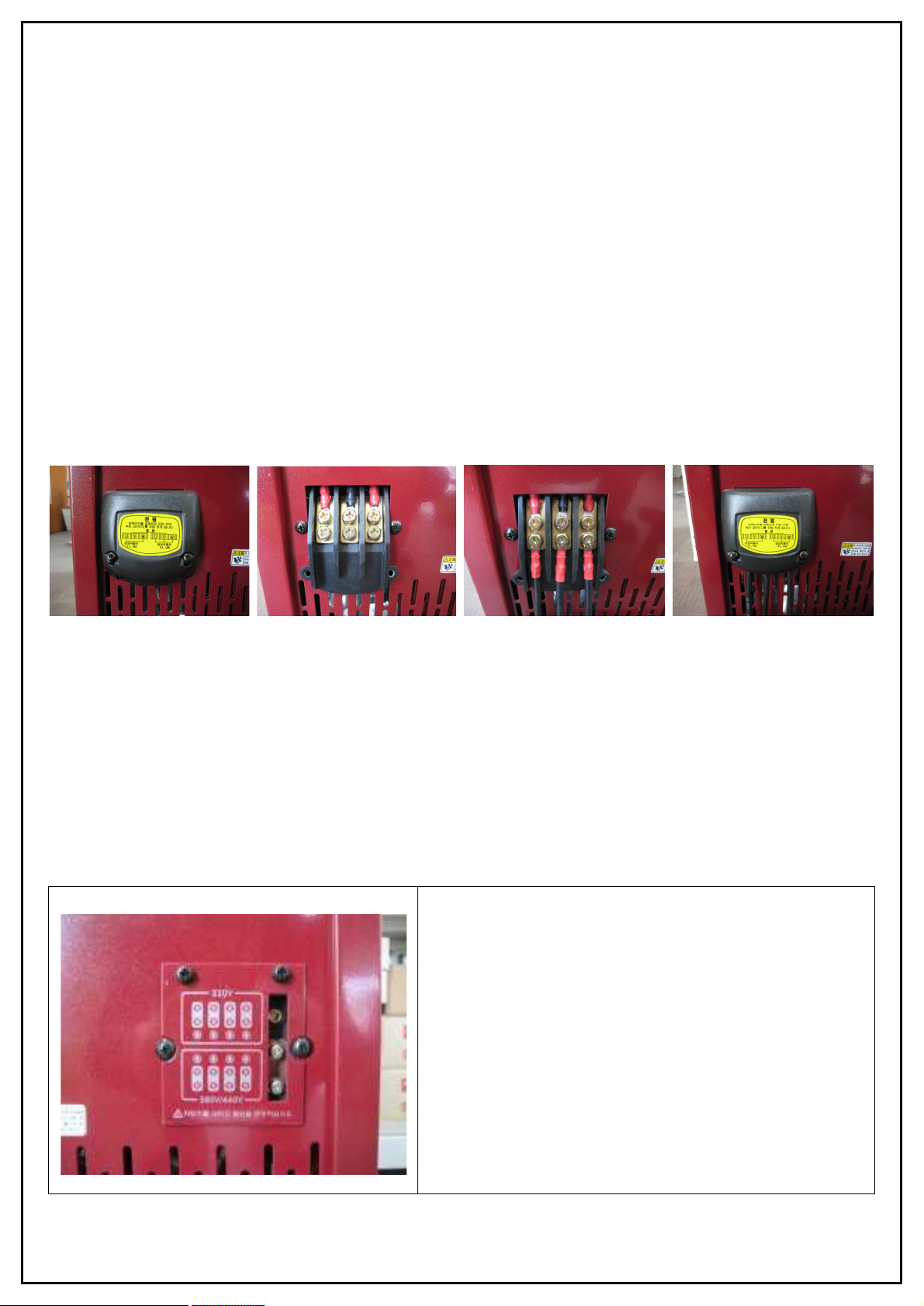
● Input Connection (Rear of the machine)
Be sure the voltage, phase and frequency of the input power is as specified on the name plate
located on the rear panel of the machine.
․ To connect the power cables, turn the power switch OFF
․ Verify the voltage to be supplied from main power.
․ Open the cover of terminal plate and connect the power cable to the power input terminal on the rear of
the machine and close the cover of terminal plate.
√ If the input power is single phase, connect two cables on left and right terminal without center.
․ For grounding the machine, connect a ground wire to the ground terminal marked with the symbol is
located on the rear panel of the machine.
․ Connect the air hose to the air-in of air regulator.
※ Input voltage selection
․ Verify the connection of voltage selection terminal.
√ If necessary to change it,
․ Remove the cover of input voltage selection plate.
․ Position the wires for the voltage to be supplied
from main power.
․ For 380V and 440V input, position a switch for the
voltage would be used which is inside welder after
removing top cover.
220V
380V 440V
● Output Connection (Front of the machine)
․ Connect the work cable (which is connected to the work clamp) to the "+ METAL"terminal.
․ To connect the torch,
- Connect a electrode cable to the "- TORCH" terminal
- Connect a torchswitch connector to the torch switch receptacle
- Connect a pilot wire to the pilotreceptacle.
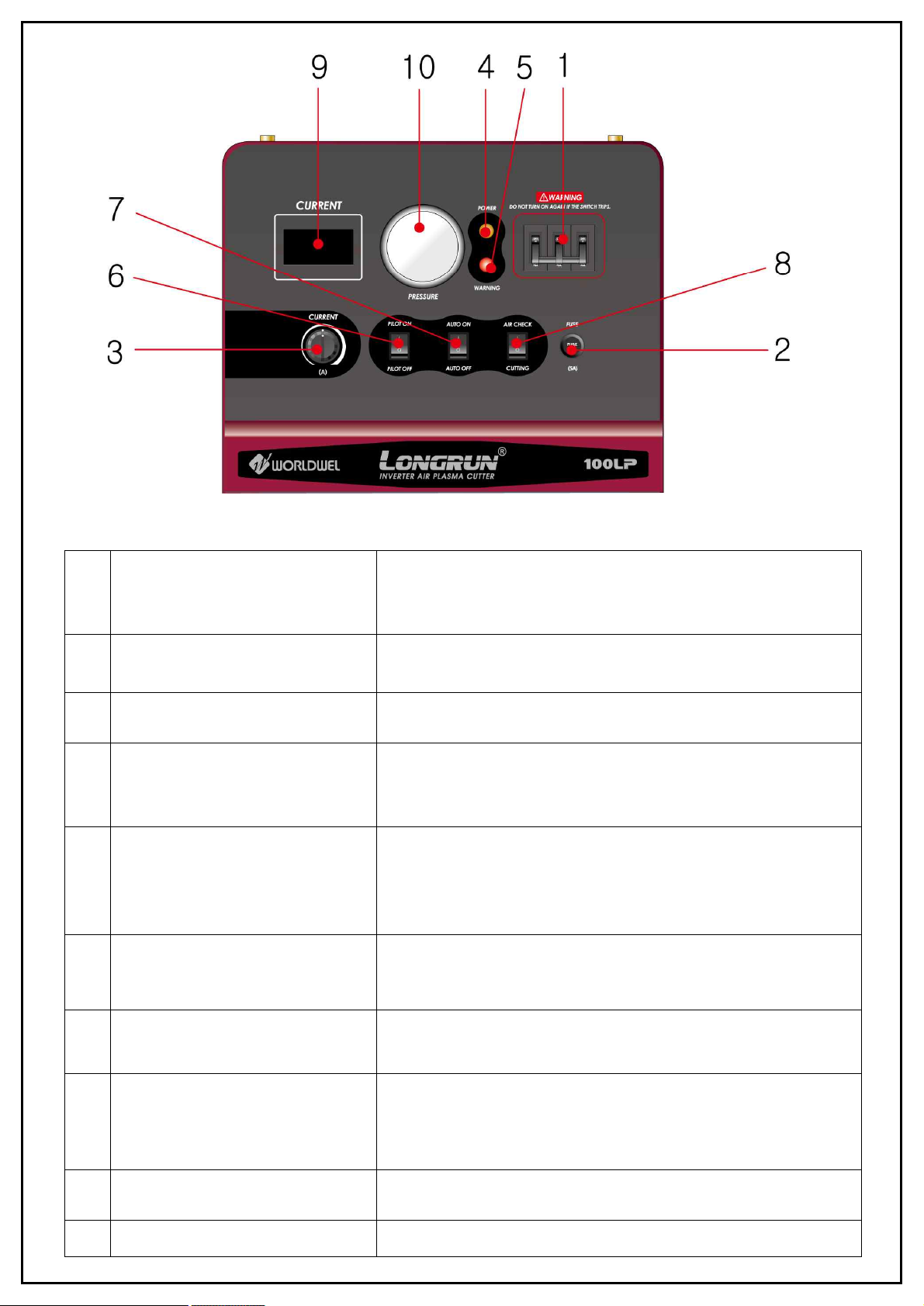
■ FRONT PANEL
1Power Switch When it is turn on, the cooling fan and all of electrical circuit
inside the machine will be operated.
2Control Fuse (5A) It will be broken by any electrical problems
3Current Adjust Volume Adjust the current
4Power Lamp It indicates that the machine is on and input voltage is within
acceptable range.
5Warning Lamp
It indicates the thermal over load or output disabled by any
electrical problems or the failure of program. When it is on, the
machine will not supply power at the output.
6Pilot Switch Possible the non contact cutting with workpiece by pilot
circuit.
7Auto Switch If it is On, no need keeping to push torch switch during
cutting
8Air Check Switch It is for checking the flow of the air. If this switch is ON, then the
air is flowed by opening the solenoid valve inside the machine.
9Ammeter It indicates the cutting current
10 Air Pressure Indicator It indicates the air pressure
■ START UP
Turn On the main power supplied to machine

Turn On the power switch of machine and then verify that the power lamp is On and the cooling fan is
running

Regulate the air pressure to 75PSI using the lever of air regulator when air check switch is ON

Select PILOT ON or OFF of the pilot selection switch

Select AUTO ON or OFF of the auto selection switch

Set the proper cutting current by the output current adjusting volume

Start cutting