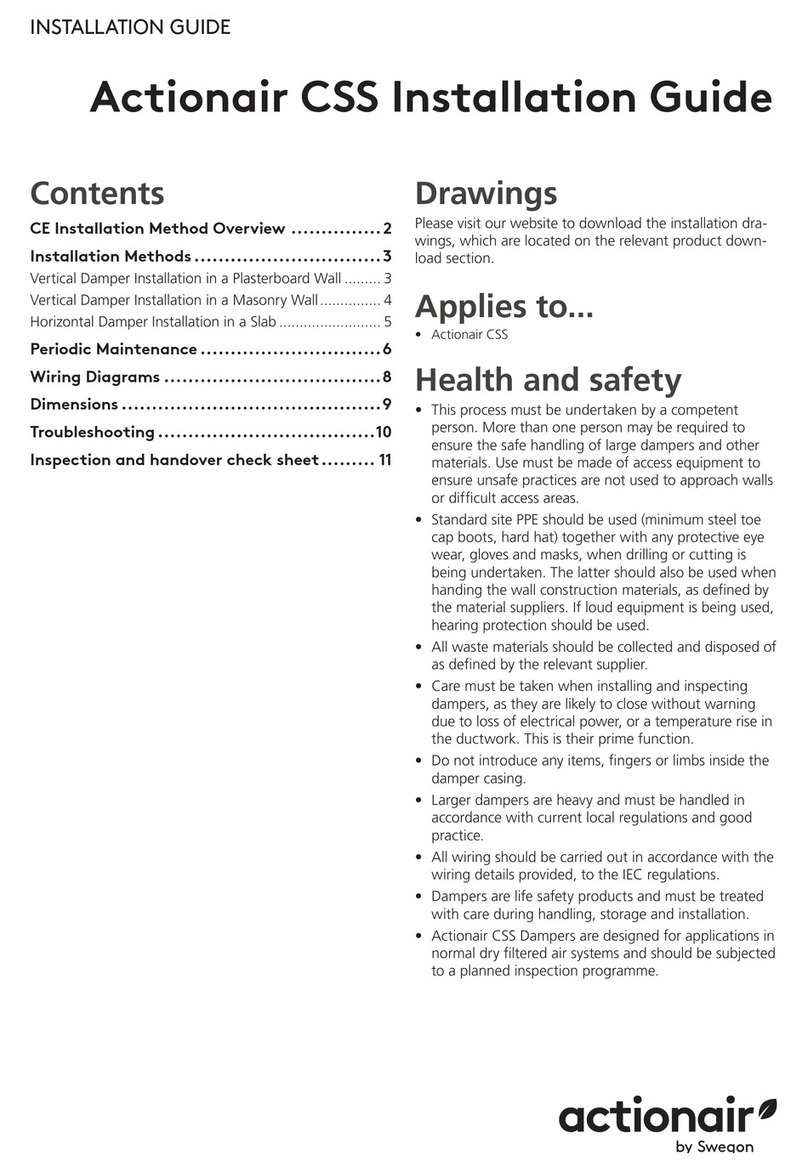
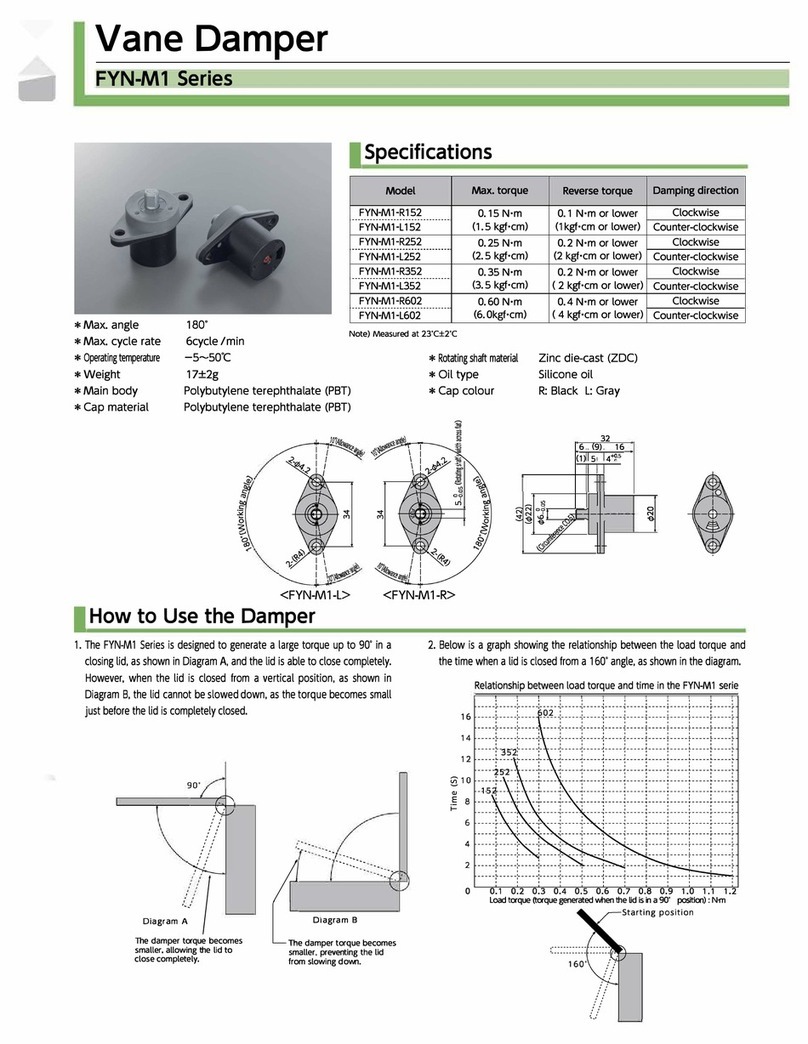
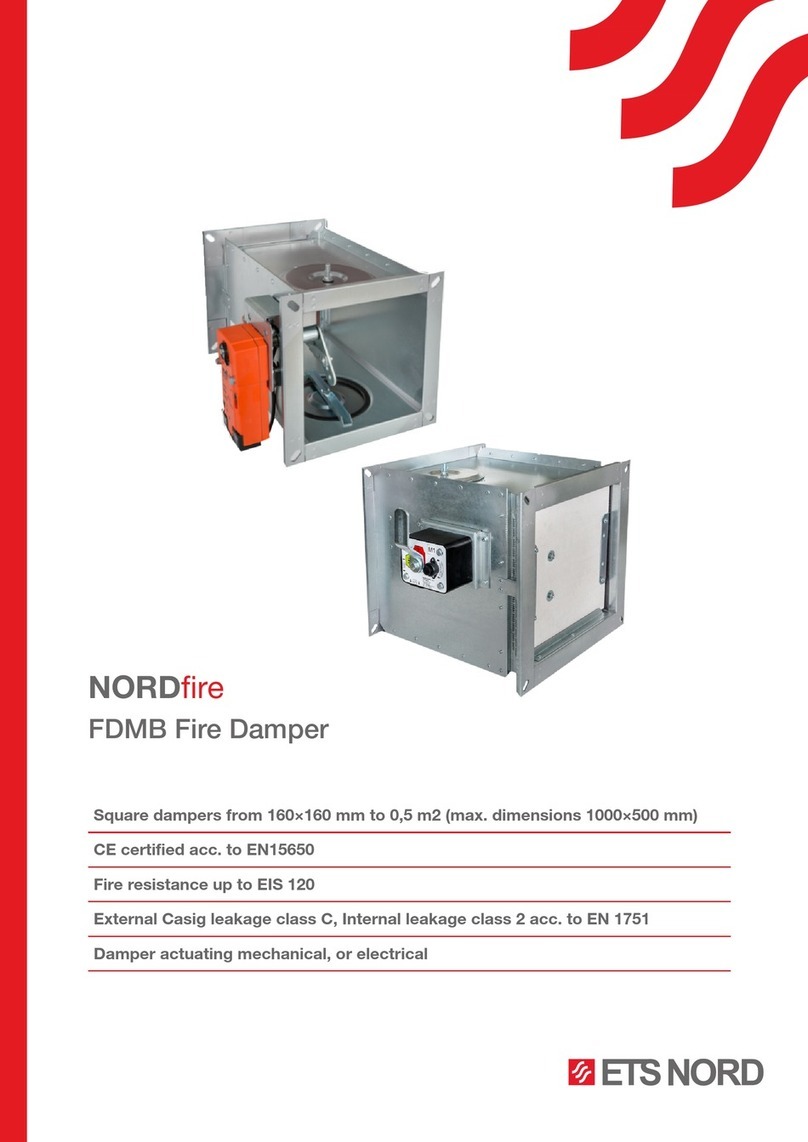
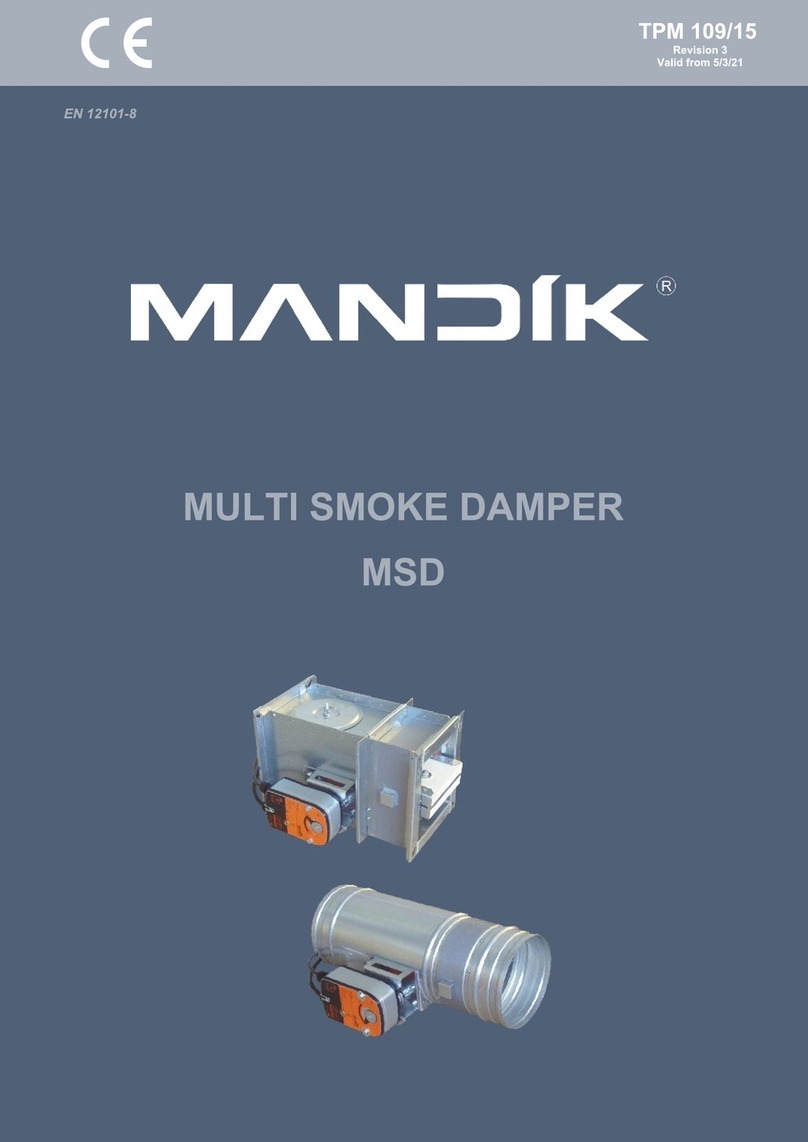
Installation, Operation and Maintenance Instructions
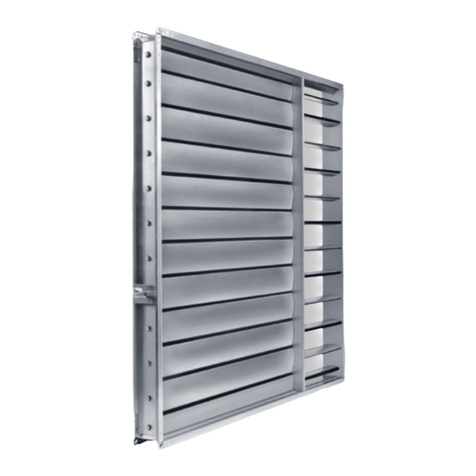
Pressure-relief dampers DRK
Back-draught dampers RSK
Product designation
DRK-10…., RSK10….
Technical specifications
Max. size W × H: DRK: 2400 mm × 7900 mm
RSK: 7900 mm × 7900 mm (subject to shipping)
Max. slat length: 1200 mm
Tripping pressure: DRK: acc. to order
RSK: no specified tripping pressure
Air flow direction: horizontal or vertical acc. to customer order
Free cross section: >60 % ((more precise figures after calculation
by manufacturer)
ATEX
DRK and RSK are only approved in specific designs and with appropriate iden-
tification for Zones 1, 21 or 2, 22 according to ATEX Directive 2014/34/EU.
If the fitter or operator changes the dampers in any way, the ATEX approval
becomes null and void. It is important to ensure that the damper and additional
equipment are installed in compliance with zoning requirements.
Shipment
In principle, avoid all damage caused by external influenc-
es. Never lift dampers by the slats or the outer linkages.
Dampers with a maximum weight of 50 kg can be lifted by
the C-profile frame. With heavier dampers, use at least
four points at the corner angles as suspension points. Do
not use individual slats under any circumstances as foot-
holds during installation. Report any damage, e.g. defor-
mation of slats, dents, impacts or warping of the C-profile
frame etc. immediately to the supplier or manufacturer.
This may impair the proper functioning of the damper and
at best cause dangerous circumstances to occur.
ATEX: Under no circumstances may ATEX dampers be fitted
after a fall or impact with visible or concealed damage.
Installation
These dampers can be fitted or removed to or from a wall
or an air conditioning system, or integrated in a duct sec-
tion. First make sure the air flow is in the proper direction
as indicated by the red arrow on the damper housing.
Mount the dampers warp-free, tension-free, on a flat sur-
face and without any angular errors in the damper frame.
When mounting, use the 4 corner holes provided as stand-
ard. With larger dampers, fit additional flange couplings
at spacings of 200–500 mm. This is the responsibility of
the planning engineer or fitter. During installation, make
sure that the slats are exactly horizontal. The damper
must be adjusted exactly vertically (for horizontal air flow)
or exactly horizontally (for vertical air flow).
When installation is complete, check the angle of the
damper frame. It must be exactly 90°. Correct any devia-
tions immediately. In addition check the free movement
of the slats, linkage and tripping mechanism.
Avoid as far as possible any reduction in freedom of move-
ment on customer premises when installing insulation ma-
terials, installation ducts, auxiliary structures etc. If this is
not observed, it can lead to considerable disruptions in
operation, e.g. slats rub against the damper frame, different
tripping pressure, damper fails to open or close, reduced
leak tightness, etc.
On models with side seals (Di, DIN, CEN etc.) protect the
units from impurities of all kinds during the installation
phase. Drilling swarf and concrete chips can damage the
side seals. Before starting up the dampers, wipe the side
seals thoroughly until they are dry.
ATEX: All relevant national and international standards
and regulations for Ex zones must be observed. On damp-
ers with ATEX functionality in particular, the damper hous-
ing must be earthed using the earthing braids attached
by the manufacturer. No mechanical changes may be
made to the product. In addition do not attach any com-
ponents (motors, limit switches, etc.) to the damper if they
have not been analyzed for ignition risk by the appropriate
manufacturers or approved for ATEX zones. It is prohibited
to drill holes or fit bolts or screws in the interior of the
dampers. This could lead to damage or disturb damper
operation. If there is a risk at the factory that foreign bod-
ies may enter the movement area of the slats, prevent
them by suitable means (filters or catchment grills). This
prevents the slats from sticking and the possibility of fric-
tional heat developing.
LUCOMA AG, Weekendweg 5, CH-3646 Einigen, Switzerland
Tel: +41 33 655 00 44, Fax: +41 33 655 00 45, www.lucoma.com, info@lucoma.com