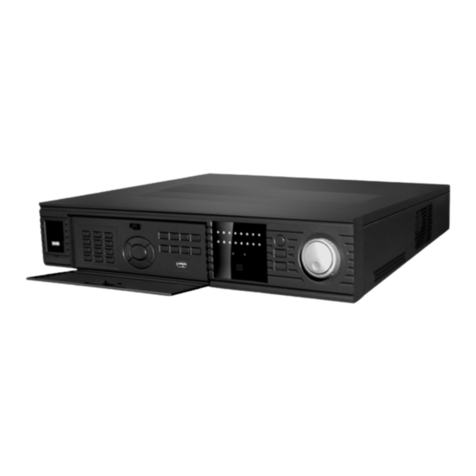
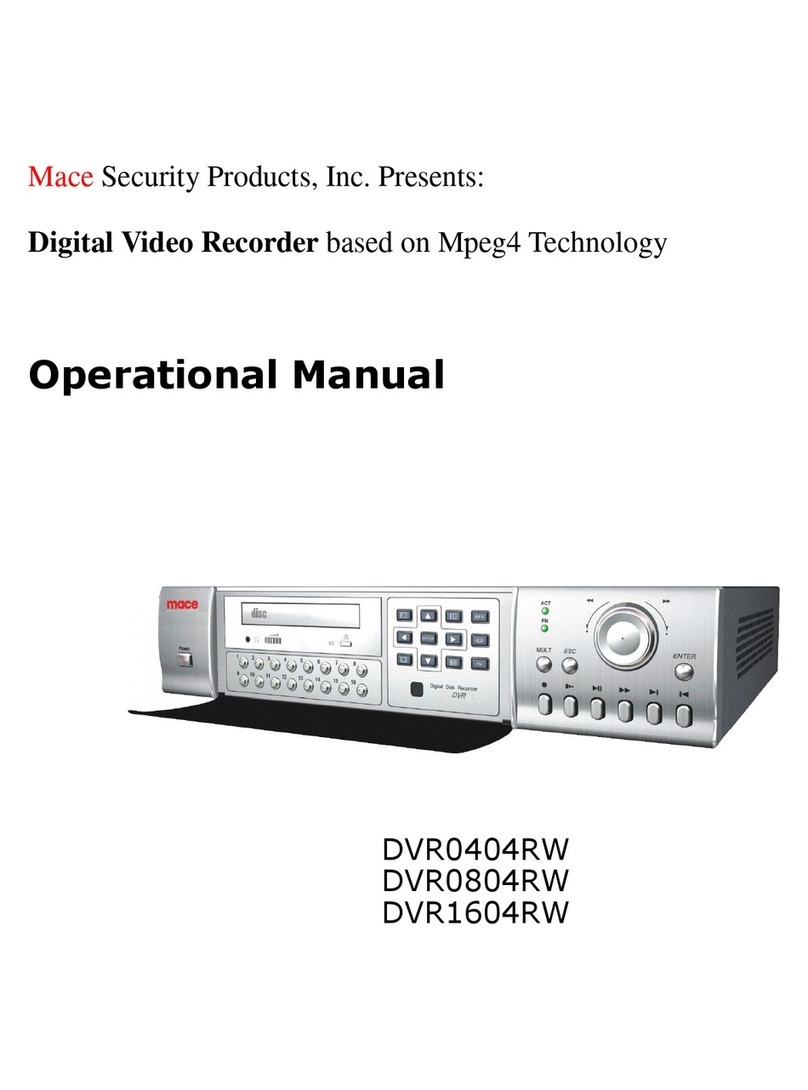
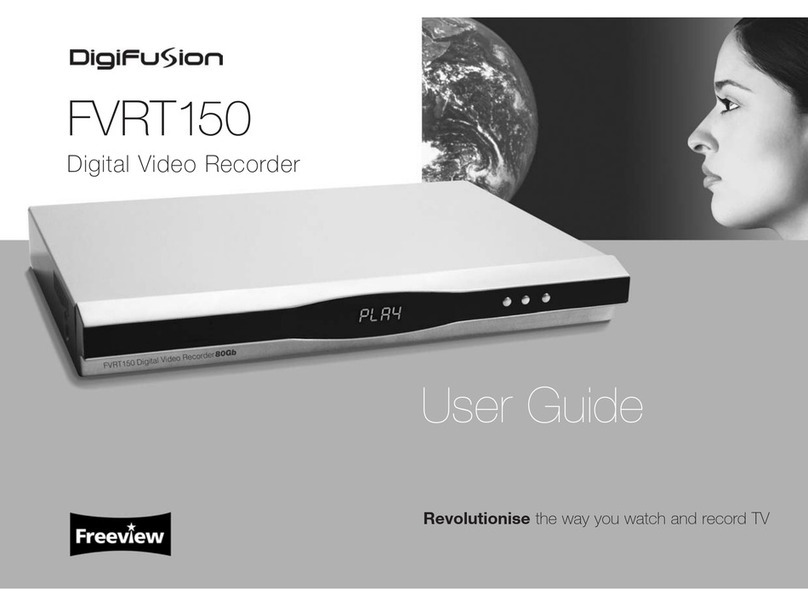
Luma LUM-500-NVR Series User manual

LUM-500-NVR Series
NVR Surveillance Recorder
Web Interface
Quick Start
Guide
Luma NVR QSG pilot.indd 1 7/10/2015 11:13:24 AM

2
NVR Quick Start Guide
Read this page before you go to the job site!
For maximum control and convenience, your system should be connected to the Internet via a local network
router. For installation, you must be able to access this network through a personal computer.
Internet connectivity allows you to use OvrC, a powerful remote maintenance service. See OvrC.com for details.
If your surveillance system is isolated from the Internet, go to SnapAV.com and download the technical reference
manual for this product, which has a chapter that steps you through installation without using the web interface.
Required Equipment
}The NVR and all cameras to be installed
}Network connection for the NVR
}Admin rights to a network computer that can access the surveillance system
}Phillips screwdriver
}Two AAA batteries for the remote control
Additional Resources
You can acquire a PDF of the full NVR technical reference manual, hard drive installation guide, and other
materials from the product page at SnapAV.com.
If you are going to install extra hard drives in the recorder, do so now before beginning installation.
Luma NVR QSG pilot.indd 2 7/10/2015 11:13:24 AM

3
NVR Quick Start Guide
Safety Tips
}Handle this device with care.
}Do not strike or shake this device.
}Do not operate this device beyond its specified
power source ratings.
}Protect the power cord from being stepped on or
pinched, particularly where it connects to the
device and to the power outlet.
}Do not drop items through the ventilation slots.
If something falls inside the device, turn off
the power immediately and contact qualified
personnel for service.
}Do not expose this device to water or moisture.
Moisture may damage the device and cause
electric shock.
}Take immediate action if the device becomes
wet: turn the power off and contact qualified
personnel for service.
}Do not use this device in humidity above 85%.
}Do not use this device near any heat sources
such as radiators, heat registers, stoves, or other
such heat-generating equipment.
}If mounting in a closed space, include adequate
ventilation. Do not block ventilation openings.
}The performance and lifespan of the hard drive
is affected by temperature. Use this device in
temperatures ranging from 14–131 °F.
}Handle the hard drive with care.
}You can damage the hard drive if this device
is moved while the hard drive is still spinning.
If you must move the device, even just to
reposition it, follow the shutdown procedure in
the technical reference manual (available online)
and wait at least 30 seconds before moving it.
}If servicing or exchanging the hard drive, protect
it from static electricity. Use a grounded static
wrist guard and mat to properly ground yourself
and the hard drive.
}Do not use an electric screwdriver to remove or
install a hard drive.
}Clean this device with a dry cloth. Do not use
strong or abrasive detergents when cleaning the
device chassis. If dirt is hard to remove, use a
mild detergent and wipe gently.
}Make a note of the system settings and save
them. This helps when changing the system
configuration or with recovery if unexpected
failure or trouble occurs.
Luma NVR QSG pilot.indd 3 7/10/2015 11:13:24 AM

4
NVR Quick Start Guide
Box Contents
The following materials are included in your package:
}This quick-start guide
}The Luma NVR
}Extra screws for mounting an additional internal hard drive into your NVR
}SATA cables for connecting an additional internal hard drive in your NVR
}Rack ears for installing your NVR into a rack
}Screws for attaching the rack ears to the NVR
}USB mouse
}Remote control
}Power cord
}Stick-on rubber feet for the unit if you will not be installing it in a rack
Please note that distributing, copying, disassembling, reverse compiling, reverse engineering, or exporting the
software provided for this product is expressly prohibited and in violation of international copyright law.
Luma NVR QSG pilot.indd 4 7/10/2015 11:13:24 AM

5
NVR Quick Start Guide
Set Up the Hardware
Router
LCD Monitor/Flat Panel TV
Caution: Do not power up the NVR until these steps are complete.
1. If desired, install the NVR in the rack. If not, attach the rubber feet to the bottom corners of the unit.
2. Connect the mouse to the USB port on the rear panel. We suggest that you leave the front USB unused and
accessible for later use.
3. If desired, connect a local monitor to the VGA, HDMI, or video out port.
4. Connect your IP surveillance cameras to the camera ports. To connect your cameras through your local
network, consult the technical reference manual (available online) for additional setup.
5. Connect your network cable to the Ethernet port.
6. Connect the power cord and turn on the power switch.
Camera(s)
Optional
USB Mouse Network Gateway
AC Power
ß or à
Optional local
video monitor
Luma NVR QSG pilot.indd 5 7/10/2015 11:13:24 AM

6
NVR Quick Start Guide
Install the Luma Utility
Use the Luma Utility to locate your surveillance hardware and set up communications.
Download and Install the Luma Utility
Visit your product page at SnapAV.com and download the Luma Utility installer.
Once it has downloaded, double-click on the Luma Utility icon to run the installer. You can
click through and accept the defaults.
Locate the NVR
Run the Luma Utility.
It searches the local network for all Luma Surveillance devices. If your NVR does not appear,
ensure that the network connections are secure and that the unit is powered up, then click
the button.
Click on the entry for your NVR to view its details. Double-clicking on the NVR opens its web
interface.
Luma NVR QSG pilot.indd 6 7/10/2015 11:13:24 AM

7
NVR Quick Start Guide
Edit the Network Settings
If you need to change the network settings at a later date, consult the
manual.
Set the IP Address
At the top of the right column of the Luma Utility, make a note of the IP
address. You will need this in the next step.
Deselect the Enable DHCP box to make the IP address static.
Change the Server and HTTP Ports
The HTTP port defaults to 80. This port enables you to access your
recorder through a web browser.
The server port defaults to 8000. This port enables the Luma mobile
application to access your system.
For security reasons, we suggest you change your ports and make a note
of the new port numbers for your records. Consult your server or router
manual for common and reserved port numbers to avoid.
To confirm changes, enter the password admin and then click Save.
Luma NVR QSG pilot.indd 7 7/10/2015 11:13:24 AM

8
NVR Quick Start Guide
Start the Web Interface
Get the Luma Plug-In
Open your browser, type the IP address of the recorder (from page 7) into the address bar, and hit Return.
Below the login window, there may be a link that reads, “Please click here to download and install the plug-
in. Close the browser when installing the plug-in.” If so, download the plug-in and close all instances of your
browser, including any running in the background.
Install the LumaWebComponents plug-in.
Restart your browser and return to your recorder’s login window.
Enter admin for both the user name and password.
You might get a pop-up message* that asks you whether you want to run the Luma Web
Components plug-in. You must allow the plug-in to access your system.
* Google Chrome does not have a pop-up message. Instead, look in the
right end of the address bar for an icon of a puzzle piece with an X over
it, as shown in the image to the right. Click on this to enable the plug-in.
Be sure to save your recorder’s page as a favorite in your browser.
Luma NVR QSG pilot.indd 8 7/10/2015 11:13:24 AM

9
NVR Quick Start Guide
Check the Cameras
After log-in, your screen shows the live page, which
should look similar to the illustration at right.
If a camera is out, check its connection to your
NVR, and ensure that it is powered up.
Edit Camera Settings (Optional)
To adjust camera settings, click on the settings icon
( ). In the configuration screen, click on Camera
Management (at the very bottom of the left column).
This displays a table of all IP cameras configured for
the NVR. In the rightmost column is a link to each
such IP camera. This link opens a new tab in your
browser for your camera’s local interface menu (see
your camera manual for details). It can only be used
from within the network.
Reinstalling Network Cameras
If you are taking cameras that were previously attached to a
network and plugging them directly into your NVR, you must
do a hardware reset on the cameras. See your camera’s manual
or the technical reference manual for details.
Luma NVR QSG pilot.indd 9 7/10/2015 11:13:25 AM

10
NVR Quick Start Guide
Set Up Dynamic DNS
This allows you to connect to your surveillance system from anywhere, via the Internet,
using a web address that’s easy to remember.
Click on Remote Configuration > Network Settings > DDNS.
Click the box labeled Enable DDNS, then choose a type from the DDNS Type menu. Next,
choose a server address. We recommend WirepathDDNS and ns2.lumadns.com.
Enter your desired domain in the Domain box. This creates a personalized server address,
which is shown under Device URL.
If someone has already registered your desired domain, the system adds a unique ID
(typically two to four digits) to your domain. If you do not like these digits, try another
domain or server address.
Example: If you choose the domain myhome
(as shown), your system’s URL would be
myhome.LumaDNS.com. If someone already
had myhome, then your system’s URL would
be something like myhome13.LumaDNS.
com.
Click Save to finalize the settings here.
Luma NVR QSG pilot.indd 10 7/10/2015 11:13:25 AM
Table of contents
Other Luma DVR manuals