manuals.online logo
Brands
  1. Home
  2. •
  3. Brands
  4. •
  5. M-Audio
  6. •
  7. Microphone
  8. •
  9. M-Audio Pulsar II Parts list manual

M-Audio Pulsar II Parts list manual

Other manuals for Pulsar II

4

Other M-Audio Microphone manuals

M-Audio Pulsar II User manual

M-Audio

M-Audio Pulsar II User manual

M-Audio Solaris User manual

M-Audio

M-Audio Solaris User manual

M-Audio Pulsar II User manual

M-Audio

M-Audio Pulsar II User manual

M-Audio uber mic User manual

M-Audio

M-Audio uber mic User manual

M-Audio Solaris User manual

M-Audio

M-Audio Solaris User manual

M-Audio Pulsar User manual

M-Audio

M-Audio Pulsar User manual

M-Audio PRO TOOLS VOCAL STUDIO User manual

M-Audio

M-Audio PRO TOOLS VOCAL STUDIO User manual

M-Audio Sputnik User manual

M-Audio

M-Audio Sputnik User manual

M-Audio Luna gd_060903 Quick start guide

M-Audio

M-Audio Luna gd_060903 Quick start guide

M-Audio Nova User manual

M-Audio

M-Audio Nova User manual

M-Audio Nova User manual

M-Audio

M-Audio Nova User manual

M-Audio Pulsar 192 PCI Parts list manual

M-Audio

M-Audio Pulsar 192 PCI Parts list manual

M-Audio Pulsar II Parts list manual

M-Audio

M-Audio Pulsar II Parts list manual

M-Audio Microphone User manual

M-Audio

M-Audio Microphone User manual

M-Audio Pulsar II Service manual

M-Audio

M-Audio Pulsar II Service manual

M-Audio Luna User manual

M-Audio

M-Audio Luna User manual

Popular Microphone manuals by other brands

IK Multimedia iRig Stream MIC PRO user manual

IK Multimedia

IK Multimedia iRig Stream MIC PRO user manual

DAPAudio RM-101 user manual

DAPAudio

DAPAudio RM-101 user manual

AKG CHM 21 User instructions

AKG

AKG CHM 21 User instructions

Sennheiser evolution wireless series EM 100 instruction manual

Sennheiser

Sennheiser evolution wireless series EM 100 instruction manual

Sony C-48 operating instructions

Sony

Sony C-48 operating instructions

GIGAMEDIA GGM PAMICUHFG user manual

GIGAMEDIA

GIGAMEDIA GGM PAMICUHFG user manual

Shure WH30TQG user guide

Shure

Shure WH30TQG user guide

auna PRO MIC-900 manual

auna PRO

auna PRO MIC-900 manual

AKG D 3800 User instructions

AKG

AKG D 3800 User instructions

Shure KSM141 user guide

Shure

Shure KSM141 user guide

MAIIN SOUND IIN style instruction manual

MAIIN SOUND

MAIIN SOUND IIN style instruction manual

Earthworks TC25 user manual

Earthworks

Earthworks TC25 user manual

Alesis MicLink Wireless user guide

Alesis

Alesis MicLink Wireless user guide

DSPPA D6234 manual

DSPPA

DSPPA D6234 manual

Monacor IMG STAGELINE ECM-300B manual

Monacor

Monacor IMG STAGELINE ECM-300B manual

Ansr Audio Scan16 user manual

Ansr Audio

Ansr Audio Scan16 user manual

Shure MXA710 Series user guide

Shure

Shure MXA710 Series user guide

Sennheiser evolution D1 user manual

Sennheiser

Sennheiser evolution D1 user manual

manuals.online logo
manuals.online logoBrands
  • About & Mission
  • Contact us
  • Privacy Policy
  • Terms and Conditions

Copyright 2025 Manuals.Online. All Rights Reserved.

Care and Usage
English
Pulsar II ▸ Care and Usage
English
Introduction
Thank you for purchasing the Pulsar II small diaphragm condenser microphone
from M-Audio. Studio artists around the world rely on M-Audio microphones
to capture acoustic performances with clarity and accurate tonal balance.
The Pulsar II improves upon that reputation with a new FET circuit, improved
diaphragm damping, and a redesigned front grill and back plate. This results in
a very smooth midrange response and adds more “air” to the top end (above
15kHz), allowing the Pulsar II to exhibit a frequency response curve surprisingly
similar to that of some of the world’s greatest small diaphragm microphones.
Please take a few moments to familiarize yourself with your new microphone by
reading this guide.
Features
▸ Top-address cardioid
instrument microphone
▸ 3/4” diameter
6-micron evaporated-gold
diaphragm
▸ Solid brass body
▸ 20Hz-20kHz frequency
response
▸ Class A FET electronics
▸ Switchable
-10dB pad
▸ Switchable
high-pass filter, 12dB per
octave at 80Hz
▸ 3-pin XLR
▸ Includes soft cloth bag,
windscreen, and hard
mount
What’s in the box?
If your box does not include the following items, please contact your dealer
immediately:
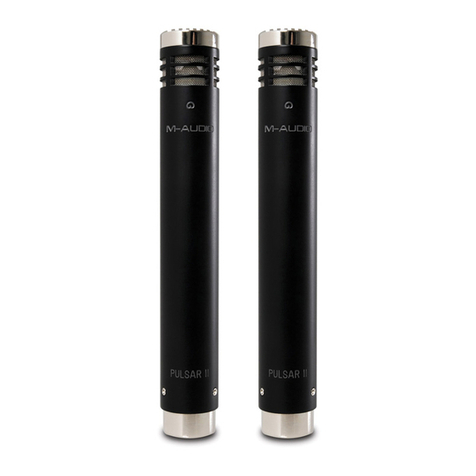
(2) M-Audio Pulsar II
microphones
(2) Hard Mounts
(2) Soft Cloth bags
(2) Windscreens
(1) Stereo Bar
(1) Microphone Riser
(1) Wooden case
(1) Care and Usage Guide
(1) Addendum
Using the Pulsar II
The M-Audio Pulsar II microphone outputs a balanced low-impedance signal.
It is designed to be connected to the mic-level inputs of a mixer channel or a
dedicated high-quality preamp such as M-Audio’s DMP3, Octane, or Tampa.
These are all very “neutral” sounding preamps that can amplify your microphone
signal, while retaining its full dynamic range and clarity.
As with all condenser microphones, your Pulsar II requires power in order to
operate. You will need to connect the Pulsar II via an XLR microphone cable to
a preamp or mixer channel input that supplies +48V phantom power. (Phantom
power shares the same XLR cable as the audio from the microphone.) In order
to avoid pops and surges that can damage components like speakers and
microphones, always perform the following steps (in the order listed) when
connecting the mic and/or cable:
1. Turn the volume/gain on your
preamp and/or mixer all the way
down.
2. Make sure that phantom power is
turned off.
3. Connect the microphone via a
high-quality XLR cable.
4. Turn on phantom power.
5. Slowly turn up the gain on your
preamp and/or mixer.
Before disconnecting the mic and/or cable, repeat steps 1 and 2 (in the order
listed).
Applications
The Pulsar II’s clean electronics combine with an evaporated gold diaphragm to
produce a smooth tone that makes it a great instrument-recording microphone.
Use it on string instruments, wind instruments, as an overhead drum mic, or as
a room ambience recording mic. When you’re ready to add more pro-quality
microphones to your mic locker, consider the award-winning M-Audio Luna and
the multi-pattern recording features of the M-Audio Solaris microphone and the
Sputnik tube microphone.
Cardioid Pattern
Cardioid is the most commonly used polar pattern engineered into
microphones. This design causes the rear of the microphone to reject
incoming sound, allowing the engineer to isolate the signal source from other
performance elements or background noise by just pointing the mic at the
sound source.
Microphone Care
Here are a few tips for care of your Pulsar II micropho ne:
▸ Never subject the Pulsar II to physical shock.
▸ Always use a stand and always use the included hard mount when
securing to a stand.
▸ Avoid harmful moisture condensation on the diaphragm when moving the
microphone between outdoor and indoor environments by allowing the
microphone to acclimate to room temperature before connection.
▸ Always use top-quality cables in order to avoid electrical problems that
may damage the microphone’s electronics.
▸ Avoid subjecting the Pulsar II to any kind of moisture. In vocal applications,
use the enclosed windscreen to protect the diaphragm from breath
condensation and saliva build-up.
▸ Never disassemble the Pulsar II microphone. There are no user-serviceable
parts inside.
▸ Avoid temperature extremes above 95°F and below 50°F.
▸ Always wipe the Pulsar II exterior down with a soft dry cloth and return it to
its case after each use to prevent damage from dust.
▸ In the event that your Pulsar II needs more extensive cleaning, lightly
dampen a soft cloth with water or mild household soap and clean the metal
exterior, wiping it completely dry when finished. Never spray a cleaning
agent on the microphone itself, as the moisture can damage the unit.

Pulsar II ▸ Care and Usage
English
Specifications
▸ Type: small diaphragm condenser
▸ Polar Pattern: cardioid
▸ Frequency Response: 20Hz – 20kHz
▸ Sensitivity: 13.8 mV/Pa (-37dBV ref. 1V/Pa)
▸ Max. SPL (<0.5% threshold level): 134dB; 144dB SPL with -10dB pad
▸ Equivalent Noise Level: 15dB A-weighted
▸ Output Impedance: 300 - 600Ω
▸ Suggested Mic Pre Input Impedance: 1 – 2.5 kΩ
▸ Preamp Topology: Class A FET, transformerless
▸ Power Requirement: 30 VDC – 50 VDC phantom power
▸ Connector: 3-pin male XLR
▸ Dimensions: 22mm (0.87”) diameter, 132mm (5.20”) long
▸ Weight: 115 g (4.0 oz)
Frequency response representation for the M-Audio Pulsar II microphone:
PULSAR II CARDIOD 04/06/2007
80Hz
-20 dB
-15 dB
-10 dB
-5 dB
+5 dB
180°
30° 30°
60°60°
90° 90°
120°120°
150° 150°
250Hz 1000Hz
5000Hz 10000Hz
Polar response representation for the M-Audio Pulsar II microphone:
PULSAR II CARDIOD 04/06/2007
80Hz
-20 dB
-15 dB
-10 dB
-5 dB
+5 dB
180°
30° 30°
60°60°
90° 90°
120°120°
150° 150°
250Hz 1000Hz
5000Hz 10000Hz
Warranty Terms and Registration
Warranty Terms
M-Audio warrants products to be free from defects in materials and
workmanship, under normal use and provided that the product is owned by
the original, registered user. Visit www.m-audio.com/warranty for terms and
limitations applying to your specific product.
Warranty Registration
Immediately registering your new M-Audio product entitles you to full warranty
coverage and helps M-Audio develop and manufacture the finest quality
products available. Register online at www.m-audio.com/register to receive
FREE product updates and for the chance to win M-Audio giveaways.
© 2008 Avid Technology, Inc. All rights reserved. Product features,
specifications, system requirements and availability are subject to change
without notice. Avid, M-Audio and Pulsar II are either trademarks or registered
trademarks of Avid Technology, Inc. All other trademarks contained herein are
the property of their respective owners.
WARNING: This product contains chemicals, including lead, known to the
State of California to cause cancer, and birth defects or other reproductive
harm. Wash hands after handling.
Pulsar II
Tested to comply with
FCC standards
FOR HOME OR STUDIO USE