manuals.online logo
Brands
  1. Home
  2. •
  3. Brands
  4. •
  5. MAJORITY
  6. •
  7. Media Player
  8. •
  9. MAJORITY FTZ-ADT User manual

MAJORITY FTZ-ADT User manual

Popular Media Player manuals by other brands

VidaBox LUX installation guide

VidaBox

VidaBox LUX installation guide

CasaTunes CT-3S quick start guide

CasaTunes

CasaTunes CT-3S quick start guide

Yamaha TSX-112 owner's manual

Yamaha

Yamaha TSX-112 owner's manual

Fantec MM-FHDL user manual

Fantec

Fantec MM-FHDL user manual

Visual Land Impulse quick start guide

Visual Land

Visual Land Impulse quick start guide

Philips GoGear Muse SA2MUS08 quick start guide

Philips

Philips GoGear Muse SA2MUS08 quick start guide

Fantec MM-HDRL user manual

Fantec

Fantec MM-HDRL user manual

Kvarta DVB Streamer quick start

Kvarta

Kvarta DVB Streamer quick start

Dune HD Duo 4K user manual

Dune HD

Dune HD Duo 4K user manual

Camos MMS-1000 manual

Camos

Camos MMS-1000 manual

Energy 75 Series user manual

Energy

Energy 75 Series user manual

Z3 Technology DME-03 user guide

Z3 Technology

Z3 Technology DME-03 user guide

Sony SVR-2000 Dimensions

Sony

Sony SVR-2000 Dimensions

Meicheng HD-1080K12 user manual

Meicheng

Meicheng HD-1080K12 user manual

DENAFRIPS ARCE owner's manual

DENAFRIPS

DENAFRIPS ARCE owner's manual

Topaz CMS Media Player Hardware user manual

Topaz

Topaz CMS Media Player Hardware user manual

InFocus LightCast user guide

InFocus

InFocus LightCast user guide

Samsung MP-80S Owner's instructions

Samsung

Samsung MP-80S Owner's instructions

manuals.online logo
manuals.online logoBrands
  • About & Mission
  • Contact us
  • Privacy Policy
  • Terms and Conditions

Copyright 2025 Manuals.Online. All Rights Reserved.

Box Contents
A. Majority Fitzwilliam Tuner
B. Power Adapter (UK or EU Plug)
C. Remote Control
Controls and Functions
Front View
1. USB Port 5V 1A
2. Headphone Jack
3. Navigation/OK Dial
4. Mode
5. Memory
. Menu
7. Back
. Display
9. Play/Pause
10. Rewind
11. Fast-Forward
12. Info
13. Power/Volume Dial
14. Remote control Sensor
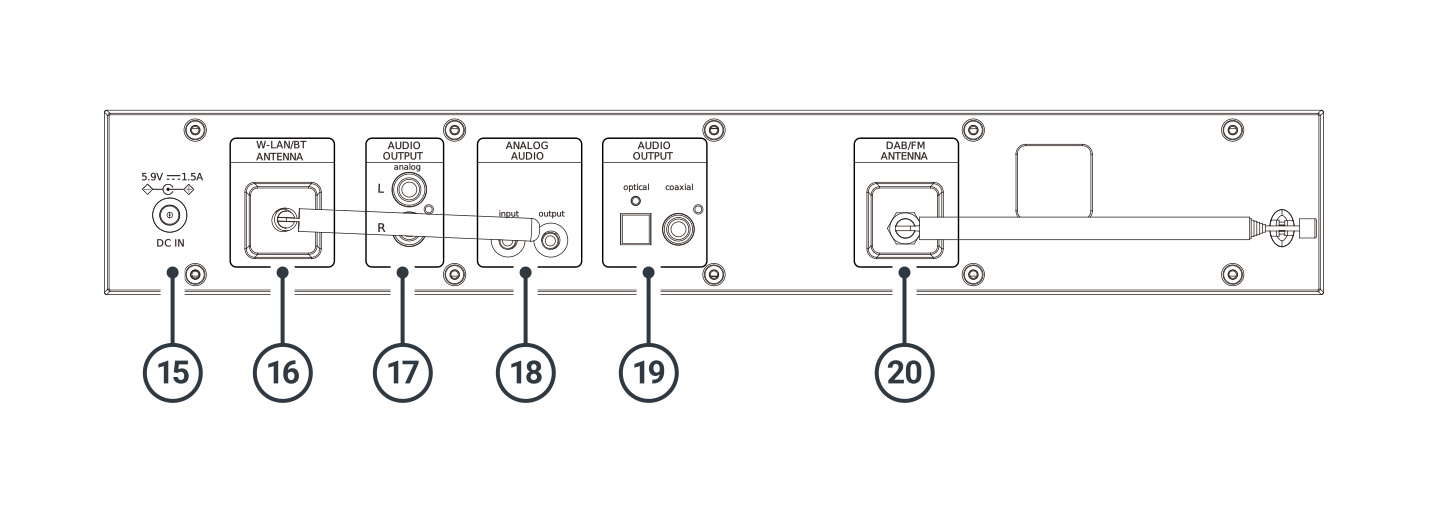
Back View
DC INDC IN
5.9V 1.5A5.9V 1.5A
W-LAN/BTW-LAN/BT
ANTENNAANTENNA
RR
LL
OUTPUTOUTPUT
AUDIOAUDIO
analoganalog
OUTPUTOUTPUT
AUDIOAUDIO
opticaloptical coaxialcoaxial
DAB/FMDAB/FM
ANTENNAANTENNA
ANALOGANALOG
AUDIOAUDIO
inputinput outputoutput
(https://www.majority.co.uk/wp-content/uploads/2021/05/Fitzwilliam-Diagrams-Updated-2.svg)

15. DC power Port
1. W-LAN/BT Antenna,
17. Audio Output
1. Analog Audio Input/Output
19. Optical & Coaxial Output
20. DAB/FM Antenna
Remote Control
23. Power/Standby
24. Dimmer
25. Equaliser
2. Back/Previous
27. Forward/Next
2. Menu
29. Up
30. Left
31. Volume Down
32. Favourites
33. Mute
34. Alarm
35. Sleep
3. Paly/Pause
37. Mode
3. Back
39. Right
40. OK
41. Down
42. Volume Up
43. 0-9 Number Selection
44. Info
Instructions Guide
Please note all (Ref.) refer to the Controls and Functions in the above diagrams.
Navigation Settings
Power/Volume Dial: This should be used to turn your system on and into Standby. To put into standby, press
and hold the dial (Ref.13). The time, date and any settings set such as alarms will be displayed.
When switched on, you will be taken to the last function used before putting into standby.
Rotate the dial to change the volume.
Navigation/OK Dial: Rotate the dial clockwise or anticlockwise to scroll through choices. Press down the dial
to conrm.
Mode Button: Press the Mode button to display and select from available modes.
Menu Button: Enter system menu options.
Info Button: In Internet Radio, DAB/DAB+ or FM mode, use the Info button to scroll through station
information.
Play/Pause, Rewind and Fast-Forward Buttons: Use in particular modes to skip backwards and forwards
through media, as well as pausing and playing.
Basic Operation
Starting Up Your Radio
Plug the adaptor connector into the back of the system labelled ‘DC in’ (Ref.15) and turn the power on. The
system will power up and display a ‘MAJORITY’ screen.
Ensure that the WLAN antenna and DAB/FM antennas are screwed onto the unit via the WLAN port (Ref.16)
and DAB/FM port (Ref.21).
After this, a ‘Setup Wizard’ will display. Press down the ‘Navigation/OK’ dial (Ref.3) or the OK button on the
remote (Ref.40) to conrm you have read the information.
Once conrmed, the screen will display “Start now?”. Highlight “Yes” with the Navigation dial or the remote,
and conrm start by pressing down the dial or the OK button on the remote.
After this, conrm whether you would like the clock display to be 12 or 24 hours. Highlight your chosen option
with the Navigation dial or the remote, and conrm your choice.
Auto Update options will display. This will allow you to update the time through one of the available modes:
DAB, FM and Network, or no update. Highlight your chosen option and conrm your choice by pressing down
the dial or the OK button on the remote.
“Set timezone” will now display. Select this so that the unit will display the correct time for your region. Scroll
through the available options with the Navigation dial or the remote, and conrm the choice.
Now choose your Daylight savings settings. Highlight your chosen option with the Navigation dial or the
remote, and conrm your choice.
Now select whether you would like to keep the network connected. We would advise selecting the “Yes”
option for ease of use.
The “Wlan Region” options will now display on the screen. Highlight your chosen option (Europe or Australia)
with the Navigation dial or the remote, and conrm choice.
The unit will now begin scanning for available networks. Once completed, the available networks will display.
Scroll through the available options with the Navigation dial or the remote, and conrm your WiFi network by
pressing down the dial or the OK button on the remote.
Change your default language in System Settings.
There are also options for “Rescan”, “Wired” or “Manual Cong” that can be found under section ‘Additional
WiFi Connection Settings’.
Connecting to WiFi
Once the available networks display for view, scroll through the available options with the Navigation dial
(Ref.3) or the remote, and conrm your WiFi network by pressing down the dial or the OK button on the
remote (Ref.40).
Once on your chosen network, three options should display: Push Button, PIN or Skip WPS. Select Skip WPS if
your WiFi router does not have a WPS button.
WPS/PIN Setup
If “Push Button” is selected, this will initiate a WPS search connection to the WiFi. Whilst the Fitzwilliam is
searching, select the “WPS” button on your WiFi modem.
This will connect your WiFi to your radio without the requirement to input the password.
If “PIN” is selected, a PIN will display on the Fitzwilliam screen. If your WiFi is capable of inserting a PIN, enter
the code into your WiFi network.
Manual Setup
If “Skip WPS” is selected, you can manually enter the WiFi password on the Fitzwilliam with the Navigation
dial or using the navigation buttons on the remote control.
Once your chosen letter or number is displayed, conrm the digit by pressing down the dial or press the ‘OK’
button on the remote. Continue this process until the WiFi password is displayed and conrm the password
by navigating and selecting “OK” on the display screen. To go back a digit, select the ‘BKSP’ option.
Once connected, the screen will display “Connected”, followed by a display of the available modes/settings in
a list.

Additional WiFi Connection Settings
When available networks display on the unit, “Rescan”, “Wired” or “Manual Cong” will also display as
additional options for WiFi connectivity.
Rescan
Select this option with the Navigation/OK dial (Ref.3) or the OK button on the remote (Ref.40) to initiate a
rescan for available WiFi networks.
Manual Conguration
The following options are available:
Wireless (WLAN) – DHCP Enable: Select Wireless > DHCP enable > Enter SSID (network name). A network
key may need to be added.
Wireless (WLAN) – DHCP Disable: Assumes DHCP server is active but network information such as IP
address, subnet mask, gateway address and DNS will need to be entered.
Internet Radio
On rst setting up, a list of available modes will display. Select “Internet Radio” from this list using the
Navigation/OK dial (Ref.3) or the OK button (Ref.40).
Alternatively, press the ‘Mode’ button on the unit (Ref.4) or on the remote (Ref.37) repeatedly until Internet
Radio mode is selected.
The following options will display:
Last Listened
This will display a list of stations previously listened to.
Station List
Select this option to browse through a range of internet radio category options: My Favourites, Local United
Kingdom, BBC, Stations, Podcasts, My Added Stations and Help.
Local United Kingdom (or Chosen Location) – Depending on the location set during the “Set Timezone”
option on set-up, stations for that location will display and are separated by genre. There is also the option to
explore All Stations.
BBC – Select this option to scroll through all available BBC stations, including national and region-specic
stations.
Stations – Select to access all available stations on the radio and narrow down by Location, Genre, Popular
Stations or New Stations. You can also search for stations via this menu option:
Search Stations – Manually type in a station with the Navigation dial or using the navigation buttons on the
remote. Once your chosen letter or number is displayed, conrm the digit by pressing down the dial or press
the ‘OK’ button on the remote. Continue this process until the station name is displayed and conrm by
selecting “OK” on the display screen.
Podcasts – Browse through a variety of podcasts by Location and Genre. Search for a podcast by manually
typing in the podcast name.
Help – Select this option for additional options such as obtaining an access code and viewing frequently
asked questions.
System Settings
Select this option to open System Settings for the unit. For more information on this, please refer to section
‘System Settings’.
Main Menu – Press to view all available modes and settings.
Internet Radio: Station Information
Station information is sometimes displayed by the station broadcaster. This can be viewed when listening to
particular stations. If the station is broadcasting information, the ‘Info’ button on the unit (Ref.12) or on the
remote (Ref.44) can be used to scroll through the following information:
Programme Information – Displays artist and song currently being played on the station.
Description – This shows the type and description of the programme provided by the station.
Genre and Show Country – Genre of the station and where it is available.
Reliability – Reliability of signal strength
Bit Rate, Codec and Sampling Rate – The data rate at which the signal is being transmitted.
Playback Buffer – Displays the speed of station buffering
Today’s Date – Displays the date as provided by the broadcaster.
Internet Radio, DAB/DAB+ and FM Presets
Presetting a Radio Station
When you have found your desired station, hold down the Memory button on the unit (Ref.5) or the ‘FAV’
button on the remote (Ref.32) for 2-3 seconds to go to the ‘Save to Preset’ screen. Alternatively, if you want to
save to preset number 1-10, press and hold the corresponding number on the remote control for 2-3 seconds.
Once the preset number has been located that you wish to save to, conrm your choice. Preset slots without
allocated stations will display “[Not Set]”. Once saved, the screen will display “Preset Stored”.
Recalling a Preset Radio Station
To view your preset stations, press the ‘Memory’ button on the unit (Ref.5) or the ‘FAV’ button on the remote
(Ref.32) to open ‘Recall from Preset’. Do not hold down the button as this will open a preset store and not
preset recall. Alternatively, recall preset numbers 1-10 by pressing (do not hold) the corresponding number on
the remote.
When ‘Recall from Preset’ options are displayed, use the Navigation/OK dial (Ref.3) or the remote to scroll
through the preset stations. Conrm your choice to begin playing the station.
DAB/DAB+ Radio
Press the ‘Mode’ button on the unit (Ref.4) or on the remote (Ref.37) until DAB/DAB+ mode is selected.
Ensure that the antenna is screwed on and connected to the DAB/FM antenna port at the back of the system
and fully extended.
When selecting DAB/DAB+ Radio mode for the rst time, the system will begin scanning for available
stations. The screen will display “Scanning…” while scanning.
Once stations have been scanned, they will display in a list. If you wish to rescan for available stations, press
the Menu button on the unit (Ref.6) or on the remote (Ref.28) and select “Scan”. The radio will now begin
scanning for DAB stations. The number of detected stations will be displayed.
Once all available stations have been found, a list will display. To scroll through the available stations, use the
Navigation/OK dial on the unit (Ref.3) or the Up/Down buttons on the remote control (Ref.29/Ref.41) and
select a station by highlighting the station and pressing down the dial (Ref.3) or the OK button (Ref.40).
The station will begin to play. To select the previous or next station, go back to the list and use the navigation
dial or the remote navigation buttons to scroll accordingly.
DAB/DAB+ Radio Settings
In DAB/DAB+ mode, press the MENU button on the unit or on the remote control to open DAB/DAB+ settings.
You will be able to view the following options:
Station List
Browse through the available DAB/DAB+ stations.
Scan
Initiate a scan for available stations.
Manual Tune
Browse through available stations by multiplex and frequency.
Prune Invalid
To remove stations that are listed but unavailable, you can turn on the ‘Prune’ setting. To switch on the Prune
setting, select “Yes”.
DRC (Dynamic Range Compression)
Select this option to reduce the volume of louder sounds and boost the volume of quiter sounds. Choose
between High, Low or Off.
Station Order
Select the order that you would like the DAB/DAB+ stations to display in. Options include alphanumeric,
ensemble and valid.
System Settings – Select to open system settings. Further guidance on these options can be found under
section ‘System Settings’.
Main Menu – Select to view available modes.
DAB/DAB+ Station Information
Whilst playing a DAB/DAB+ station, the following station information can be viewed by pressing the ‘Info’
button on the unit or on the remote.
Programme Information: Displays artist and song currently playing.
PTY (Programme Type): This shows the type and description of the programme provided by the DAB station.
Channel and Frequency: Displays the station transmission channel number and frequency.
Signal Error/Strength: Displays station signal strength.
Bit Rate, Codec and Sampling Rate: The data rate at which the signal is being transmitted.
Today’s Date: Displays the date as provided by the broadcaster.
FM Radio
Press the ‘Mode’ button on the unit (Ref.4) or on the remote (Ref.37) until FM mode is selected.
Ensure that the antenna is screwed on, connected to the DAB/FM antenna port at the back of the system
(Ref.21), and fully extended.
On rst use of FM radio, the FM frequency “87.5 MHz” will display on the screen. To initiate an automatic
scan up the bandwidth to the next available station, press down the Navigation/OK dial (Ref.3) or on the
remote (Ref.40). Repeat to scroll through available stations.
Use the Navigation/OK dial or the remote to scroll through the frequencies. Scroll clockwise or press up on
the remote to manually scroll up the bandwidth and scroll anti-clockwise or press down to manually scroll
down the bandwidth.
FM Radio Settings
In FM mode, press the MENU button on the unit (Ref.6) or on the remote control (Ref.28) to open FM
settings. Here you can scroll through the following options:
Scan Setting
Select whether you would like to scan for all stations, or for stations only with a strong signal. Once selected,
the screen will display “Strong stations only?”. To scan only for stations with strong signal, select “YES”.
Audio Setting
All stereo stations are reproduced in stereo; for weak stations this can result in poor audio quality. The audio
quality in FM mode can be improved by using mono audio mode.
Select whether to listen to the audio in stereo or mono. Once selected, the screen will display “Listen in Mono
only?”. To listen in Mono, select “YES”. To listen in Stereo, select “NO”.
System Settings – Select to open system settings. Further guidance on these options can be found under
section ‘System Settings’.
Main Menu – Select to view available modes.
FM Station Information
Whilst playing an FM station, the following station information can be viewed by pressing the ‘Info’ button
(Ref.12) on the unit or on the remote (Ref.44).
Programme Information: Displays artist and song currently being played.
PTY (Programme Type): Shows the type and description of the programme provided by the DAB station.
Frequency: Displays the station transmission frequency.
Today’s Date: Displays the date as provided by the broadcaster.
Spotify Connect (in applicable models)
Please note that this is only compatible in applicable models.
Setup
Connect your Majority Fitzwilliam to your wi network
Open up the Spotify app on your phone, tablet or laptop using the same wi network.
Play a song and select Devices Available.
Select your Majority Fitzwilliam and start listening.
Use your phone, tablet or computer as a remote control for Spotify. Go to spotify.com/connect to learn how.
The Spotify Software is subject to third party licenses found here:
www.spotify.com/connect/third-party-licenses
Music Player
Press the ‘Mode’ button on the unit (Ref.4) or on the remote (Ref.37) repeatedly to scroll through to Music
Player mode.
USB Playback
Select USB mode and insert a USB stick (Ref.1) with les. Conrm the device and highlight the desired
folder/song with the Navigation/OK dial (Ref.3) or the navigation buttons on the remote and select the OK
button (Ref.40) to play audio.
Please ensure that the USB stick is formatted as FAT16 or FAT32.
My Playlist
You can create a playlist on the Fitzwilliam using ‘USB Playback’ settings.
On ‘USB Playback’ settings, choose the le to be added to the playlist. Press and hold the Navigation/OK dial
or OK button on the remote for approximately 3 seconds until the display shows “Added to Playlist”.
You can also use playlists that were created on your Windows PC.
To remove les from the playlist, choose the le and then press and hold down the Navigation/OK dial for 3
seconds.
The screen will then display “Delete from My Playlist?”. Conrm the delete by selecting “YES”.
Repeat Play
Switch between turning the repeat playlist function ON and OFF.
Shue Play
Switch between turning shue playlist ON and OFF.
Clear My Playlist
Select this option to clear the whole playlist saved in “My Playlist”.
Prune Servers
Reset the list of connected servers by selecting “YES”.
Bluetooth Mode
Press the ‘Mode’ button on the unit (Ref.4) or on the remote (Ref.37) repeatedly until Bluetooth mode is
selected.
Go to your device’s Bluetooth settings to connect your chosen device to the radio via Bluetooth.
Please note that the radio only takes Bluetooth input from devices such as a phone or tablet.
The device will display on your Bluetooth device as “Majority Fitzwilliam”. Select the radio from your device
and the connection will begin.
Select your chosen audio on your device and play.
Once connected, skip, play and pause the playing audio from the unit, remote control, or from your device.
AUX-In Mode
Press the ‘Mode’ button on the unit (Ref.4) or on the remote (Ref.37) repeatedly until AUX-In mode is
selected.
You can connect your phone or tablet with an AUX 3.5mm cable that connects to the Audio-in jack on the
back of the unit (Ref.17).
Connect the AUX cable from the back of the Fitzwilliam into the device that you wish to play media from.
You can now begin playing media from your device. Ensure that the volume on the device is switched up for
the best sound quality.
Note: When using playback in AUX mode, the buttons on the remote control and on the
Fitzwilliam unit cannot be used to control media.
Dual Alarm Setting
Setting Alarm 1/Alarm 2
To set an alarm, select the ‘Alarm’ button on the remote control (Ref.12) or on the unit. Select ‘Main Menu’
and ‘Alarms’ to open alarm settings. Select Alarm 1 or Alarm 2 with the navigation dial (Ref.3) or OK button
on the remote (Ref.40) to begin setting an alarm:
Enable: Choose the frequency of your alarm (Daily, Once, Weekends and Weekdays). If “Once” is selected, the
date and time of the alarm will need to be set. Select ‘Off’ to turn off the alarm.
Time: The hour digits of the alarm will now begin to ash. Change the alarm hour with the Navigation dial or
Up/Down buttons (Ref.29/Ref.41). Press down the dial or the OK button to conrm. Follow the same steps to
set the alarm minutes.
Mode: Select between the following alarm wake-up tones: Buzzer, Internet radio, DAB and FM.
Preset: If internet, digital or FM radio is selected as your alarm tone, the station you last listened to on this
mode or one of your preset favourites can be set as your alarm tone.
Volume: Use the Navigation dial or Up/Down buttons on the remote to scroll to your chosen alarm volume.
Conrm the volume by pressing down the dial or the OK button.
Save: Once the above features have been set for the alarm, select ‘Save’ with the Navigation dial or OK button
to conrm. Once set, an alarm icon will display on the standby screen.
Setting: Alarm Features
How to Cancel Your Alarm
Cancel the alarm before it sounds by pressing the ‘Alarm’ button on the remote control (Ref.34) or use the
‘Menu’ button on the unit. Select ‘Main Menu’ then ‘Alarms’ to open alarm settings.
Select the alarm that you would like to cancel (Alarm 1 or Alarm 2) with the navigation dial (Ref.3) or the OK
button (Ref.40). Select “OFF”. Save and conrm alarm switch off by pressing down the Navigation/OK dial or
the OK button.