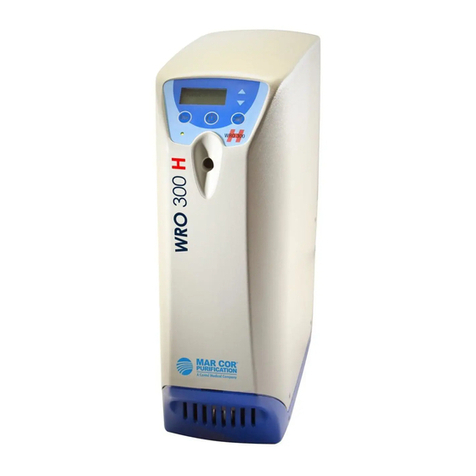
Mar Cor Purification 23G-SERIES User manual

Mar Cor Purification
23G-SERIES REVERSE OSMOSIS SYSTEM
Operation and Maintenance Manual
OS1157051 Rev. G 13July07


OS1157051 REV. G A 13-July-07
NOTICE
For personal and system safety, and for
optimum product performance, make sure
you thoroughly read and understand the
contents of this manual before installing,
using, or maintaining this product.

OS1157051 REV. G B 13-July-07
This page intentionally left blank.

OS1157051 REV. G 13-July-07
A
TABLE OF CONTENTS
1.0 GENERAL INFORMATION
1.1 General Description
1.2 The Manual
1.3 Safety Summary
1.3.1 Read This Manual
1.3.2 Use Proper Power Connections
1.3.3 Device Labeling
1.4 Flow Description
1.5 Machine Nomenclature
1.6 Machine Permeate Quality
1.7 Machine Features
1.8 Specifications for 23G Machine
1.8.1 RO Feedwater Specifications
1.8.2 Permeate (Product Water) Flow Rate
1.8.3 Concentrate Flow Rate
1.8.4 Primary Operating Pressure
1.8.5 Pump
1.8.6 Reverse Osmosis Machine Rejection
1.9 Service Assistance
1.10 Medical Membrane Element Specification for Water Purification
2.0 INSTALLATION
2.1 Machine Location
2.2 Pluming
2.2.1 Inlet Plumbing
2.2.2 Valve for Clean-In-Place (CIP)
2.2.3 Concentrate Outlet Connection
2.2.4 Permeate Outlet Connection
2.3 Electrical
2.4 Machine Lockout
3.0 PREPARATION AND START-UP
3.1 Pretreatment for Water Purification
3.2 Initial Start-up
3.3 Daily Start-up and Operation Checklist

OS1157051 REV. G 13-July-07
B
4.0 ECM-100 OPERATION
4.1 ECM-100 General Description of Operation
4.2 ECM-100 Displays and Controls
4.2.1 System Status Lights – Left Column
4.2.2 System Status Lights – Right Column
4.2.3 Keypad – Control Section
4.2.4 Keypad – Menu Select Section
4.2.5 Liquid Crystal Display (LCD)
4.2.6 ECM-100 Passcode
4.2.7 Factory Settings Storage
4.2.8 Display Menus
4.3 ECM-100 Operation
4.3.1 Selecting Parameters and Changing Settings
4.3.2 Responding to an Alarm
4.3.3 ECM-100 Clean-In-Place (CIP Operation)
4.4 ECM-100 Display Screens
4.4.1 ECM Display Screen Hierarchy
4.4.2 Detail of Date and Time Operation (Menu 01)
4.4.3 Detail of Alarm Limits Operation (Menu 02)
4.4.4 Detail of Timer Presets Operation (Menu 03)
4.4.5 Detail of Accumulated Hours Operation (Menu 04)
4.4.6 Detail of Log Tables Operation (Menu05)
4.4.7 Detail of Calibration Operation (Menu 06)
4.4.8 Detail of Print Current Values Operation (Menu 08)
4.4.9 Detail of Metric/US Select Operation (Menu 09)
4.4.10 Detail of Perm High Conductivity Alarm Operation (Menu 10)
4.4.11 Detail of Factory Settings Operation (Menu 11)
4.4.12 Detail of Auto-On Tank Full Operation (Menu 12)
4.4.13 Detail of Comm Port Speed Operation (Menu 13)
5.0 MACHINE OPERATION AND MAINTENANCE
5.1 Daily Requirements
5.2 Weekly Requirements
5.3 Quarterly Requirements
5.4 Semi-annual Requirements
5.5 Annual Requirements
5.6 Flushing

OS1157051 REV. G 13-July-07
C
5.7 Step-Wise Cleaning
5.7.1 Installation of the 23G CIP
5.7.2 General Clean-In-Place Procedure
5.8 Sanitizing Using a CIP System
5.9 Membrane Element Cleaners and Sanitizers for 23G Machines
5.10 Pre-filter Replacement Procedure
5.11 Recording Performance Data
5.12 Preparing Machine for Movement
5.13 Membrane Element Replacement
5.13.1 Membrane Element Removal
5.13.2 Membrane Element Installation
5.14 Flow Control Adjustments
5.14.1 Leaks
5.15 Permeate Divert
5.16 Product Water Pressure Relief
6.0 OPTIONAL FEATURES AND ACCESSORIES
6.1 Level Controls
6.2 PH Controller/Sensor (ECM-100-pH)
6.3 Remote Alarm Interface - Six Channel
6.4 Printer/Computer Interface
6.4.1 Printer Interface
6.4.2 Computer Interface
6.4.3 Computer Connection
6.4.4 Printer Connection
6.4.5 Print Test
6.4.6 Print Functions
7.0 TROUBLESHOOTING
7.1 Emergency Alarm Bypass
7.1.1 Permeate Conductivity High or Rejection Low Alarms
7.1.2 Rejection Low Alarm Due to Failed Feed Conductivity Probe
7.1.3 Temperature High Alarm
7.1.4 pH Alarms
7.1.5 Pressure
7.1.6 Permeate Flow (Stuck at Zero)
7.2 General ECM-100 Reference/Troubleshooting Guidelines
7.2.1 Resetting the ECM-100
7.2.2 Check the Main Board Terminal Strip for Good Connections
7.2.3 Check the Relay Board Terminal Strip for Good Connections
7.2.4 Low Rejection Warning (Due to High Purity Feedwater)
7.2.5 Verifying the Temperature Circuitry of the Main Board
7.2.6 Difficulty Calibrating Permeate Conductivity
7.2.7 Information to Obtain Before Contacting Your Equipment Supplier

OS1157051 REV. G 13-July-07
D
8.0 23G SOFTWARE
8.1 Calibration Procedures – Version 2 Software
8.2 pH Calibration Procedure – Software Version V2
8.3 V2 Logic Board
8.4 Temperature Calibration Procedure – V2
8.4.1 Cleaning the Feed Conductivity Sensor
8.4.2 Calibrating the Temperature
8.5 Conductivity Calibration Procedure – V2
8.5.1 Measuring the Conductivity of Feed and Permeate Samples
8.5.2 Verifying the Percent Rejection Reading on the ECM-100
8.5.3 Displaying the Feed Conductivity on the ECM-100
8.5.4 Calibrating the Feed Conductivity
8.5.5 Restoring the Rejection Low Alarm Setting
8.5.6 Calibrating the Permeate Conductivity
8.6 Pressure Transducer Calibration Procedure – V2
8.7 Flow Calibration Procedure – V2
8.7.1 Calculating Permeate Flow Rate
8.7.2 Calculating Concentrate Flow Rate
8.7.3 Calibrating the Concentrate and Permeate Flow Rate Offsets
8.7.4 Verifying the Concentrate and Permeate Flow Rate Slopes
8.7.5 Calibrating the Concentrate and Permeate Flow Rate Slopes
9.0 RETURNED GOODS AUTHORIZATION PROCEDURE
10.0 SERVICE ASSISTANCE
11.0 SPARE PARTS LISTS
Valves
Prefilters
6-Channel Remote
Flow Block and Connectors
Pump and Motor Assemblies (Three-phase, 60 Hz)
Pump and Motor Assemblies (Three-phase, 50 Hz)
Pump and Motor Assemblies (Single-phase)
Sensor
Electrical
Membrane Elements
4-inch Housing Spare Parts
Test Kits
Clamps
Miscellaneous

OS1157051 REV. G 13-July-07
E
List of Figures
Figure Title
1.1 Membrane Element with Interconnectors
1.2 System Schematic
1.3 Typical Flow Diagram for 23G Systems
2.4 Three-Phase Motor Wiring
4.5 ECM-100 Front Panel
4.6 23G Series ECM-100 Main Board Electrical Diagram
4.7 23G Series ECM-100 Relay Board Electrical Diagram
5.8 Brine Seal at the Exit End
5.9 Membrane Element Installation
5.10 Cross-Sectional View Membrane Element and Housing
5.11 Flow Control Manifold
7.11 ECM-100
List of Tables
Table Title
1.1 23G Model Number Matrix
1.2 Shipping Weights and Dimensions
2.3 Single-Phase Electrical Connections
2.4 Three-Phase Electrical Connections
4.5 ECM-100 Alarm Settings
4.6 ECM-100 Timer Settings
5.7 Dry Chemical Cleaners
5.8 Liquid Chemical Cleaners
6.10 Example of ECM-100 History Log

23G-Series RO System
OS1157051 Rev G 1 13-July-07
1.0 GENERAL INFORMATION
1.1 General Description
CAUTION:
When used as a medical device, Federal law restricts this device to sale
by or on the order of a physician, per 21 CFR 801.109 (b).
Your Mar Cor Purification 23G reverse osmosis machine is a durable
piece of equipment which, with proper care, will last for many years.
These instructions give operating and maintenance details vital to the
sustained performance of the machine.
Reverse Osmosis (RO) is the separation of one component of a solution
from another component by means of pressure exerted on a
semipermeable membrane. In other words, reversing the natural passage
of a liquid from a concentrate solution to a more dilute solution by using
external pressure. Removal of ionic, organic, and suspended/dissolved
impurities occurs during the RO process. Unlike a filter, which separates
by “normal” filtration, the membrane element separates using a process
called cross-flow filtration. Feedwater solution is separated into two
streams, permeate and concentrate, and collected from both sides of the
membrane. A semipermeable RO membrane, under sufficient pressure,
allows passage of purified water while rejecting and concentrating
dissolved and suspended solids.
Mar Cor Purification manufactures a spiral-wound membrane package,
with turbulent flow design. This membrane element module collects the
purified water within a central tube (permeate tube), as represented in
Figure 1.1.
Figure 1.1 Membrane Element with Interconnectors
Permeate Tube
Permeate
Concentrate
Feed Solution
Brine Seal
Permeate Carrier
Membrane
Feed Channel Spacer
Outer Wrap
Feed Channel Spacer
Membrane

23G-Series RO System
OS1157051 Rev G 2 13-July-07
1.2 The Manual
This manual has been prepared to provide the operator with information
on the installation, operation, maintenance, and troubleshooting of 23G
Water Purification Systems.
The manual is supplemented with drawings and schematics for
clarification whenever possible.
1.3 Safety Summary
The safety summary does not contain all of the safety statements in the
manual. Other safety statements are included within the manual text and
are enhanced and defined as follows:
NOTE:
Indicates statements that provide further information and clarification.
CAUTION:
Indicates statements that are used to identify conditions or practices that could
result in equipment or other property damage.
WARNING:
Indicates statements that are used to identify conditions or practices that could
result in injury or loss of life. FAILURE TO FOLLOW WARNINGS COULD
RESULT IN SERIOUS INJURY OR DEATH TO HEMODIALYSIS PATIENTS OR
OPERATOR.
1.3.1 Read This Manual
Prior to operating or servicing this device, this manual must be read
and understood. Keep it and other associated information for future
reference and for new operators or qualified personnel near the
machine.
1.3.2 Use Proper Power Connections
Use proper wiring and connection methods as stated in this
manual.
1.3.3 Device Labeling
Do not, under any circumstances, remove any Caution, Warning, or
other descriptive labels from the devices until the conditions
warranting the label are eliminated.
Operating definitions are provided to help you further understand
your machine:

23G-Series RO System
OS1157051 Rev G 3 13-July-07
Permeate Rate [Product Water Rate (Qp)]
Permeate rate is the flow rate of purified water which has passed
through the membrane and out of the membrane element;
expressed in gal/min (gpm) or gal/hr (gph) [in metric, liter/min (Lpm)
or cubic meters/hour (m3/h)]. Specified permeate rates are
normally at 77°F (25°C).
Concentrate Rate [Waste Water Rate (Qc)]
Concentrate rate is the flow rate of water containing rejected solids
to drain in gpm or gph (Lpm or m3/h).
Feed Rate (Qr)
Feed rate is the flow rate of incoming water in gpm or gph (Lpm or
m3/h). Feedwater rate equals permeate rate plus concentrate rate.
Recovery
Recovery is the percentage (%) of feedwater converted to
permeate. For example, 75% recovery means that out of a given
feed rate, 75% is produced as pure water (permeate).
Concentration
Concentration equals the Total Dissolved Solids (TDS) of any
stream (feedwater, concentrate or permeate) of a solution
expressed as milligrams per liter (mg/L) or conductivity
(microSiemens/cm).
Cf= Feed Concentration
Cp= Permeate Concentration
Cc= Concentrate Concentration
Cavg = Average Concentration in Machine
Salt (Ionic) Rejection
Salt (Ionic) Rejection is the percent of dissolved salt rejected by the
membrane, calculated from an average concentration over the
membrane.
Salt (Ionic) Passage
Salt (Ionic) Passage is the percent of dissolved salts passed
through the membrane.

23G-Series RO System
OS1157051 Rev G 4 13-July-07
Primary Pressure (Pp)
Primary Pressure (Pp) is the pressure between the pump discharge
and the feed port of the first membrane element housing.
Final Pressure (Pf)
Final Pressure (Pf) is the pressure between the concentrate outlet
of the last housing and the concentrate valve.
Pre-filter Pressure (Ppre)
Pre-filter Pressure (Ppre) is the water pressure entering the pre-filter.
Post-filter Pressure (Ppost)
Post-filter Pressure (Ppost) is the water pressure leaving the pre-
filter.
Membrane Elements
Membrane elements are the key to reverse osmosis. Interleaved
layers of semipermeable membrane, spacer and permeate carrier
spiraled around a central permeate tube make up the element. The
spacer allows for movement of the concentrate past the membrane,
and the permeate carrier carries the pure water out of the
membrane element. The elements that Mar Cor Purification uses
are spiral-wound membrane elements with a turbulent flow design.
The membrane element collects the permeate water within the
central tube, called the permeate tube.
Figure 1.2 System Schematic
Recovery 75%
100 mg/L Cavg
Feed
Pump (Cf)
(Qf)
24 gpm
Membrane Porous
Backing Material
375 mg/L
6 gpm
8.3 mg/L
18 gpm
(Cc)
Concentrate
(Qc)
(Cp)
Permeate
(Qp)

23G-Series RO System
OS1157051 Rev G 5 13-July-07
An example of how to calculate salt rejection and recovery:
Average Concentration (Cavg) = (Cf) + (Cc) 100 mg/L + 400 mg/L = 250 mg/L TDS
2 2
Rejection = (Cavg) - (Cp)x 100 250 - 6.2 x 100 = 97.5%
(Cavg) 250
Passage = (Cp)x 100 6.2 x 100 = 2.5%
(Cavg) 250
Recovery = (Qp)x 100 6 gpm x 100 = 75%
(Qf) 8 gpm
1.4 Flow Description
The pretreated feedwater passes through a disposable 5 micron cartridge
filter (pre-filter) which removes suspended solids. Filtered water then flows
to the inlet control valve. This solenoid-actuated valve is controlled by
Enhanced Controller/Monitor (ECM-100) and opens when the machine is
turned on, allowing water to flow to the pump inlet. When the machine is
turned off, the valve closes, preventing laminar flow through the
membrane element, which would lead to shortened membrane life.
The pump feeds water to the membrane element housings in a series
and/or parallel configuration, depending upon the design flow rates. The
direction of water flow is indicated by an arrow on each membrane
element housing.
Permeate from each membrane element housing is collected at the
permeate manifold where a common check valve prevents backflow into
the membrane elements. A pressure sensor is provided to allow the ECM-
100 to monitor excessive backpressure and initiate an immediate alarm
and machine shutdown should the setpoint be exceeded. Permeate is
directed through a turbine flow sensor and contacts a conductivity sensor
before reaching the outlet point of the machine.

23G-Series RO System
OS1157051 Rev G 6 13-July-07
The concentrate leaves the last membrane element housing and flows into
the manifold block. This concentrated water is then divided into recycle
and concentrate streams. The recycle portion mixes with the feedwater by
returning to the inlet piping, allowing higher machine recovery while still
maintaining adequate crossflow through the membrane elements. The
concentrate valve on a 23G machine is used to increase the concentrate
flow rate for flushing. The normal concentrate flow rate is controlled by the
concentrate orifice. The concentrate valve or orifice has three functions: it
controls the amount of concentrate flowing to the drain; it controls the
pressure within the machine; and it helps control system recovery. A
solenoid-controlled Autoflush valve is also provided in the concentrate line
to provide periodic intervals of increased drain flow rate controlled by the
ECM-100. The concentrate portion leaving the manifold block is directed
through a turbine flow sensor before reaching the outlet point of the
machine.

23G-Series RO System
OS1157051 Rev G 7 13-July-07
Figure 1.3 Typical Flow Diagram for 23G Systems

23G-Series RO System
OS1157051 Rev G 8 13-July-07
1.5 Machine Nomenclature
Mar Cor Purification water purification machines are numbered in such a
way as to indicate the permeate flow and quality you can expect from the
machine. The nomenclature (model number) of your machine is shown on
the serial number label on the side panel of the machine.
Table 1.1
23G Model Number Matrix
RO, 23G XXXX, XXX, X, XX, XXXX
1.6 Machine Permeate Quality
23G machines use high rejection, polymeric membrane, providing the
ultimate in high purity water.
Rated Permeate Flow
GPD
3000
4500
6000
7500
9000
10500
12000
13500
15000
16500
Volts
208
230
460
380
Hertz
6=60
5=50
Recovery
50%
75%
Options
Single
Phase
W/Casters

23G-Series RO System
OS1157051 Rev G 9 13-July-07
1.7 Machine Features
Mar Cor Purification 23G Series machines contain an array of useful
standard features to provide additional system safety and reliability, to
simplify system monitoring and data collection, and to ensure the longest
membrane life.
Standard features include:
• 50% and 75% recovery models available.
• Multi-stage centrifugal stainless steel pump, submersible design.
• Enhanced controller/monitor (ECM-100); includes parameter
display, alarms, and machine status indicators.
• Automatic inlet shut-off valve.
• Common check valve in the permeate line to prevent backflow.
• Pre-filter housings and 5 micron cartridge filters.
• Pre- and post-filter pressure indication.
• Primary and final pressure indication.
• Permeate backpressure indication.
• Product water divert.
• Product water pressure relief.
• Concentrate and percent rejection indication for permeate quality
and membrane performance monitoring.
• Temperature indication for feedwater temperature monitoring.
• Membrane element housings made of all 304 stainless steel.
• Autoflush - programmable periodic high velocity membrane flushing
to maintain long membrane life. Set at factory and adjustable in the
field.
• Inlet low pressure alarm automatically shuts off the machine to
prevent pump damage, should inlet pressure fall to an inadequate
level.
• Components in contact with the RO water (permeate) are made of
either inert plastic (nylon, poly-ethylene, Noryl*, polypropylene,
PVC, EPDM, Nitrile) or stainless steel materials.
• Memory for more than 400 sets of historical operating data
(generated by approximately 2.5 full months of continuous
operation).
• Comprehensive alarm package, with adjustable limits and common
time-out, to ensure safety and proper operation. Alarm is both
visual and audible. Alarms include:

23G-Series RO System
OS1157051 Rev G 10 13-July-07
• high/low primary pressure (immediate shutdown on primary high
pressure)
• low inlet post-filter pressure
• high permeate pressure (immediate shutdown)
• high/low pH
• high temperature
• high permeate conductivity
• low permeate conductivity
• low permeate flow
• low percent rejection
• high pre-filter pressure drop
• high membrane pressure drop
NOTE:
All alarms except high primary pressure, high permeate pressure, and
high temperature are ignored in Clean in Place (CIP) mode.
*Noryl is a trademark of General Electric Company.

23G-Series RO System
OS1157051 Rev G 11 13-July-07
Specifications for 23G Machines
1.7.1 RO Feedwater Specifications
The rated flow for all machines in this section is based upon the
following feedwater specifications. Limits should not be exceeded
without consulting the factory.
Inlet Pressure Rated; 30 psi (2.1 bar)
Maximum; 60 psi (4.1 bar)
Minimum; 20 psi (1.4 bar)
Temperature135-77°F (2-25°C) not to exceed 85°F (29°C)
Langelier Saturation Negative 0.1
Index of Concentrate2
Continuous Free Chlorine (mg/L)3Less than 0.1 ppm
Silt Density Index4Less than 3
Iron 0 ppm
Other Impurities5
Pre-filter 5 micron cartridge(s)
Inlet Connection Thread 1-inch Female National Pipe (FNPT)
1. Continuous operation over 85°F (30°C) may cause
permanent decline in the membrane element performance.
Actual permeate flow rates typically increase/decrease by
1.4% for each 1°F change in temperature. For other
temperatures, use “Temperature Factor Chart” (Technote
113) to determine permeate rate. Contact authorized
equipment supplier if feedwater is outside these parameters.
This manual suits for next models
10
Table of contents
Other Mar Cor Purification Water Filtration System manuals
Popular Water Filtration System manuals by other brands

Watkins Wellness
Watkins Wellness Freshwater Salt System owner's manual

Wisy
Wisy Optima 4 Installation instructions manual

Lectranator Systems
Lectranator Systems ST 48 manual

Culligan
Culligan Drinking Water System owner's guide

Grunbeck
Grunbeck pureliQ:K Operation manual

Paramount Fitness
Paramount Fitness ClearO3 installation manual