Installation and Operation Manual - WHDEHUM-90P
7
return path to the dehumidier to improve overall
airow from other far apart rooms. CAUTION: Be
sure that grills and/or diffusers do not excessively
restrict airow.
Supply Ducting for Whole-House Separate Room
For the supply output ducting (output air from the
dehumidier), the total duct length should be less
than 10 feet total to reduce the back pressure on
the dehumidier blower. CAUTION: Be sure that
grills and/or diffusers do not excessively restrict
airow.
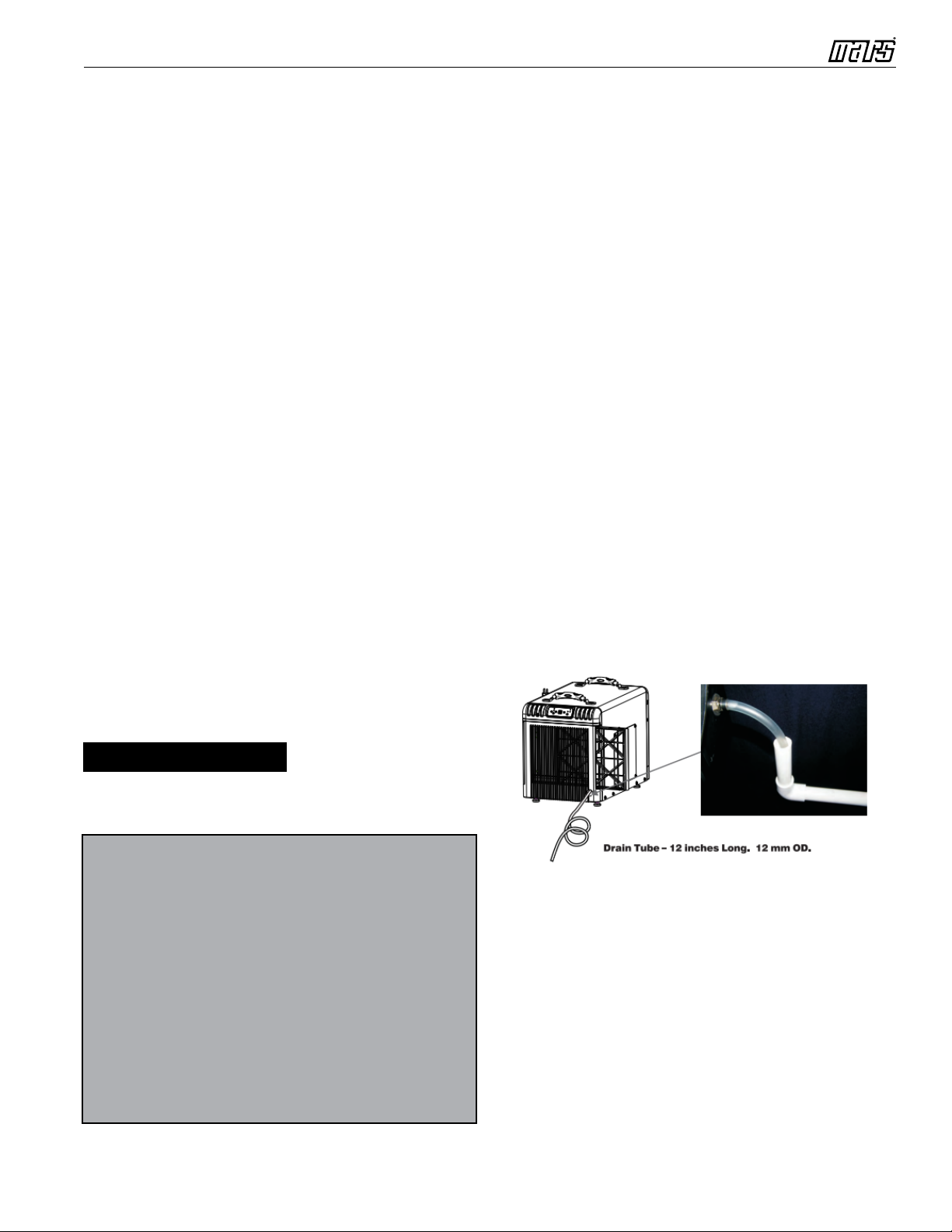
Ducting for Whole-House HVAC Conguration
For whole-house HVAC duct connections, please
reference Figures 2A and 2B on page 4. In both of
these congurations, the dehumidier is placed in
the return path of the HVAC system.
For Figure 2A, the dehumidier sources its return air
connection from the HVAC return connection, and
then the source air connection from the dehumidier
is fed back to the HVAC return air duct a few feet
downstream. For whole-house HVAC, this is the
most common, most effective, and easiest ducting
implementation to use. It is best because it is
dehumidifying the air ahead of the air conditioning
coil system to eliminate the wettest air rst ahead of
the HVAC coils. This enhances the overall cooling
system efciency. Also, by inputting air from the
HVAC return duct and returning the conditioned
air to the same HVAC return duct, there is not an
additional air pressure differential to overcome. In
this conguration, keep the length of the dehumidier
return and source ducting at a minimum.
For the second whole-house HVAC conguration,
please reference Figure 2B on page 4. The
difference from Figure 2A is that the dehumidier
return path is independent from the HVAC return
path. In this conguration, the dehumidier has its
own completely independent and dedicated ducting
and return air grill. This conguration is ideal when
there is a need to dry a specic conditioned or
unconditioned area. An example would be to feed
the separate room from the main living area, which
would maximize the airow from there, proving a
living area that likely is more dry than the other living
areas.
Discussed and illustrated here will be the basic
control scenario for three classes of dehumidier
control:
1. Standalone unit dehumidication
2. Whole-house separated dehumidication
3. Whole-house using high integration consolidated
thermostat and humidistat
SUD Congurations
No extra control wiring is required for SUD
congurations, as the dehumidier in this mode
operates completely standalone, sampling humidity
from the local air - and then using the settings made
by the user interface to either switch-on or switch-
off. Please reference the Operation section for
details on how to congure and use the dehumidier
in standalone congurations.
Whole-House Separated Room Congurations
This type can be controlled with the addition of a
single humidistat located in the living area that is
to be served by the dehumidier. See Figure 4 on
page 8 to guide specic hook-ups. For external
control, the dehumidiers are connected to the
control systems with the 6-position terminal strip as
illustrated.
Terminals A3 and A4 need to be powered to switch
the dehumidier on, typically connecting A4 to the
control voltage common signal (C) and switching
the 24VAC control hot signal (R) through a set of
normally open contacts typically integrated into
the separate humidistat. When the humidity rises
above the set-point, the humidistat contacts close,
which then connects the dehumidier pin A3 to
24VAC and switches the dehumidier ON.
To implement a required interlock with the HVAC
fan control, interconnect dehumidier terminal strip
connections A3 to A2 as illustrated below. Then,
connect the dehumidier terminal strip A1 back to
the HVAC “green” connection, which typically turns
the HVAC fan ON.
Also in the illustration below, please note the
functionality associated with dehumidier connections
A5 and A6. A5 and A6 can be used to interlock
the dehumidier to the condensate drain system.
Wiring