PRIMO TECHNICAL MANUAL Page
3
1 How a silent chiller works
Unlike the noisier compression cooling, absorption cooling has no moving parts and
is run by a heating element powered by electricity. It is important to remember that
the heat given off during the absorption and condensation processes must be
dispersed into the surrounding air, and therefore the units require adequate
ventilation space.
Absorption technology
Even though the process is more complex, we will try in a simple way to explain how
the system works. In order to do so, it is important to understand that there are 4
basic parts to an absorption cooling unit, these being:
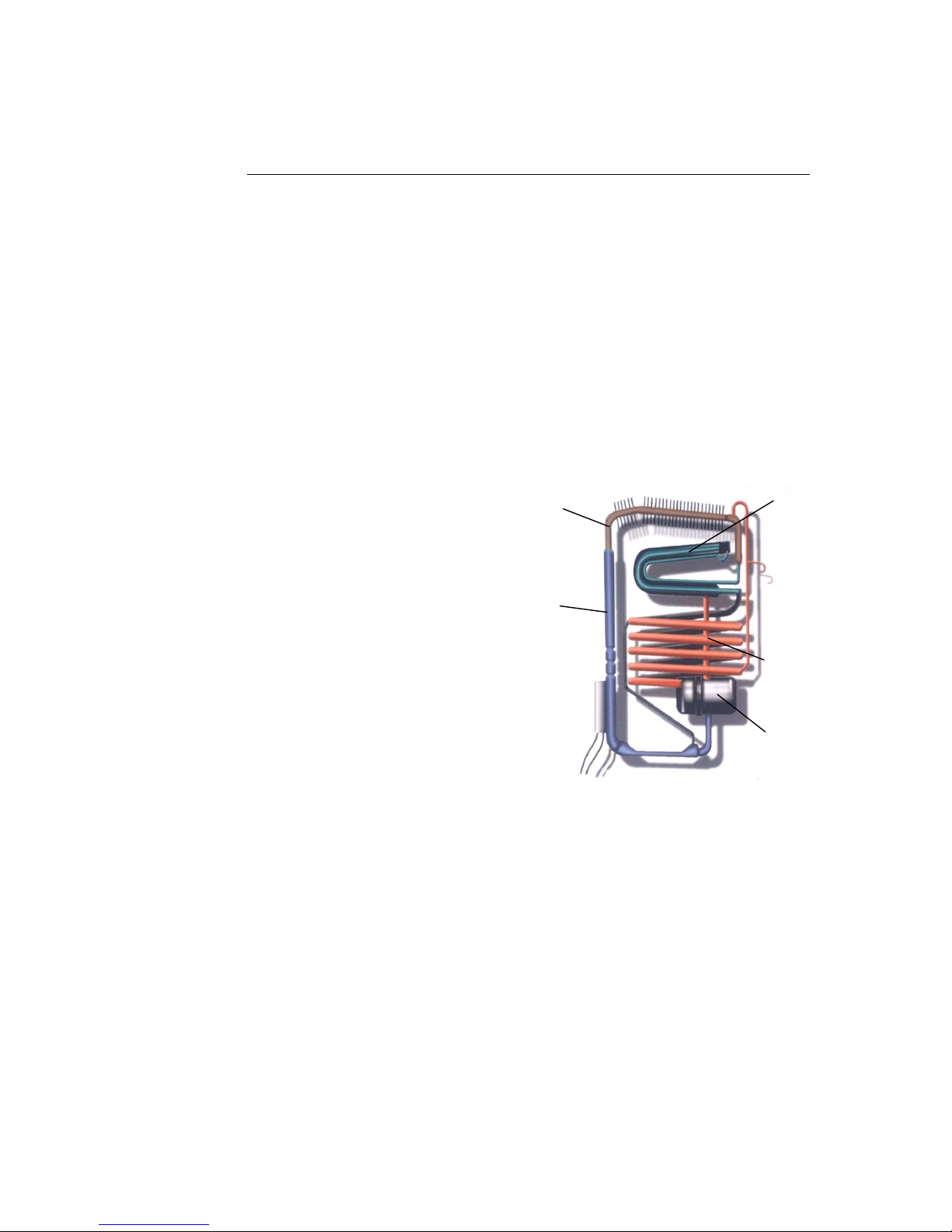
i. The reservoir-absorber
ii. The boiler pump
iii. The condenser
iv. The evaporator (most
commonly called the chiller)
The system works within a sealed
environment and with a solution
made basically of water, ammonia
and hydrogen.
The boiler pump electrically heats up
and boils the water with a high
concentration of ammonia, which
comes from the reservoir, and that
releases the ammonia now in a form
of gas. The ammonia gas rises to the
upper part of the system, called the
condenser, where, with the help
Illustration 1: Absorption cooling unit
of the cooling fins, it causes the temperature to drop, thus condensing only the
ammonia from gas to a liquid form.
This liquid and highly pure ammonia is then moved to the evaporator, where it meets
with hydrogen at different pressure, causing the ammonia to evaporate again. It is a
physical phenomenon that every time we have an evaporation there is a temperature
absorption. In other words, the process pulls the heat from the surrounding area,
consequently cooling the evaporator to a degree that frost is formed in the outer part
of it, and the temperature in the inside of the Minibar is lowered.
The evaporated ammonia, together with the hydrogen, then travel to the absorber,
where we have fairly pure water which, once it encounters the evaporated ammonia
gas, it absorbs it. This process is what gives the system its name, since here water is
absorbing ammonia. By gravity this water-ammonia solution travels through the
absorber coil, absorbing as much ammonia as possible, and ending at the reservoir.
Once in the reservoir, the water with a high content of ammonia passes again to the
boiler pump, where a new cycle then starts.
Boiler
pump