4Introduction
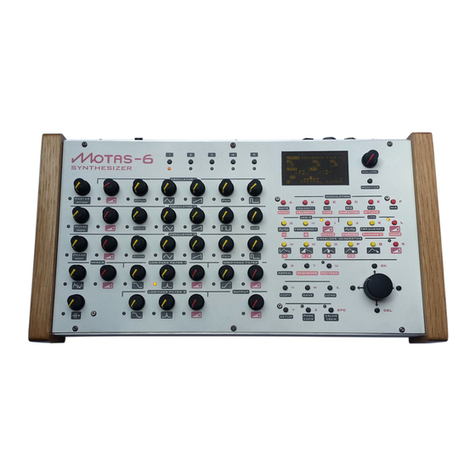
is a super-flexible monophonic syn-
thesizer with classic analogue subtractive synthe-
sis and powerful digital control - giving huge mod-
ulation possibilities.
• Fully analogue audio signal path
• Three analogue oscillators (VCOs) with freely
mixable waveforms:
–triangle (oscillators 1, 2 and 3)
–sawtooth (oscillators 1, 2 and 3)
–variable width pulse (oscillators 1 and 3)
–square and sub-oscillator (oscillator 2)
• Oscillator hard-syncing (multiple options)
• Analogue phase modulation (oscillators 2 and
3)
• Analogue noise souce (white or pink)
• Internal audio feedback or external audio in-
put
• 4 CV/gate inputs for analogue control
• Three independent analogue filters (VCFs) with
flexible routing:
–Low-pass resonant filter (6-pole with selectable
outputs and resonance character adjustment)
–Second low-pass resonant filter (4-pole)
–High-pass filter (2-pole)
• Multiple output distortion options
• Powerful modulation architecture:
–4 global LFOs (Low Frequency Oscillators)
–4 global EGs (Envelope Generators)
–33 parameter-local LFOs
–33 parameter-local EGs
–Four freely configurable modulation
sources from MIDI and CV/gate inputs
• Quick-access buttons to 5 active patches
• Copy/reset/randomise feature
• Full MIDI control and USB MIDI interface
• Oscilloscope and spectrum analyser
• Flexible arpeggiator
• Built-in pattern sequencer
• Non-volatile internal memory for saving 500 patches,
56 patterns, 16 sequences and user settings
• High-resolution OLED graphic display
• Compact high-quality tabletop case
Analogue oscillators
has three analogue voltage-con-
trolled oscillators (VCOs) with various hard-sync,
pulse-width and phase-modulation options. These
are true analogue oscillators and not DCOs. The
oscillators, analogue noise source (with white/pink
output option) and an internal feedback routing
or external audio input all feed into a mixer be-
fore the filters.
Analogue filters
has very powerful filtering capabil-
ities. There is a 6-pole voltage-controlled low-pass
filter (VCF) with adjustable resonance to self-oscillation
(with selectable 1, 2, 3, 4, 5 and 6-pole outputs),
a 2-pole high-pass filter and a second 4-pole low-
pass filter with adjustable resonance to self-oscillation
(similar in design to the filter from a certain silver
box from the 1980s. . . )
The filters can be chained in parallel or in series
and the outputs are separately mixable giving huge
sound-creation potential. The final audio output
has a variety of clipping distortion options.
Modulation
Each analogue-controlled parameter has its own
dedicated LFO and EG. In addition each param-
eter has dedicated modulation amount settings
from velocity, pitch, the global modulation sources
and the global LFOs and EGs. Secondary ’mod-
ulation of the modulators’ is also possible, for ex-
ample, a global modulation source can control
the LFO frequency. This allows very flexible and
powerful control of the analogue sound.
Up to four global modulation sources can be freely
defined from incoming MIDI controller data and/or
analogue signals on the CV/gate inputs.
User Guide v1.17 page 5