9
14 Transport
Do not throw, strike, or roll compressed air cylinders.
Never seize cylinders by the valve hand wheel, but by the valve housing only, otherwise there is
the risk to turn the cylinder valve open unintentionally.
For transport in a cylinder cart the upright position (cylinder valve upturned) has proven best. This reduc-
es the risk of valve damage by falling or lateral crashing.
For transport on public roads compressed air cyl-
inders filled to more than 2 bar pressure are sub-
ject to the hazardous material transport regula-
tions of GGVSE and ADR. The compressed air
cylinders or the transport package, respectively
must be labelled with the hazard label No. 2.2 ac-
cording to subsection 5.2.2.2 ADR (see Fig 5).
Fig 2
The individual components of a hazardous material cargo must be stowed and secured on a vehicle such
that they cannot shift their position to each other and to the vehicle walls (see ADR, Section 7.5.7.1).
A particular protection of the cylinder valves with suitable packaging is required, e.g. by protective crates
or – frames, since breathing air cylinders for compressed air breathing apparatus due to their design and
intended use do not have protection caps nor collars (see subsection ADR 4.1.6.4).
15 Safety Instructions
The following safety instructions refer to risks arising during the entire life span of a compressed air cylinder.
These risks may influence the safety of compressed air cylinders during transport, storage, assembly and
commissioning, in use, while checking or testing, at disassembly and scrapping.
The compressed air cylinder must not be subjected to strong mechanical strain!
The packaging of compressed air cylinders (e.g. pallets , cartons, crates) for storage and transport must
be designed adequately robust, to prevent damage to the compressed air cylinders. It must also be suffi-
ciently stable to resist the conditions of transport and storage. For selection of suitable packaging meth-
ods the cylinder weight must be taken into account.
The compressed air cylinder must not be distorted or damaged. If necessary, particular precautions must
be implemented to protect the compressed air cylinder from damage.
Strong damage may cause the bursting of compressed air cylinders!
During storage the compressed air cylinder must not be exposed to direct flames, nor to high or extremely
low temperatures. The permissible operating temperatures must implicitly be adhered to (see Cylinder
shoulder or hazmat label, respectively).
The permissible temperature range of the assembly group – cylinder with cylinder valve – must be
observed!
For operation of compressed air cylinders the same temperature range is applicable as that for storage.
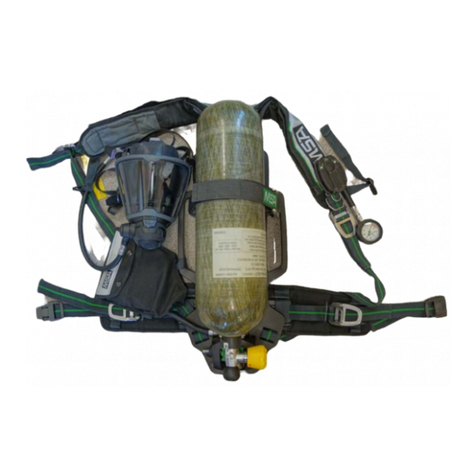
If necessary, protection against heat exposure must be used, e.g. the MSA Nomex-cylinder covers
(Mat.-Nos. D4075877 or D4075878). Temperatures beyond the permissible limits may cause changes of
the mechanical properties and the strength of the compressed air cylinder.
High and extremely low temperatures may cause the bursting of compressed air cylinders!
The compressed air cylinders must not be exposed to electric and magnetic fields heating them beyond
the maximum permissible temperature. The compressed air cylinders must be protected against lightning
stroke. If necessary suitable protection must be installed.
Excessive heating by electric or magnetic fields or by lightning stroke may cause the bursting of
compressed air cylinders!
For operation of compressed air cylinders the same temperature range is applicable as that for storage.
If necessary, protection against heat exposure must be used. Temperatures beyond the permissible limits
may cause changes of the mechanical properties and the strength of the compressed air cylinder.
High and extremely low temperatures may cause the bursting of compressed air cylinders!