manuals.online logo
Brands
  1. Home
  2. •
  3. Brands
  4. •
  5. MSI
  6. •
  7. Motherboard
  8. •
  9. MSI MS-6163VA User manual

MSI MS-6163VA User manual

Other MSI Motherboard manuals
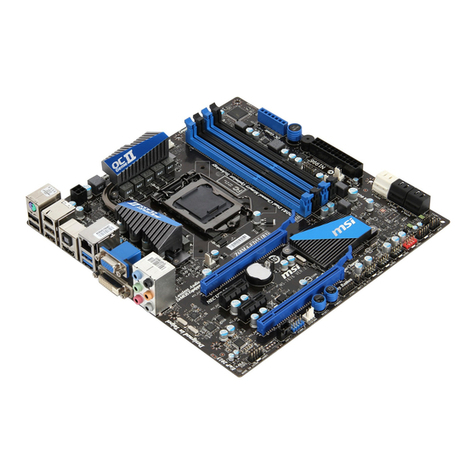
MSI P67A-GD65 Series User manual

MSI

MSI P67A-GD65 Series User manual

MSI B550-A PRO User manual

MSI

MSI B550-A PRO User manual

MSI Z87I User manual

MSI

MSI Z87I User manual

MSI MS-7255 User manual

MSI

MSI MS-7255 User manual

MSI MEG Z590 GODLIKE User manual

MSI

MSI MEG Z590 GODLIKE User manual

MSI A320M PRO-C User manual

MSI

MSI A320M PRO-C User manual

MSI MAG Z590 TORPEDO User manual

MSI

MSI MAG Z590 TORPEDO User manual

MSI MS-6380 LE2 User manual

MSI

MSI MS-6380 LE2 User manual

MSI 815EPT Pro User manual

MSI

MSI 815EPT Pro User manual

MSI H310M PRO-M2 PLUS User manual

MSI

MSI H310M PRO-M2 PLUS User manual

MSI B350 TOMAHAWK User manual

MSI

MSI B350 TOMAHAWK User manual

MSI 648 Max User manual

MSI

MSI 648 Max User manual

MSI PRO Series User manual

MSI

MSI PRO Series User manual

MSI 645 Ultra MS-6547 User manual

MSI

MSI 645 Ultra MS-6547 User manual

MSI B350M MORTAR ARCTIC User manual

MSI

MSI B350M MORTAR ARCTIC User manual

MSI MAG B660 TOMAHAWK WIFI DDR4 User manual

MSI

MSI MAG B660 TOMAHAWK WIFI DDR4 User manual

MSI RX480 Neo2 MS-7151 User manual

MSI

MSI RX480 Neo2 MS-7151 User manual

MSI Z87M GAMING User manual

MSI

MSI Z87M GAMING User manual

MSI MS-7293 Series User manual

MSI

MSI MS-7293 Series User manual

MSI MAG B660 TOMAHAWK WIFI DDR4 User manual

MSI

MSI MAG B660 TOMAHAWK WIFI DDR4 User manual

MSI MS-7364 User manual

MSI

MSI MS-7364 User manual

MSI GF615M User manual

MSI

MSI GF615M User manual

MSI B360I GAMING PRO AC User manual

MSI

MSI B360I GAMING PRO AC User manual

MSI B350M MORTAR ARCTIC User manual

MSI

MSI B350M MORTAR ARCTIC User manual

Popular Motherboard manuals by other brands

Gigabyte MNJ190I-FH user manual

Gigabyte

Gigabyte MNJ190I-FH user manual

Biostar HI-FI-Z87X-3D Setup manual

Biostar

Biostar HI-FI-Z87X-3D Setup manual

Atmel SAM9753PIA-DK user guide

Atmel

Atmel SAM9753PIA-DK user guide

Coapt GEN2 Handbook

Coapt

Coapt GEN2 Handbook

Supero SUPER P4DL6 user manual

Supero

Supero SUPER P4DL6 user manual

Cypress CY3210-PSoCEVAL1 quick start guide

Cypress

Cypress CY3210-PSoCEVAL1 quick start guide

ASROCK B660M-HDV manual

ASROCK

ASROCK B660M-HDV manual

Fujitsu D2831 Short description

Fujitsu

Fujitsu D2831 Short description

Industrial Computers ADE-6050 user manual

Industrial Computers

Industrial Computers ADE-6050 user manual

Asus TUF Z270 MARK 2 manual

Asus

Asus TUF Z270 MARK 2 manual

DFI NB71-BC user manual

DFI

DFI NB71-BC user manual

ASROCK H61 Pro BTC user manual

ASROCK

ASROCK H61 Pro BTC user manual

Norco POS-7893 user manual

Norco

Norco POS-7893 user manual

Intel DG965MS specification

Intel

Intel DG965MS specification

Asus B85M-VIEW PAKER user manual

Asus

Asus B85M-VIEW PAKER user manual

Asus P5G41T-M LX V2 user manual

Asus

Asus P5G41T-M LX V2 user manual

Gigabyte GA-K8VT800-RH user manual

Gigabyte

Gigabyte GA-K8VT800-RH user manual

Gigabyte Z790M AORUS ELITE user manual

Gigabyte

Gigabyte Z790M AORUS ELITE user manual

manuals.online logo
manuals.online logoBrands
  • About & Mission
  • Contact us
  • Privacy Policy
  • Terms and Conditions

Copyright 2025 Manuals.Online. All Rights Reserved.

CHAPTER 1 INTRODUCTION
1-1
The MS-6163VA ATX VIA mainboard is a high-performance personal
computer mainboard based on the Intel®Pentium®II processor. The Intel®
Pentium®II processor supports MMXTM (Multimedia Extension) technology.
The mainboard uses the highly integrated VIA®VT82C693 chipset to
support the PCI/ISA and Green standards, and to provide the Host/AGP
bridge. TheVIA®VT82C596A chipset integrates all system control functions
such as ACPI (Advanced Configuration and Power Interface). The ACPI
provides more Energy Saving Features for the OSPM(OS Direct Power
Management) function. The VIA®VT82C596A chipset also improves the
IDE transfer rate by supporting Ultra DMA/33 IDE that transfers data at the
rate of 33MB/s.
Chapter 1
INTRODUCTION
CHAPTER 1 INTRODUCTION
1-2
1.1 Mainboard Features
CPU
lSlot 1 for Intel®Pentium®II/Pentium®III/CeleronTM processor.
lSupports233MHz,266MHz,300MHz,333MHz,350MHz,400MHz,
450MHz,500MHzand faster.
Chipset
lVIA®VT82C693chipset
FSB(FrontSideBus)
l66.6MHz, 100MHz and faster clocks are supported.
MainMemory
lSupports six memory banks using three 168-pin unbuffered DIMM.
lSupportsamaximum memory sizeof384MB (8M x8) or 768MB (16Mx 4)
registered DIMM only.
lSupportsECC(1-bit Error Code Correct) function.
lSupports 3.3v SDRAM DIMM.
Slots
lOne AGP slot.
- AGP specification compliant
- AGP66/133MHz 3.3v device support
lFive 32-bit Master PCI Bus slots and two 16-bit ISA Bus slots (wherein
one slot is shared).
*See Chapter 2-48 for further details on PCI slots.
lSupports 3.3v/5v PCI bus Interface.
On-BoardIDE
lAn IDE controller on the Intel®PIIX4E PCI Chipset provides IDE HDD/
CD-ROM with PIO, Bus Master and Ultra DMA/33 operation modes.
lCan connect up to four IDE devices.
CHAPTER 1 INTRODUCTION
1-3
On-BoardPeripherals
lOn-BoardPeripherals include:
-1 floppy port supports 2 FDD with 360K, 720K, 1.2M, 1.44M and
2.88Mbytes.
-2 serial port (COM A) + (COM B)
- 1 parallel port supports SPP/EPP/ECP mode
- 2 USB ports
- 1 IrDA connector
- 1 Audio port ( Line_Out, Line_In, and Mic_In Jack) and 1 MIDI/
GamePort
Audio (Optional)
lCreative®ES1373
-Running on PCI BUS.
-64 Voice and AC3 Capable
- Support Direct Sound and Direct Sound 3D
-AC97’Compliant
- Support SPDIFTM output
BIOS
lThe mainboard BIOS provides “Plug & Play” BIOS which detects the
peripheral devices and expansion cards of the board automatically.
lThe mainboard provides a Desktop Management Interface(DMI) function
which records your mainboard specifications.
lACPI(Advanced Configuration and Power Interface) feature.
Dimension
lATXForm Factor : 30cm(L)x19.2cm(W) x 4layersPCB
Mounting
l6 mounting holes.
CHAPTER 1 INTRODUCTION
1-4
OtherFeatures
lKeyboard Password Wake-Up
lLAN Wake-Up
lInternal/External Modem Wake-Up
CHAPTER 1 INTRODUCTION
1-5
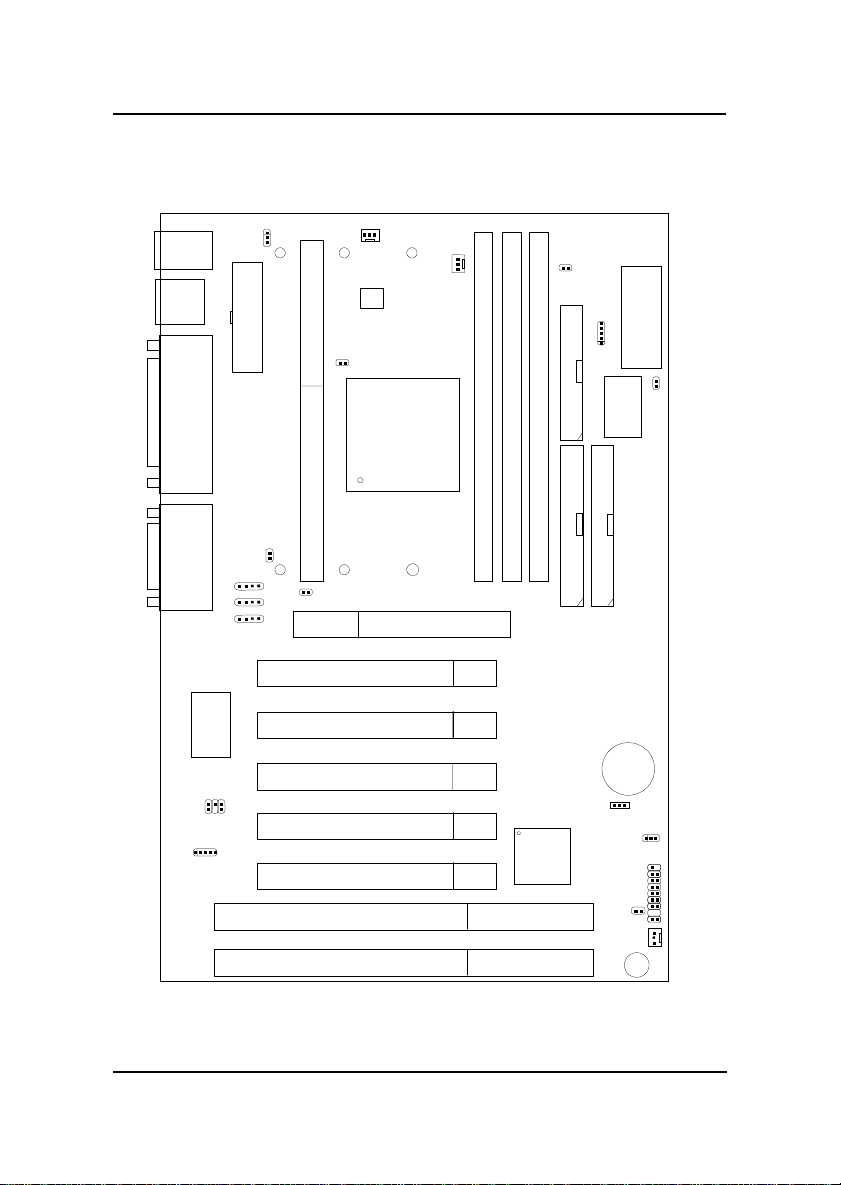
1.2 Mainboard Layout
MS-6163VA ATX VIA Mainboard
PCI SLOT 3
PCI SLOT 2
PCI SLOT 1
ISA SLOT 2
ATX
Power Supply
VT82C693
SLOT 1
DIMM 2
Top: Mouse
Bottom:
Keyboard
Top:Port1
USB
DIMM 1
IDE2
Bottom:
Port2
IDE1
FDD
VT82C596A
JMDM1 JFP
JGS1
JBAT1
BIOS
JPHONE:MDM_IN
JAUX: AUX_IN
CPUFAN
JSOR1
JRMS1
PSFAN
IR
BATT
+
Top: LPT
Bottom:
COM1/
COM2
Top: Midi/
GamePort
Bottom:
Line-Out
Line-In
Mic
JCD: CD_IN
SW2
JKBV
System
Hardware
Monitor
(optional)
AGP SLOT
JCASE
DIMM 3
PCI SLOT 4
PCI SLOT 5
ISA SLOT 1
JWOL1
SYSFAN
WINBOND
W83977EF-AW
SB_Link
JT3
Creative
ES1373
(Optional)
CHAPTER 2 HARDWARE INSTALLATION
2-1
Chapter 2
HARDWARE INSTALLATION
2.1 Central Processing Unit: CPU
This mainboard operates with Intel®Pentium®II/CeleronTM processor. The
mainboard uses a CPU Slot called Slot 1 for easy CPU installation. The CPU
should always have a Heat Sink and a cooling fan attached to prevent
overheating.
CHAPTER 2 HARDWARE INSTALLATION
2-2
2.1-1 CPU Installation Procedures
A. OEM Pentium®II Processor Installation Procedures
Different kinds of Pentium®II processor that is currently used: the OEM
version, the Boxed version, and CeleronTM. OEM Pentium®II Processor has
no Heat Sink, Fan and Heat Sink Support, the Boxed Pentium®II Processor
is provided with Heat Sink w/ fan and Heat Sink Support, while the
CeleronTM processor is a plain processor card without cover or heatsink.
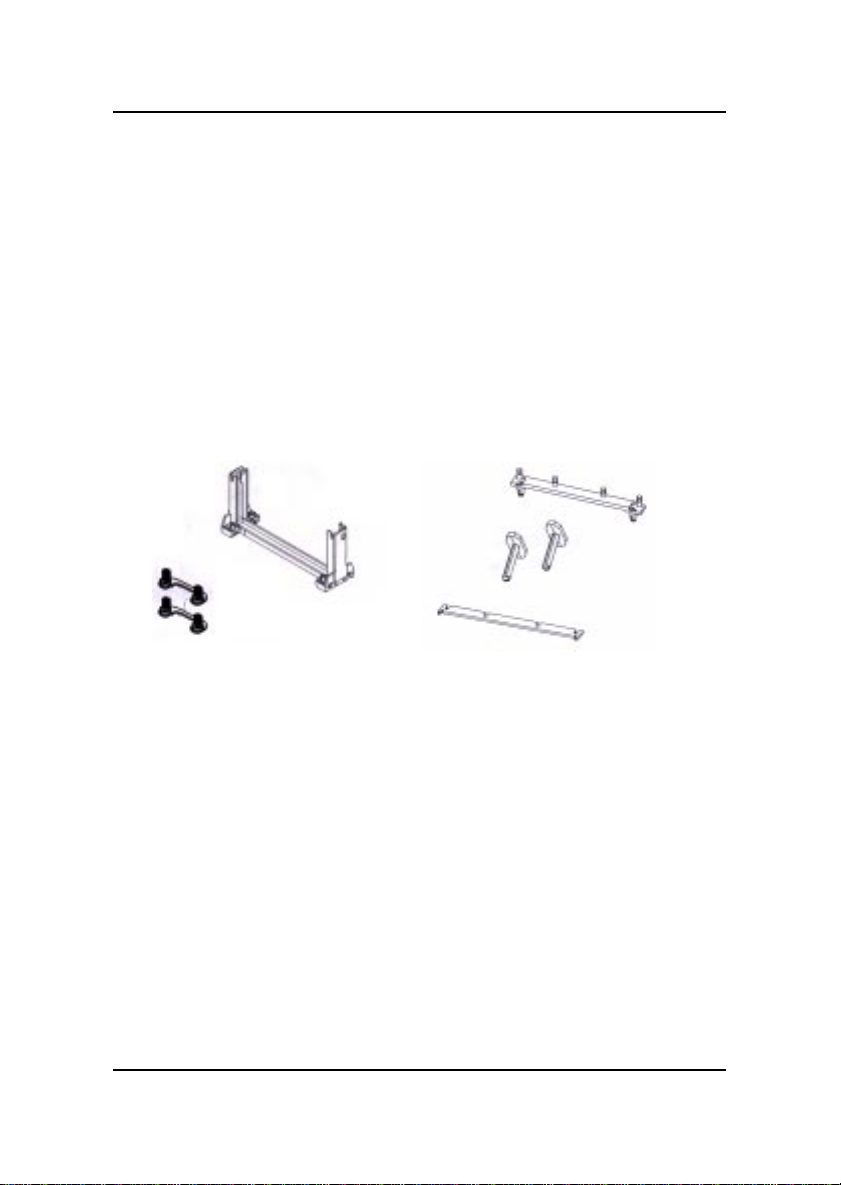
Required Things:
Pentium®IIprocessor-Processor.
*RetentionMechanism(RM)- Plastic Guide that holds the S.E.C. Catridge
in the Slot 1 connector.
*RetentionMechanismAttachMount(RMAM) -Bolt/Bridgeassemblies
inserted up through the bottom of the
motherboard. RM secures to RMAM ( 2
RMAM required per RM ).
*Heat Sink SupportBase (HSSBASE) - Plastic support bar mounted to
the mainboard under the ATX heatsink.
(One leg is always bigger than the other one)
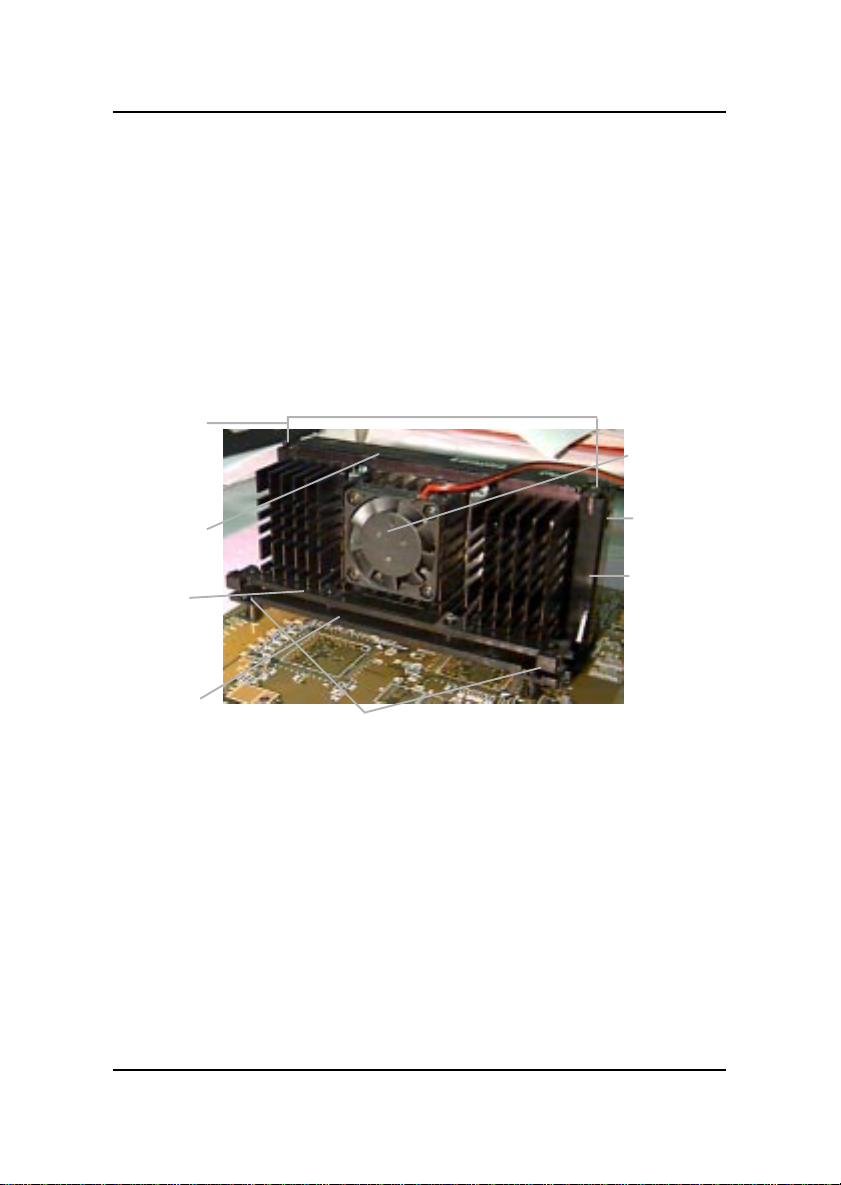
Processor
Lock
Retention
Mechanism
Pentium®II
Processor
Heat Sink
W/Fan
Notch Hole
Heat Sink
Support Base Heat Sink
Support Pin
Heat Sink
Support
Top Bar
CHAPTER 2 HARDWARE INSTALLATION
2-3
*HeatSink Support Pin (HSSPIN) - Plastic pins inserted through the
HSSBASE to secure it to the mainboard (2
required per Assembly).
*Heat Sink Support TopBar (HSSTOP) - Plastic bar that clips onto the
HSSBASE through the fins on the ATX
heatsink.
**Heat Sink w/ fan - Heat Sink that can be attached to the Pentium®II
processorwith metal clip.
Note:* Provided by MSI mainboard.
** Provided by Special request.
RM
HSSPIN
HSSTOP
HSSBASE
RMAM
CHAPTER 2 HARDWARE INSTALLATION
2-4
SLOT1
Retention
Mechanism
êê
Key
êê
Retention
Mechanism
Attach Mount
Notch
Key
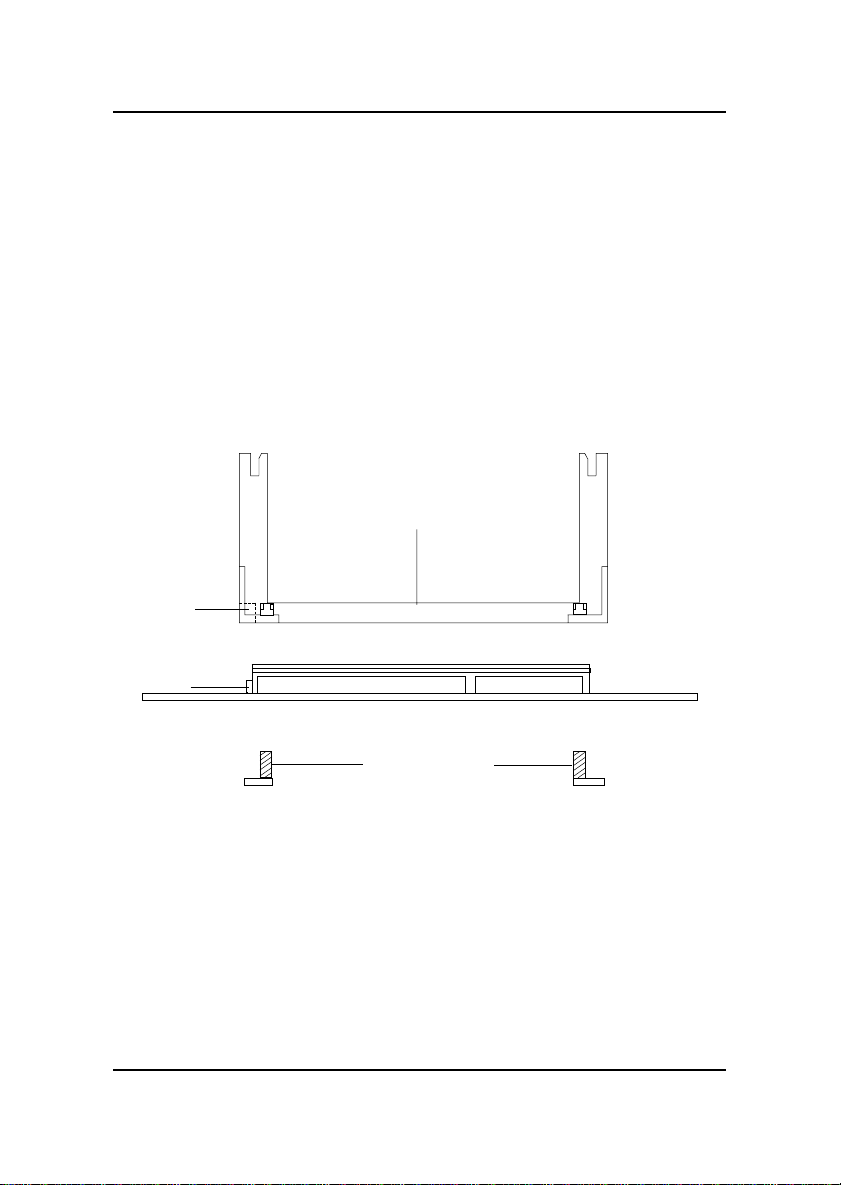
Step 1: Insert the Retention Mechanism Attach Mount at the bottom
of the mainboard.
Step 2: Install the Retention Mechanism.
Look for the key on Slot 1, and match it with the Notch Key on the
Retention Mechanism for proper direction. Then, attach the
Retention Mechanism to the Retention Mechanism Attach Mount.
Use a Screwdriver to secure the Retention Mechanism.
CHAPTER 2 HARDWARE INSTALLATION
2-5
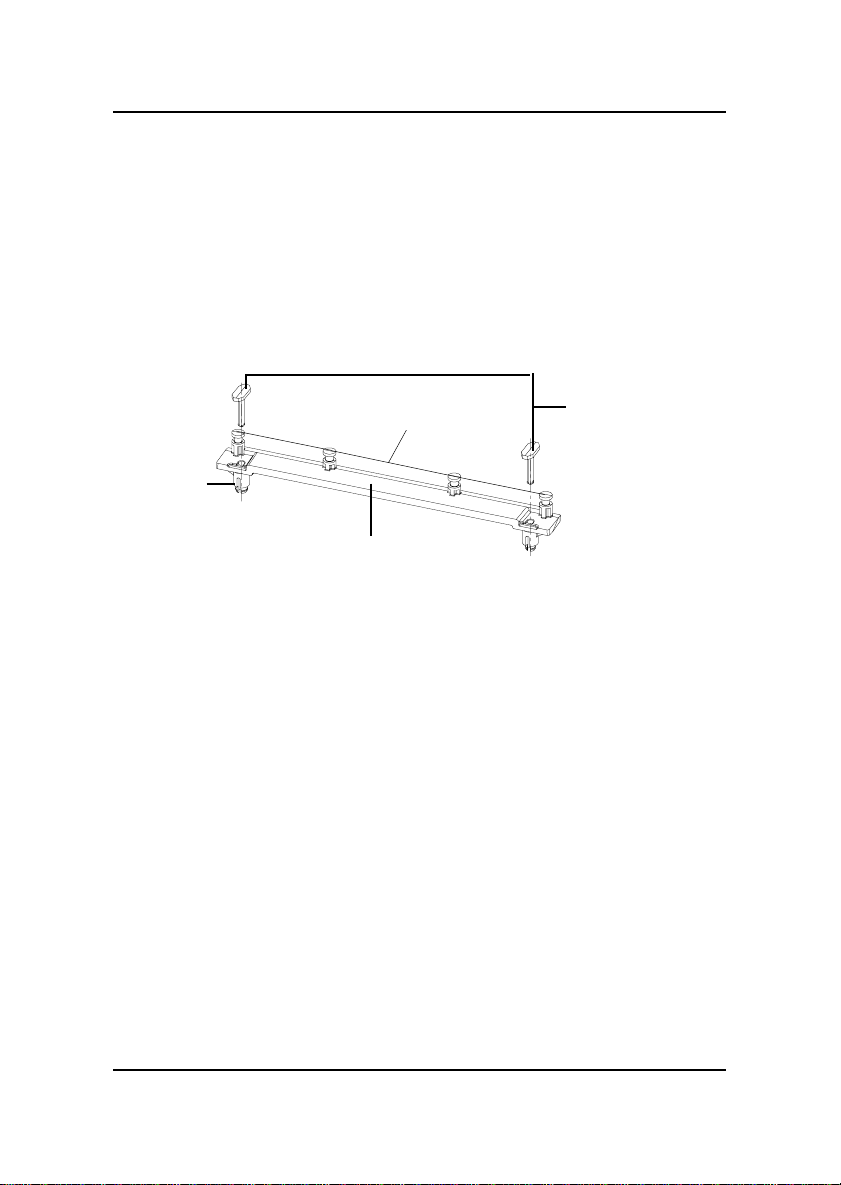
Step 3: Install the Heat Sink Support Base.
Look for the Two holes across Slot 1, and match it with the Two legs
of the Heat Sink Support Base for the proper direction. Take note
that one hole/leg is bigger than the other. The Four top pins of the
Heat Sink Support Base should also be oriented towards Slot 1.
Push the Heat Sink Support Base onto the mainboard, until you hear
a click sound. Check for a perfect fit.
Step 4: Install the Heat Sink Support Pin.
Push the Heat Sink Support Pins onto the two holes of the Heat Sink
Support Base. Check for a perfect fit. These pins are used to secure
the Heat Sink Support Base.
Heat Sink
Support Base
Heat Sink
Support Pin
Leg
pins