manuals.online logo
Brands
  1. Home
  2. •
  3. Brands
  4. •
  5. MuxLab
  6. •
  7. Extender
  8. •
  9. MuxLab 500070 User manual

MuxLab 500070 User manual

Other MuxLab Extender manuals

MuxLab 100509 User manual

MuxLab

MuxLab 100509 User manual

MuxLab 500417 User manual

MuxLab

MuxLab 500417 User manual

MuxLab 500850 User manual

MuxLab

MuxLab 500850 User manual

MuxLab 500752 User manual

MuxLab

MuxLab 500752 User manual

MuxLab DomoStream User manual

MuxLab

MuxLab DomoStream User manual

MuxLab 500115 User manual

MuxLab

MuxLab 500115 User manual

MuxLab 500752 User manual

MuxLab

MuxLab 500752 User manual

MuxLab 500771 User manual

MuxLab

MuxLab 500771 User manual

MuxLab 500459-100 User manual

MuxLab

MuxLab 500459-100 User manual

MuxLab 100504 User manual

MuxLab

MuxLab 100504 User manual

MuxLab 500140 User manual

MuxLab

MuxLab 500140 User manual

MuxLab 500401-WP-US User manual

MuxLab

MuxLab 500401-WP-US User manual

MuxLab 500754 User manual

MuxLab

MuxLab 500754 User manual

MuxLab 500800 User manual

MuxLab

MuxLab 500800 User manual

MuxLab 100518 User manual

MuxLab

MuxLab 100518 User manual

MuxLab 500451-TX User manual

MuxLab

MuxLab 500451-TX User manual

MuxLab 500450-LR User manual

MuxLab

MuxLab 500450-LR User manual

MuxLab VideoEase MonoPro XLR User guide

MuxLab

MuxLab VideoEase MonoPro XLR User guide

MuxLab VideoEase User manual

MuxLab

MuxLab VideoEase User manual

MuxLab 500772 User manual

MuxLab

MuxLab 500772 User manual

MuxLab 500758 User manual

MuxLab

MuxLab 500758 User manual

MuxLab 500453 User manual

MuxLab

MuxLab 500453 User manual

MuxLab 500710 User manual

MuxLab

MuxLab 500710 User manual

MuxLab 500754 User manual

MuxLab

MuxLab 500754 User manual

Popular Extender manuals by other brands

SY HDBT-60T installation guide

SY

SY HDBT-60T installation guide

Appsys ProAudio ADX-16 user manual

Appsys ProAudio

Appsys ProAudio ADX-16 user manual

Atlona RS232 user manual

Atlona

Atlona RS232 user manual

IDK OPF-TH1000-A user guide

IDK

IDK OPF-TH1000-A user guide

Enable-IT 824WP quick start guide

Enable-IT

Enable-IT 824WP quick start guide

Worx Landroid RadioLink WA0864 Get started

Worx

Worx Landroid RadioLink WA0864 Get started

TP-Link TL-WA730RE user guide

TP-Link

TP-Link TL-WA730RE user guide

Camplex CMX-HDMI-SFPL user manual

Camplex

Camplex CMX-HDMI-SFPL user manual

SC&T HE03-4K user manual

SC&T

SC&T HE03-4K user manual

Samsung SCS-26UC4 user guide

Samsung

Samsung SCS-26UC4 user guide

Foxun SX-GES24 operating instructions

Foxun

Foxun SX-GES24 operating instructions

foxunhd SX-AEX01 operating instructions

foxunhd

foxunhd SX-AEX01 operating instructions

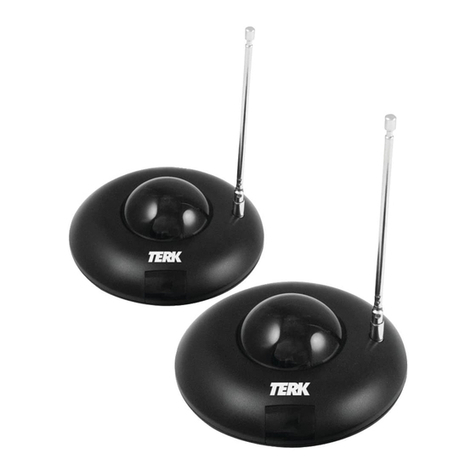
TERK Technologies LFIRX2 owner's manual

TERK Technologies

TERK Technologies LFIRX2 owner's manual

Devolo Audio Extender supplementary guide

Devolo

Devolo Audio Extender supplementary guide

Edimax EW-7438RPn V2 instructions

Edimax

Edimax EW-7438RPn V2 instructions

Shinybow USA SB-6335T5 instruction manual

Shinybow USA

Shinybow USA SB-6335T5 instruction manual

SECO-LARM ENFORCER EVT-PB1-V1TGQ installation manual

SECO-LARM

SECO-LARM ENFORCER EVT-PB1-V1TGQ installation manual

ASUSTOR AS5004U Quick installation guide

ASUSTOR

ASUSTOR AS5004U Quick installation guide

manuals.online logo
manuals.online logoBrands
  • About & Mission
  • Contact us
  • Privacy Policy
  • Terms and Conditions

Copyright 2025 Manuals.Online. All Rights Reserved.

© MuxLab Inc. 2009
Specifications
Environment USB 1.1 Peripherals
Devices Desktop or Laptop computers
Transmission Transparent to the user
Bandwidth 1.5 Mbps and 12 Mbps (USB Low-Speed and Full-Speed)
Input Impedance USB: 90 ohms
Output Impedance Cat5: 100 ohms
Connectors: Transmitter Host Side: USB Type A male connector
Link: RJ-45 (Cat5e)
Connectors: Receiver Link: RJ45 shielded (Cat5e)
Device Side: Four (4) USB ports
USB cables not included.
Max. Distance 150 ft (46m)
RJ45 Pin Configuration
Reverse Polarity Sensitive.
Use EIA/TIA 568 A or B,
straight-through wiring.
USB: Pin 1 (R)
Pin 2 (T)
Power: Pin 3 (R)
Pin 6 (T)
Power: Pin 4 (R)
Pin 5 (T)
Power: Pin 7 (R)
Pin 8 (T)
Cable Category 5e unshielded twisted pair cables or better required.
Power Supply 110-240V/5VDC/2.6A
Removable AC blades included for North America, Continental
Europe & UK
5VDC power jack
LED Indicators Device Side: (1) Link Led and (1) Power LED
Temperature Operating: 32º to 105º F (0º to 40º C).
Storage: 15º to 160º F (-10º to 70º C).
Enclosure Black. ABS fire retardant plastic
Dimensions Receiver: 2.4" x 2.25" x 1.0" (6.1 x 5.5 x 2.5 cm)
Transmitter: 1.9" x 1.0" diameter (4.8 x Ø2.5 cm), plus 7.5"
(19 cm) USB cable.
Weight 0.6 lbs/0.3 kg Total
Compliance Regulatory: FCC, CE, RoHS
Warranty 2 years
Order Information 500070 USB 4-Port Extender Kit
Tel.: (514) 905-0588 Fax: (514) 905-0589
Toll Free (North America): (877) 689-5228
E-mail: videoease@muxlab.com URL: www.muxlab.com
94-000658-A SE-000659-A
USB 4-Port Extender Kit (500070)
Quick Installation Guide
Overview
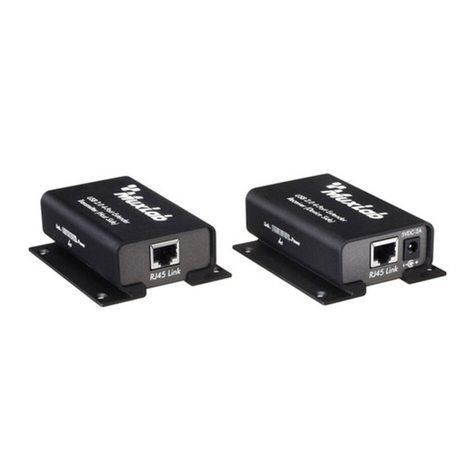
The MuxLab USB 4-Port Extender Kit (500070) allows USB equipment to be
connected up to 150 ft (46 m) at full-speed (12 Mbps) in a point-to-
p
oint
configuration. By contrast, standard USB connections are limited to 16 ft (5 m). The
kit comes with one Transmitter and one Receiver that uses a single Cat5e
unshielded twisted pair (UTP) in a structured cabling system. The receiver is a four-
port USB hub that supports up to four self-powered USB devices. It supports up to
four bus-powered USB devices when used with the included power supply.
Applications for the USB 4-Port Extender Kit include boardroom, classroom and
residential setups, surveillance, home automation, and remote data logging systems.
Pre-Installation Check
Identify the connectors on the Transmitter and Receiver as indicated on the product
labels.
© MuxLab Inc. 2009
Installation
Verify that the distance between the USB transmitter and receiver are within
MuxLab specifications (150 ft / 46m).
Host-Side Installation
Install the host-side transmitter as follows:
1. Connect the Host side transmitter to the computer’s USB port.
2. Connect a Cat5e (or higher) grade UTP cable to the RJ-45 connector on
Transmitter.
Device-Side Installation
Install the device-side receiver as follows:
1. Connect the Receiver to the USB Peripherals with USB-compliant cables.
2. Connect the Cat5e cable to the RJ-45 connector of the Receiver. If the
computer is powered on, the “Link” LED will be ON.
3. Connect the 5 VDC power supply first to the Receiver and then plug the
power supply into an AC power outlet (mains plug). If power is available,
the green power LED will be ON.
In some cases, power from the PC’s USB port may be sufficient to run up
to four self-powered USB devices or one or two low-power USB devices
such as a mouse and a keyboard. However, we recommend that you always
connect the power supply included with the kit to the receiver for best
performance.
The following diagram shows the final configuration.
Troubleshooting
The following table describes some of the symptoms, probable causes, and possible
solutions in respect to the installation of the USB 4-Port Extender Kit. If you still cannot
diagnose the problem, please call MuxLab Customer Technical Support at 877-689-5228
(toll-free in North America) or (+1) 514-905-0588 (International).
Symptom LED
Power
LED
Link
Probable
Cause
Possible Solutions
USB Peripheral
does not work
ON or
OFF
OFF Faulty wiring Check continuity.
Check the Cat5 cable is not damaged and the
connectors are properly crimped (straight-
through wiring is required).
Verify that the host-side is properly plugged in
the USB port and that the computer is ON.
Computer
does not
recognize the
USB
Peripheral
Try connecting the peripherals directly to the
computer to ensure that they work correctly.
Try plugging the transmitter into a different
USB port (both in front and behind the
computer).
Connect the power supply included with the
kit to the receiver.

Check that the length of the cable run is within
specifications (150 ft / 46m).
No power Check for the availability of power at the AC
power outlet: Plug a lamp into the outlet.
Power supply is
plugged in, but
the “power”
LED is not on
OFF ON or
OFF
Wrong power
supply
Ensure that you are using the 5V power
supply that is included with the kit.
“Not enough
power” error
message
OFF ON The supplied
power supply
is not
connected
Connect the power supply included with the
kit to the receiver.