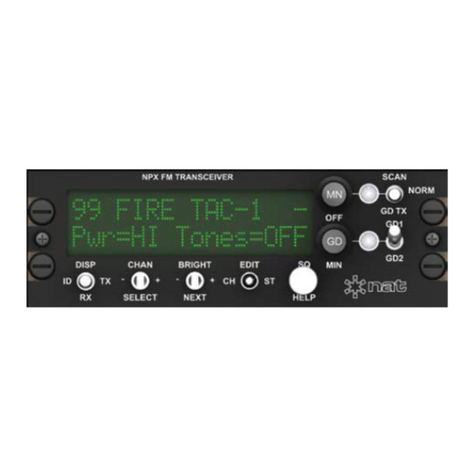
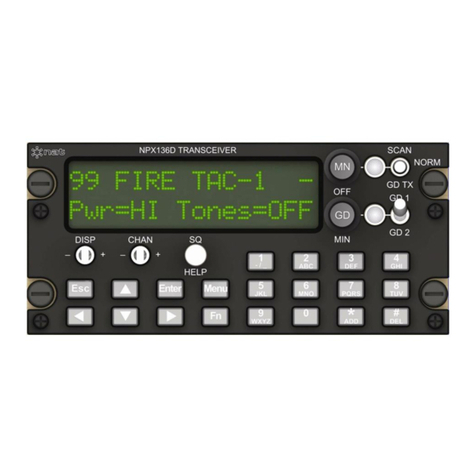
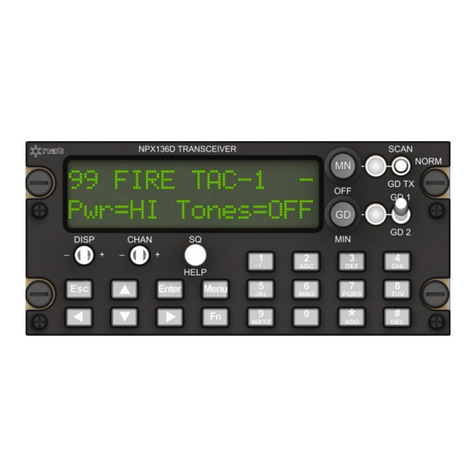
Nat SM05 User manual

CONFIDENTIAL AND PROPRIETARY TO NORTHERN AIRBORNE TECHNOLOGY LTD.
SM05
TAC/COM SERIES
VHF TRANSCEIVERS (NT030-NT150)
INSTALLATION AND OPERATION MANUAL
REV 4.00 November 26, 2003
Northern Airborne Technology Ltd.
1925 Kirschner Road
Kelowna BC, Canada
V1Y 4N7
Telephone (250) 763-2232
Facsimile (250) 762-3374
Copyright 2003 by Northern Airborne Technology


SM05 Rev. 4.00 VHF Transceiver Manual
Nov 26, 2003 Page ii
ENG-FORM: 820-0109.DOT
CONFIDENTIAL AND PROPRIETARY TO NORTHERN AIRBORNE TECHNOLOGY LTD.
Periodically NAT will release manual amendments. In order to maintain the most
accurate and up to date manual these amendments should be carried out
immediately upon receipt and recorded on the following amendment record.
AMENDMENT RECORD
Amendment #
Amend. Date
Date Entered
Entered By


SM05 Rev. 4.00 VHF Transceiver Manual
Nov 26, 2003 Page iii
ENG-FORM: 820-0109.DOT
CONFIDENTIAL AND PROPRIETARY TO NORTHERN AIRBORNE TECHNOLOGY LTD.
Table of Contents
Section Title Page
1.0 Description
1.1 Introduction 1-1
1.2 Purpose of Equipment 1-1
1.3 Design Features 1-1
1.4 Specifications 1-2
1.4.1 System Specifications 1-2
1.4.2 Transmitter Specifications 1-3
1.4.3 Receiver Specifications 1-4
1.5 Unit Nomenclature 1-4
2.0 Installation
2.1 General 2-1
2.2 Unpacking and Inspection 2-1
2.3 Installation Procedures 2-1
2.3.1 Warnings 2-1
2.3.2 Cautions 2-2
2.3.3 Cabling and Wiring 2-2
2.3.4 Mechanical Mounting 2-3
2.3.5 Antenna Selection Guide 2-5
2.3.6 Post-Installation Checks 2-6
2.4 Installation Drawings 2-9
3.0 Operation
3.1 General 3-1


SM05 Rev. 4.00 VHF Transceiver Manual
Nov 26, 2003 Page 1-1
ENG-FORM: 800-0107.DOT
CONFIDENTIAL AND PROPRIETARY TO NORTHERN AIRBORNE TECHNOLOGY LTD.
Section 1.0 Description
1.1 Introduction
Tac/Com series transceivers have been optimized for full feature operation within the
total Tac/Com system architecture, and provide agile operation over a wide range of RF
frequencies.
Using a combination of serial and parallel tuning, these transceivers provide a simple
interconnect with powerful channeling ability. The design of the transceivers also
supports full encryption capability to DES 1027, or VGE formats without modification.
Subaudible (CTCSS) tone coded squelch and DPL coding are also fully supported.
Various levels of scanning are supported in these fast lock synthesized radios, such as
'PRIORITY' or 'SCAN' list formats. These modes can emulate multiple 'guard' receiver
operation under full control of the operator, and can be altered in the system software
(control head). The basic radio stores 32 frequencies within 2 pages of non-volatile
memory, any or all of which can be altered by the Tac/Com system control head as
needed by the operator.
1.2 Purpose of Equipment
These transceivers are designed to meet the difficult airborne requirements of law
enforcement and public service/public safety groups for tactical FM communication
systems. The Tac/Com series of radio control heads provide a centralized location for
tactical radio control of up to four transceiver systems, which can be of either NAT or
other manufacture. Alphabetic labeling or identification of each radio channel is
provided, as well as a display of receive and transmit frequencies, to ease pilot
identification of the selected channel. Intended for aircraft use, these components may
also be operated in vehicular applications (when correctly ordered) to provide the same
capability for communications vans, emergency site co-ordination, or surveillance.
1.3 Design Features
The Tac/Com transceiver family uses advanced technology microprocessor controlled
frequency synthesis, and NOVRAM channel data storage to provide its powerful
features. The radio itself is completely modular, facilitating quick repair and service.

VHF Transceiver Manual SM05 Rev 4.00
Page 1-2 Nov 26, 2003
ENG-FORM: 800-0107.DOT
CONFIDENTIAL AND PROPRIETARY TO NORTHERN AIRBORNE TECHNOLOGY LTD.
The physical enclosures for the Tac/Com transceivers are die-cast, with fully RF
gasketed closures, to provide the most rugged possible unit. The design is qualified to
MIL-STD 810D for environmental performance.
Many new band splits are supported by the Tac/Com family, providing airborne systems
for new frequencies now required by land based law enforcement agencies and public
service groups. These new splits can be mixed with other existing equipment via the
Tac/Com control head to produce full function systems with minimum cost.
The thermal management of the radio is outstanding, resulting in minimal case
temperature rise regardless of operational cycles. This is a significant departure from
many existing systems which are at design limits even with low duty cycles.
A wide range energy conversion power supply is used in the transceivers for 28VDC
operation, which significantly reduces both current consumption from the aircraft bus,
and waste heat generation.
All transceivers have the same mounting footprint, RF connector, and plug-compatible
interconnect, for ease of installation.
Unit covers have integral screws (anti-tamper) and hardware for ease of bench
servicing (no more lost screws). Mating logic/interface connectors use gold contacts,
and the Mil-spec type "N" RF connector is tarnish resistant, for improved performance in
humid environments.
1.4 Specifications
1.4.1 System Specifications
Frequency range NT30A 29- 41.995 MHz
NT30B 34- 49.995 MHz
NT136 138-155.995 MHz
NT150 148-173.995 MHz
Input Power Nominal 28 VDC
Current Consumption RX (squelched) 0.4-0.7 A (typ.)
TX 2.0A(typ.)
Frequency Stability 0.0005%
Channel Spacing 5.0 kHZ*

SM05 Rev. 4.00 VHF Transceiver Manual
Nov 26, 2003 Page 1-3
ENG-FORM: 800-0107.DOT
CONFIDENTIAL AND PROPRIETARY TO NORTHERN AIRBORNE TECHNOLOGY LTD.
Temperature Range -30°C to +60°C
Humidity to 90% (non-condensing/60°C)
Altitude 16,500' in unpressurized area
Duty Cycle 100% RX, 20% TX
CTCSS Tones 38 (From 67.0 Hz to 250.3 Hz EIA Std.)
DPL Codes (Digital Private Line) 83 (023 to 754)
Encryption Capability -DES per FS1027
-GE Voice Guard
-Transcrypt
Shock EIA and MIL-STD-810D
Dimensions 2.7" x 8.0" x 14.0" (W/R Version)
(H x W x D) 2.7" x 9.5" x 13.3"
Weight (less accessories) 8.5 lbs. (W/R Version)
9.5lbs.
* Alternate 5.0/12.5 kHz spacing available on NT150 when used
with Tac/Com II controls. On NT136-PAS, Tac/Com II provides
5.0/6.25 kHz spacing for European applications.
1.4.2 Transmitter Specifications
Conducted Spurious -80 dB
(-70 dB NT806)
Modulation ±4.5 kHz (Max.)
Distortion Less than 2% (1000 Hz)
Less than 5% (300 to 3000 Hz)
Deviation Symmetry 0.3 kHz maximum
Microphone Load Impedance 600 ohms
RF Output Impedance 50 ohms (Type "N" connector)

VHF Transceiver Manual SM05 Rev 4.00
Page 1-4 Nov 26, 2003
ENG-FORM: 800-0107.DOT
CONFIDENTIAL AND PROPRIETARY TO NORTHERN AIRBORNE TECHNOLOGY LTD.
1.4.3 Receiver Specifications
Sensitivity 0.35 uV (EIA 12 dB SINAD) typical
Normally set to 0.6 uV
Selectivity (EIA 2-signal method, -80 dB
25kHz channels)
Spurious Response -85 dB
Audio Output Phones-Nominal 600 ohm line output
100 mW minimum
(Transformer coupled output)
Speaker-Nominal 4 W into 8 ohms.
(Bridge output, DO NOT GROUND)
1.5 UnitNomenclature
Tac/Com transceivers are identified by two groups of numbers. The first defines the
frequency band, and the second defines any optional attributes of the R/T.
Part numbers:
NT150-000 W/R ÍDenotes Weight Reduced
ÏÑ
Defines Frequency Band Defines Options
The options currently available are as follows:
-050 Separate 2 channel dedicated receiver module with
USFS/OAS channels installed (NT150 only).
-060 Separate 2 channel dedicated receiver module with user
defined guard channels (Some restrictions may apply).
-100 Separate DF Receiver (DF100-001), which will allow NT136
and NT150 transceivers to operate with NAT's TDF System.
-EUR Transceiver modification to provide improved adjacent
channel rejection for compliance with European
specifications.
-EXT Transceiver modification to allow the NT30B extended range
of 33 to 50 MHz.
End of Section 1.0
This manual suits for next models
5
Table of contents
Other Nat Transceiver manuals