3
FORMNO.L-21170-A-0803
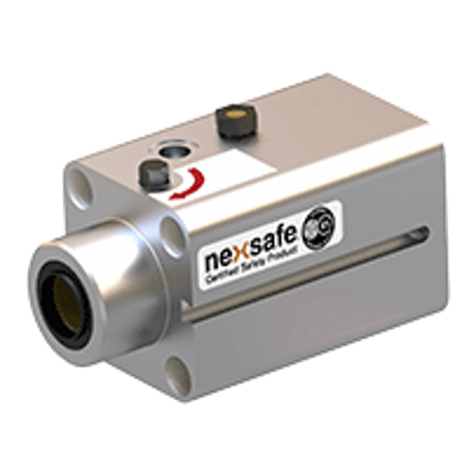
1. Apply a constant supply of at least 4.8 bar (70 PSI)
to the rod lock device.
2. Remove the supplied rod from the inside of the lock
and keep for future use.
CC
CC
CAA
AA
AUTIUTI
UTIUTI
UTIONON
ONON
ON
Do not engage the rod lock without aDo not engage the rod lock without a
Do not engage the rod lock without aDo not engage the rod lock without a
Do not engage the rod lock without a
properly sized rod in place or damage toproperly sized rod in place or damage to
properly sized rod in place or damage toproperly sized rod in place or damage to
properly sized rod in place or damage to
the internal components may result.the internal components may result.
the internal components may result.the internal components may result.
the internal components may result.
INSTALLATION
ROD MATERIAL
• Nexen’s Rod Lock must mount to a shaft that is
hardened to a minimum of HRC 60 or hard-chrome
plated to a minimum thickness of 20 microns
[0.0008 in] or damage to the shaft may result.
• The diameter must lie in the h8 tolerance range.
Reference: USAS B4.1 - 1967(1974)
ISO 286-1 - 1988
ISO 286-2 - 1988
AIR FITTINGS
3. Carefully work the new rod past the seal and
through the rod lock assembly.
4. When the rod is in the desired position, engage the
lock by removing air pressure.
5. A variety of mounting configurations are available;
mount the rod lock as desired. The rod lock unit can
be installed in any orientation.
DANGER
Support the load before disengaging the Rod Lock. Failure to
support the load could result in serious bodily injury.
1. The Nexen rod lock is equipped with a 1/8 inch
NPT port for the air inlet. Route clean air, using soft
or hard lines, supplying at least 4.8 bar [70 psi] to
facilitate full disengagement.
NOTE: Install the valve in close proximity to the Rod
Lock unit for faster engagement and disengagement.
Higher air pressures will also speed the disengage-
ment time, but do not exceed 10.0 bar [150 psi] air
pressure.
2. The Nexen rod lock is equipped with a 1/16 inch
NPT port for the internal vent. If the air quality
around the application is poor, route the vent of the
rod lock to a more suitable area, or use a filtered
breather. Contact Nexen for available components.
NOTE: Clean air is important for proper Rod Lock func-
tioning. Debris inside the rod lock may inhibit perfor-
mance and/or shorten the life of the product.
• The surface roughness Rmax must be 3.2 microns
[16 microinch] or better.
• The rated holding force corresponds to static load
conditions. If the rated value is exceeded, slippage
may occur. Operating dynamic forces must not
exceed the static holding force.