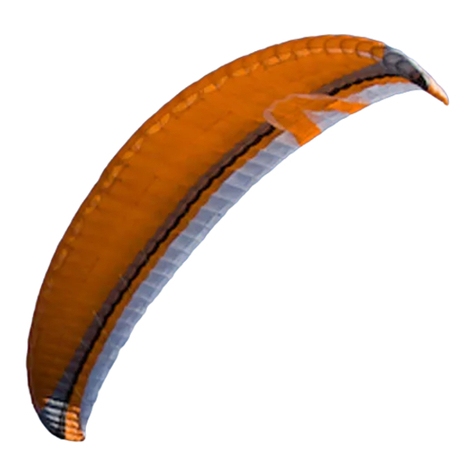
The ROLLER 2 is able to stay airborne in strong winds when conventional paragliders can no longer fly.
However, if conditions are very turbulent, we recommend not flying until the forecast improves.
All paragliders must be piloted for the prevailing conditions and the pilot is the ultimate safety factor.
We recommend active flying in turbulent conditions, always taking measures to maintain control of the wing,
action, make the input then re-establish the correct flying speed.
4.2 POSSIBLE CONFIGURATIONS
To become familiar with the manoeuvres described below, we recommend practising within the environment
over-steering.
the tested manoeuvres. Having this information is crucial to know how to react during these manoeuvres in
real flight, so you can deal with these situations as safely as possible.
Asymmetric collapse
in very strong turbulence, especially if you do not fly actively and prevent the collapse. In this case the glider
attack). If the collapse does happen, the ROLLER 2 will not react violently, the turning tendency is gradual
and easily controlled. Weight-shift toward the open, flying side (the opposite side of the collapse) to keep the
wing flying straight, while applying light brake pressure to that side if necessary. Normally, the collapsed side
of the wing should then recover and reopen by itself. If it does not, try to weight-shift towards the collapsed
the way (100%) down and release it back up immediately. You may have to repeat this action to provoke the
re-opening of the collapsed glider side. Do not over-brake or slow down the flying side of the wing (control
the turn). Once the collapsed side is open make sure you return to normal flying speed.
Frontal collapse
Due to the ROLLER 2’s design, in normal flying conditions frontal collapses are unlikely to take place. The
of both brakes will accelerate the re-inflation if necessary. Release the brake lines immediately to return to
default glider air speed.
Negative spin
A negative spin does not conform to the ROLLER 2’s normal flight behaviour. Certain circumstances however,
the wing’s default air speed and angle of attack by progressively reducing the tension on the brake lines. The
360o
Parachutal stall
appears to be fully inflated. To regain normal air speed, release brake line tension symmetrically and manually
push on the A-lines or weight-shift your body to any side WITHOUT PULLING ON THE BRAKE LINES.
Deep Stall
The possibility of the ROLLER 2 stalling during normal flight is very unlikely. It could only happen if you are
rearward and then reposition itself overhead, rocking slightly, depending on how the manoeuvre is done.
important to maintain brake pressure until the glider has returned to its default overhead flying position.
To resume normal flight conditions, progressively and symmetrically release the brake line tension to regain
air speed. When the wing reaches the overhead position, the brakes must be fully released. The wing will
10