5
We recommend paying special attention to the ight test report made
by the certication test house. It provides all necessary technical
information to know about the wing and how it reacted during each
tested manoeuvre.
It is important to note that different sized wings will react differently
during manoeuvres. Even within the same size, at maximum or minimum
load, the behaviour and reactions of the wing may vary.
For further information on the ight test and the corresponding
certication number, please see the nal pages of this manual.
1.3 IN-FLIGHT BEHAVIOUR
Niviuk developed this wing by adopting very specic goals: the objective
was to seek utmost performance - faster, steadier and better in turns.
Better feel for the wing and easier piloting.
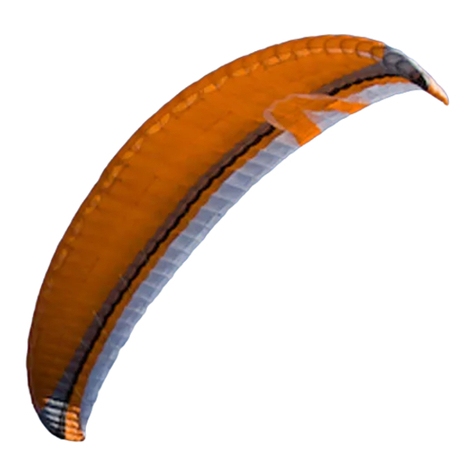
The ROLLER provides extreme stability in conjunction with precise
handling and is fast and dynamic. It is exceptionally good at dampening
turbulence thanks to its reduced size and prole.
The brakes respond immediately to pilot input and directional control
through weight-shift is accurate and automatic. The unfavourable roll
behaviour sometimes found in speedying wings does not exist in the
ROLLER; pitch is damped enough so that the wing does not suffer
unexpected frontal collapses or loss of internal pressure, allowing the
pilot to fully concentrate on reading the terrain.
The wing remains stable during takeoff and the entire ight. It ies at high
speeds without stress. During the wing design, maximum attention was
paid to its ability to descend mountains quickly by swooping or to use
the conditions and elements by ridge soaring, thermalling, playing with
the laminar wind or trying out new ways of ight.
Please note!
The term ‘speedying’ implies that together with the experience and skill
required to y a glider of this type, the pilot should y actively and be
able to anticipate the wing’s reactions to input.
Attention must be paid to groundspeed in turns, induced pitching and
generally in all manoeuvres which involve acceleration. These must be
performed correctly, especially when undertaken near the terrain. The
accuracy and speed of response, either through the brake or weight-
shift, is an excellent characteristic of the ROLLER, but it requires
considerable practise to fully master it.
1.4 ASSEMBLY, MATERIALS
The ROLLER has all the technological innovations used on other Niviuk
gliders. It is built with the most careful selection of current materials,
technology and accessories available, to improve pilot comfort whilst
increasing safety and performance.
RAM Air Intake system (RAM) – it is characterised by the arrangement of
the air inlets, to ensure optimal internal pressure is maintained. Thanks to
this design, we were able to reduce their size, while maintaining the same
air ow at all angles to improve laminar ow.
Having greater internal pressure means better tolerance of turbulence,
greater consistency of the prole shape across the speed range;
excellent handling at low speed is achieved by allowing the pilot
to extend the braking limit, there is a lower risk of collapse and
consequently, greater control and stability.
Titanium Technology (TNT) – a revolutionary technique using titanium.
Using Nitinol for the internal wing construction offers great advantages:
on the one hand it reduces the overall wing weight, which reduces the
inertia and improves the manoeuvrability and launch ination.
On the other hand, the leading edge is more rigid and the wing surface
remains perfectly taut, without creases or parasitic drag. This optimises
glide in all phases of the ight.