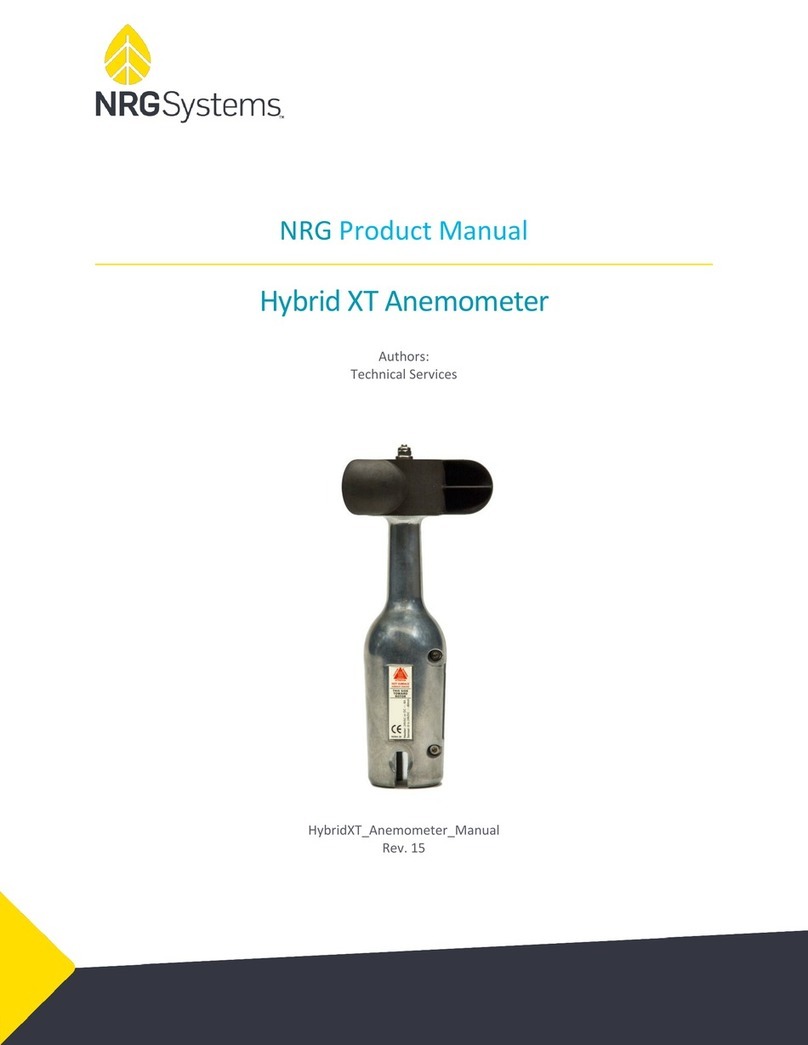
IceFree3 Heated Vane & Anemometer | WRA
IceFree3_AnemometerVaneWRA_Manual
Rev. 4.0
ICEFREE3 ANEMOMETER
Kit #2651 | FG #2649
AC Sine Output | 8m Cable
Operation
The IceFree3 anemometer provides an AC sine wave output signal. Rotation of the anemometer head
rotates the four pole magnet past a low impedance generator coil inducing a current in the coil. The coil
electrical output is a sine wave with frequency directly proportional to the wind speed. Amplitude of the
sine wave varies from about 50 mV at threshold to several volts at full speed.
A typical logger/controller input stage may consist of overvoltage protection, low pass filter (corner
frequency of 100 Hz), limiter, and comparator. If unsure of your input circuit design, please consult with
NRG.
Calibration
If the IceFree sensor has been calibrated, a sensor specific calibration report has been shipped with the
sensor. If the calibration report should get lost, you may contact NRG for a copy. Please note that you
will need the sensor serial number when you contact NRG.
Anemometer Installation
1. Tape the ends of the cables to prepare them for feeding through the mounting boom. Maintain
the isolation of the signal leads from the boom. Remove the nut and bolt from the base of the
unit. Feed the cables through the mounting boom until the sensor is on the boom. Align the bolt
hole in the base (not the slot) with the hole in the boom such that the hole in the base points
towards the tower.
2. Check to be sure that the sensor is secure against the top of the boom. Insert the bolt into the
slot side of the base. Place the nut on the end of the bolt and tighten.
3. Using the notations on the individual wires, connect the ground (common) lead to your
controller first. Then connect the signal leads. Connect power last, especially if power is on
during connection. Confirm input on controller.
4. Connect the heater power cable to your power source and check to be sure that the sensor
head is heating. You do not need to wait until the body gets hot to be sure the heaters are
working. Any warmth at the top of the stem (near the head) means that the heaters are
working. The lower housing will take longer to warm up and will not get as hot.
IceFree sensors should be heated year-round to maintain constant bearing temperatures and to prevent
moisture or condensation internally. We do not recommend turning off the heaters, even in warm weather.