©2020
Rev 8
Installation, Operation & Maintenance
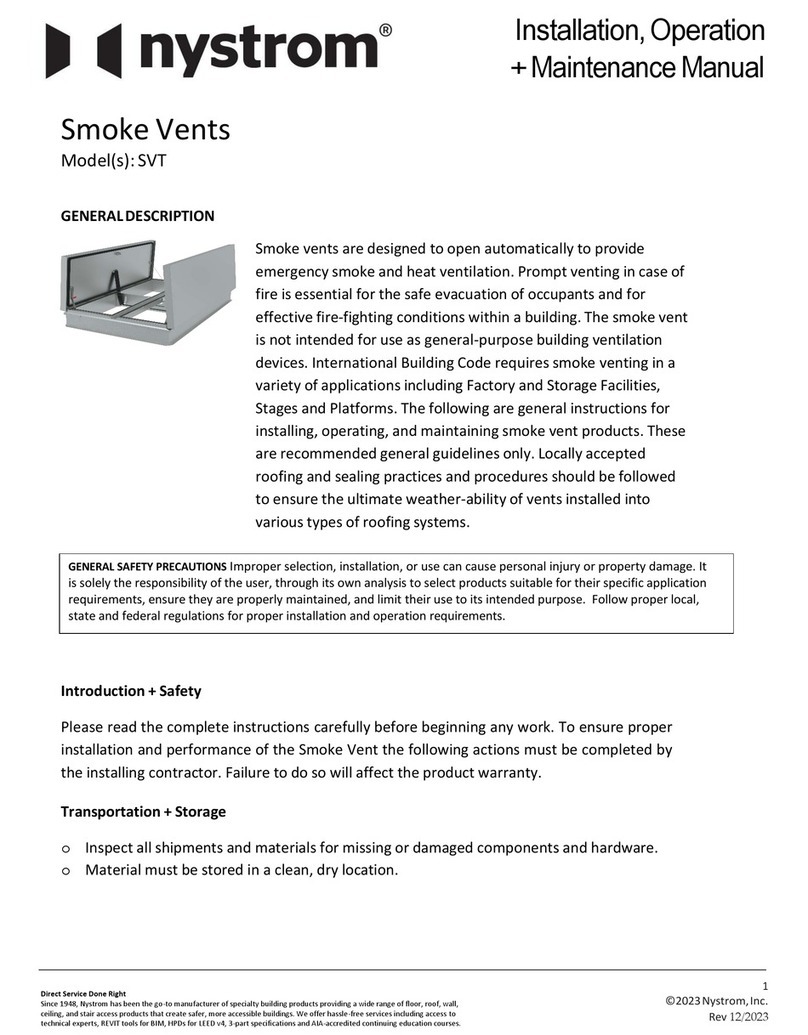
AcousticMAX Smoke Vents
Model(s): SVX/SVY
Introduction + Safety
Please read the complete instructions carefully before beginning any work. To ensure proper
installation and performance of the roof hatch the following actions must be completed by the
installing contractor. Failure to do so will affect product warranty.
Transportation + Storage
oInspect all shipments and materials for missing or damaged components and hardware.
oMaterial must be stored in a clean, dry location.
INSTALLATION
The following is a general instruction for installing, operating and maintaining smoke vent products. These
are recommended general guidelines only. Locally accepted roofing and sealing practices and procedures
should be followed as appropriate for the different roofing systems. This product may be installed on a
flat or sloping roof. When installed on a slope up to 7:12 pitch (30˚), the hinge side must run parallel with
the slope. CAUTION: smoke vent doors are under spring pressure.
1. Ensure that the roof mounting surface is level to avoid twisting of the smoke vent base. It is essential
that the vents are installed level and square for the door to make a proper seal. Place the smoke vent
over the existing opening in the roof that has been prepared with appropriate roofing membrane, if
applicable.
a. The roof rough opening dimensions are equal to the vent dimensions as measure from the
inside curb to inside curb. For example, a 48” x 96” smoke vent will have a roof rough opening
of 48” by 96”.
2. The smoke vent curb flange comes with two (2) types of mounting holes to accommodate the
following fastening methods
a. Mark the pre-drilled 5/8” diameter holes from the mounting flange through to the roof deck or
a concrete curb. Drill roof deck or concrete curb for installation of anchors or other fasteners
(provided by others). Bolt or otherwise fasten roof hatch curb flange to roof deck using 3/8” or
½” bolts with washers.
GENERAL SAFETY PRECAUTIONS
Improper selection, installation, or use can cause personal injury or property damage. It
is solely the responsibility of the user, through its own analysis to select products suitable for their specific application
requirements, ensure they are properly maintained, and limit their use to its intended purpose. Follow proper local,
state and federal regulations for proper installation and operation requirements.