10
Antennae Requirements
When purchased as part of The Oceanscience Group Riverboat System, the remote (boat)
transceiver utilizes a rugged 2.4GHz/900MHz antenna, while the base unit comes equipped with
an omni-directional antenna. All antennae, their connectors and cables have 50ohms of impedance.
Using other antennae, connectors, or cabling could result in unsatisfactory results.
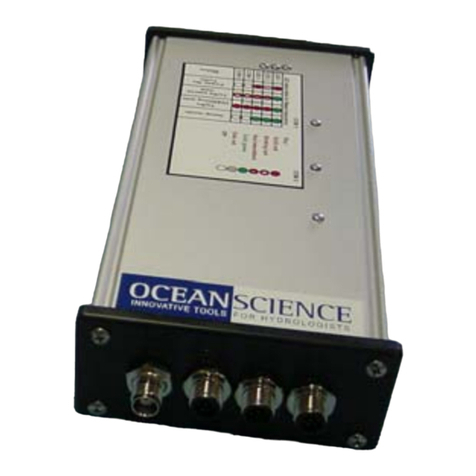
Placement of your HydroLink ML2 base unit may have a significant impact on its performance. In
practice you should also place the transceiver away from computers, telephones, answering
machines, and other similar equipment.
Generally, the higher the antenna, the better the communications link - height is everything! To
improve the data link, Oceanscience offers directional and omnidirectional antennas with cable
lengths ranging from 3 to 200 feet and of varying gain.
When using an external antenna, placement of that antenna is critical to a solid data link. Other
antennas in close proximity are a potential source of interference. It is also possible that slight
adjustments in antenna placement (as little as 2 feet) will solve noise problems. In extreme cases,
such as when the transceiver is located close to pager or cellular telephone transmission towers,
noise may be reduced by special filters available from Oceanscience.
RS232 Interface
Because the transceivers’ serial data parameters are fixed, instruments and any related application
PC software must be set to match. The serial data rates for the HydroLink ML2 are 38,400 Kbps
on Com 1 and 4,800 Kbps on Com 2.
When configuring the instrument and application software to match the transceiver, the PC and
instrument should be connected directly. If using a GPS provided by Oceanscience there is no need
to change the baud rate as they are configured at the factory.
Do not attempt to change instrument settings using the transceivers. Communication is not
possible until the instrument and application software settings match those of the transceivers.
Some instruments transmit or receive control pulses using the computer RS232 com port. Because
the transceivers transfer binary data, with a pre-defined data byte length, attempting to send
control pulses using the transceivers is not recommended. A specific example of this is the “wake-
up” or break command used by some ADCP manufacturers. The standard “wake-up” command is
a 300 ms pulse sent from the computer comm port to the ADCP. If this pulse is routed through the
transceivers, it will not be recognized by the ADCP. The solution to this format conflict is to use the
ADCP alternate “wake-up” command of three ASCII equals signs” = = = “. Using this alternate
control command maintains the binary data format and will be recognized by the ADCP through
the transceivers.
Some GPS instruments transmit and receive data using the NMEA 0183 V3.0 or higher spec. This
specification calls for a RS-422 transmission format, not RS-232. All instrumentation connected to
the transmit and receive data lines of the transceiver should be verified to use RS-232 format.