4 5
844·674·4461
TECHSUPPORT@ORIGINACOUSTICS.COM WWW.ORIGINACOUSTICS.COM
SEASONS INSTALLATION MANUAL
2) Tracing the Template and Drilling the Holes
Using the template, mark the
location for the screws on
the wall. (The speaker can be
mounted vertically or horizon-
tally.)
Depending on the type of sur-
face you’re installing the speak-
er on, you may need to use
anchors of some kind. If you’re
installing the speaker on a
hollow wall, it’s recommended
you use hollow-wall anchors.
Likewise, if you’re installing the
speaker on brick, stone, or con-
crete, it’s best to use masonry
anchors.
Drill the holes for the screws. If you’re installing the speaker on
brick, stone, or concrete, use a hammer drill. Install the screws
leaving a 1/10” (2.5mm) space between wall and screwhead for
hanging the bracket.
3) Mounting the Speaker
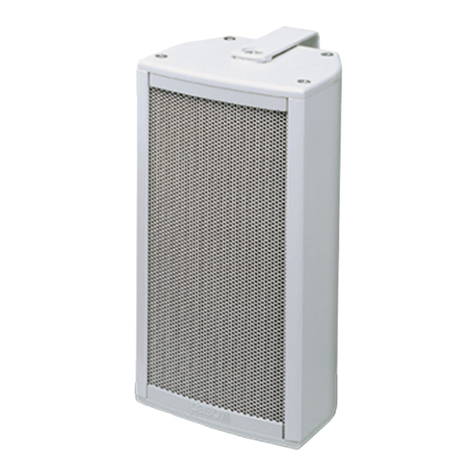
When you’re finished, hang the speaker on the wall. The speaker
is designed to have the tweeter at the top if it’s mounted verti-
cally, or to the outside if mounted horizontally. If the speaker is
installed horizontally, the logo can be rotated to be right-side-up.
Figure 5.1: Trace Template
You will need a wire that has at least two conductors; one that can be
identified as the positive and the other as the negative. All two conductor
wires have some means of identifying which conductor is which, but at
times this identification may be subtle. It’s crucial that you keep track of
which wire you use for positive (+) and negative (-). Typically if the wires
are colored red and black, the red wire is used for positive and the black
wire is used for negative, but sometimes other colors or patterns are
used. You can choose whichever color of wire you want to be positive and
negative as long as you remain consistent throughout the install.
On both your amplifier and your speaker the connectors will be identi-
fied as red for positive and black for negative. It is very important to look
carefully at the speaker wires and be certain that the same wire that is
attached to the positive connector on the amplifier is attached to the
positive connector on the speaker.
About Speaker Wire
Installation
1) Running the Wire
Fully plan out how you’ll route the wire to the desired speakers.
When choosing the point where the wire exits the house, remem-
ber that it’s best if less wire is exposed to the outside elements.
Try to find a point in the wall as close to the speaker as possible
when drilling a hole for the wire. Once you run the wire through
that point, be sure to properly seal the hole.
If you’re routing the wire underground, use a direct burial wire.
To prevent future damage, it’s recommended to also use a PVC
conduit.
When the wire can’t be run through the wall, make sure it’s se-
cured in a safe, out-of-the-way route to avoid damage.