Typical Pump Installations
Location of Unit
Locate the pump as near the well or water source as
possible, using a short, direct suction pipe. Keep the
static suction lift (vertical distance between the center
line of the pump and the water level), to a minimum.
Mount the pump on a solid, level foundation, which pro-
vides a rigid and vibration-free support. It should be
located where the unit is readily accessible for service
and maintenance. The pump should be protected
against flooding and excessive moisture.
Pump Description
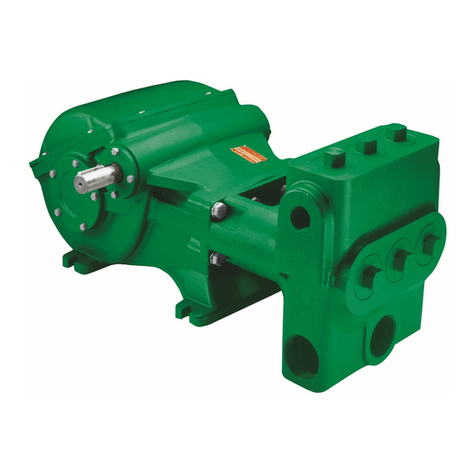
The pump is a high capacity self-priming centrifugal
pump suitable for lawn sprinkling or other applications
where large quantities of water are required. It will
pump water from depths of 610 cm or less, and is self-
priming once the pump body is initially filled with water.
A foot valve, or a check valve as near the water as pos-
sible is necessary and will reduce priming time to an
absolute minimum. No check valve or foot valve is fur-
nished.
Piping
Both suction and discharge piping should be indepen-
dently supported at a point near the pump to avoid
strains being placed on the pump. Start all piping at the
pump to avoid strains left by a gap at last connection.
It is advisable to increase the size of both suction and
discharge piping at the pump if any appreciable run of
pipe is required. Never use smaller suction pipe than
the suction tapping on the pump.
Suction Piping
The suction pipe must be kept free of air leaks and
must have a gradual slope upward to the pump. Avoid
any fittings which may cause an air trap.
A foot valve is required on pumps installed with a
cased well. On pumps using driven points, a check
valve is required and should be installed close to
ground level in a vertical position.
Discharge Piping
A gate valve and union should be installed in the dis-
charge line. For removal of the pump for service, close
the gate valve, and disconnect at the union.
Lawn Sprinkling Application
The pump is especially adapted to lawn sprinkling. It is
designed to deliver plenty of water at full sprinkler pres-
sure. It can pump from a pond, cistern or well points. If
source water is a driven well, it may be necessary to
drive two or more points piped together to satisfy the
pump capacity. Figure 1 shows a suggested layout.
Priming the Pump
This pump is of the self-priming type, but only after the
pump body has been filled with water on the initial
startup. It need not be primed again, unless it has been
removed from service and/or drained.
NOTE: The pump body must be filled with water before
starting!
To Fill:
Install a service tee or cross in the discharge opening
of the pump to provide access for priming.
Fill pump body with water up to the suction inlet.
Replace pipe plug, using pipe joint compound on male
threads only.
Start pump. Water will be pumped after a few minutes,
the time depending on depth to water and length of
horizontal suction line.
If pump does not produce water after a reasonable
length of time (5 to 10 minutes) check the following:
1. Depth to water – must not be over 610 cm.
2. Total suction lift. Check both vertical lift and length of
horizontal run (distance from pump to vertical piping)
– 300 cm of horizontal piping is equivalent to 30 cm
of vertical lift, due to friction loss. Total must not
exceed 610 cm.