2018-02
10
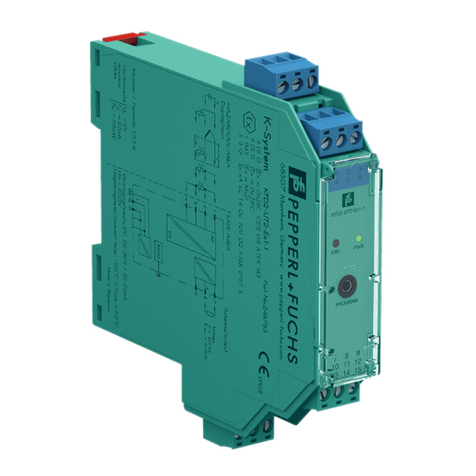
Functional Safety KCD2-UT2-(Ex)1, HiC2081
Planning
3.2 Assumptions
The following assumptions have been made during the FMEDA:
• Failure rate based on the Siemens standard SN29500.
• Failure rates are constant, wear is not considered.
• Failures during configuration are not considered.
• The collective error message output is not considered in the FMEDA and in the
calculations.
• Propagation of failures is not relevant.
• External power supply failure rates are not included.
• The collective error message output is not safety relevant.
• The indication of a dangerous failure (via fault bus) is detected within 1 hour by the
programmable logic controller (PLC).
• The safety-related device is considered to be of type Bdevice with a hardware fault
tolerance of 0.
• The device will be used under average industrial ambient conditions comparable to the
classification "stationary mounted" according to MIL-HDBK-217F.
Alternatively, operating stress conditions typical of an industrial field environment similar to
IEC/EN 60654-1 Class C with an average temperature over a long period of time of 40 ºC
may be assumed. For a higher average temperature of 60 ºC, the failure rates must be
multiplied by a factor of 2.5 based on experience. A similar factor must be used if frequent
temperature fluctuations are expected.
• The application program in the programmable logic controller (PLC) is configured to detect
underrange and overrange failures. These failures have been classified as dangerous
detected failures.
SIL 2 Application
• The device shall claim less than 10 % of the total failure budget for a SIL 2 safety loop.
• For a SIL 2 application operating in low demand mode the total PFDavg value of the SIF
(Safety Instrumented Function) should be smaller than 10-2, hence the maximum
allowable PFDavg value would then be 10-3.
• For a SIL 2 application operating in high demand mode the total PFH value of the SIF
should be smaller than 10-6 per hour, hence the maximum allowable PFH value would then
be 10-7 per hour.
• The IEC/EN 61511-1 section 11.4.4 allows devices to be used in applications one SIL
higher than given by table 3 of IEC/EN 61508-2, if the device is proven-in-use. The
assessment and proven-in-use demonstration lead to the result that the device may be
used in applications up to SIL 2. However, it is the responsibility of the end-user to decide
on applying proven-in-use devices.