1
Instruction Manual Dolphin 40
ADDITIONAL ITEMS REQUIRED
о40-53 Two Stroke Engine
о4 Channel Radio With 4 Servos
оGlow Plug to Suit Engine
оPropeller to suit Engine
оDubro Protective Foam Rubber
оGlobal Silicon Fuel Line
оPrather Stick On Weight For Balance
TOOLS AND SUPPLIES NEEDED
оKwik Bond #2 Thick C/AGlue
оKwik Bond 30 Minute Epoxy
оKwik Bond 5 Minute Epoxy
оHand or Electric Drill
оAssorted Drill Bits
оModeling Knife
оStraight Edge Ruler
о2mm Bondhus Ball Driver # 10654
Instruction Manual Dolphin 40
I/C FLIGHT GUIDELINES
Made in Vietnam
When ready to fly, first extend the
transmitter aerial.
Operate the control sticks on the
transmitter and check that the control
surfaces move freely and in the
CORRECT directions. ALWAYS land the model INTO the
wind, this ensures that the model lands
at the slowest possible speed.
Switch on the transmitter.
Switch off the transmitter.
Check that the transmitter batteries
have adequate power.
Switch off the receiver.
Switch on the receiver. ALWAYS take off into the wind.
Check that the wings are correctly
fitted to the fuselage. If the model does not respond correctly
to the controls, land it as soon as
possible and correct the fault.
Empty the fuel tank after flying, fuel left
in the tank can cause corrosion and
lead to engine problems.
14
Instruction Manual Dolphin 40
I/C FLIGHT WARNINGS
Always operate in open areas, away
from factories, hospitals, schools,
buildings and houses etc. NEVER fly
your aircraft close to people or built
up areas.
THE PROPELLER IS DANGEROUS
Keep fingers, clothing (ties, shirt
sleeves, scarves) or any other loose
objects that could be caught or drawn
in, away from the propeller. Take care
at ALL times.
Keep all onlookers (especially small
children and animals) well back from
the area of operation. This is a flying
aircraft, which will cause serious
injury in case of impact with a person
or animal.
NEVER fly near power lines, aerials
or other dangerous areas including
airports, motorways etc.
NEVER use damaged or deformed
propellers or spinners.
DO NOT dispose of empty fuel
containers on a fire, this can lead to
an explosion.
NEVER fly in wet conditions or on
windy or stormy days.
ALWAYS adjust the engine from
behind the propeller, and do not allow
any part of your body to be in line
with the propeller.
Instruction Manual Dolphin 40
3
SUGGESTION
To avoid scratching your new airplane, do not
unwrap the pieces until they are needed for
assembly. Cover your workbench with an old
towel or brown paper, both to protect the
aircraft and to protect the table. Keep a couple
of jars or bowls handy to hold the small parts
after you open the parts bags.
NOTE:
Please trial fit all the parts. Make sure you have
the correct parts and that they fit and are
aligned properly before gluing! This will assure
proper assembly. The DOLPHIN 40 ARF is
hand made from natural materials, every plane
is unique and minor adjustments may have to
be made. However, you should find the fit
superior and assembly simple.
The paint and plastic parts used in this kit are
fuel proof. However, they are not tolerant of
many harsh chemicals including the following:
paint thinner, C/A glue accelerator, C/A glue
de-bonder and acetone. Do not let these
chemicals come in contact with the colors on
the covering and the plastic parts.
SAFETY PRECAUTION:
• This is not a toy
• Be sure that no other flyers are using your radio
frequency.
• Do not smoke near fuel
• Store fuel in a cool, dry place, away from
children and pets.
• Wear safety glasses.
• The glow plug chip must be securely attached
to the glow plug.
• Do not flip the propeller with your fingers.
• Keep loose wires and clothing away from the
propeller.
• Do not start the engine if people are near. Do
not stand on the side of the propeller.
• Make engine adjustments from behind the
propeller only. Do not reach around the
spinning propeller.
3. Place the servo into the servo tray. Center the
servo within the tray and drill 1,6mm pilot holes
through the block of wood for each of the four
mounting screws provided with the servo.
Remove the covering
2
1
INSTALLING THE AILERON SERVOS
1. Install the rubber grommets and brass eyelets
onto the aileron servo.
2. Using a modeling knife, remove the covering
from over the pre-cut servo arm exit hole on the
aileron servo tray / hatch. This hole will allow
the servo arm to pass through when installing
the aileron pushrods.
PREPARATIONS
Remove the tape and separate the ailerons
from the wing and the elevators from the stab.
Use a covering iron with a covering sock on
high heat to tighten the covering if necessary.
Apply pressure over sheeted areas to
thoroughly bond the covering to the wood.
3
4. Using the thread as a guide and using masking
tape, tape the servo lead to the end of the
thread: carefully pull the thread out. When you
have pulled the servo lead out, remove the
masking tape and the servo lead from the
thread.
Servo lead
4
Instruction Manual Dolphin 40
4
7
3. Repeat step # 1 - # 2 to install the control horn
on the opposite aileron.
INSTALLING THE CONTROL HORNS
1. One aileron control horn in positioned on each
aileron. Using a ruler and a pen, locate and
mark the location of the control horn. It should
be mounted on the bottom side of the aileron at
the leading edge, in line with the aileron
pushrod.
2. Drill two 1.6mm holes through the aileron using
the control horn as a guide and screw the
control horn in place.
RIGHT WRONG
6. Repeat step # 2 - # 5 to install the second
aileron servo in the opposite wing half.
5. Place the aileron servo tray / hatch into the
servo box on the bottom of the wing and drill
1,6mm pilot holes through the tray and the
servo box for each of the four mounting screws.
Secure the servo tray in place using the
mounting screws provided ( 2mm x 12mm ).
7. Using masking tape, tape the servo leads on to
the top of the wing.
5
To the cowl
6
To the cowl
INSTALLING THE AILERON LINKAGES
1. Working with the aileron linkage for now, thread
one nylon clevis at least 14 turns onto one of
the 2mm x 180mm threaded wires.
2. Attach the clevis to the outer hole in the control
horn. Install a silicone tube on the clevis.
3. Locate one nylon servo arm, and using wire
cutters, remove all but one of the arms. Using a
2mm drill bit, enlarge the third hole out from the
center of the arm to accommodate the aileron
pushrod wire.
4. Plug the aileron servo into the receiver and
center the servo. Install the servo arm onto the
servo. The servo arm should be perpendicular
to the servo and point toward the middle of the
wing.
5. Center the aileron and hold it in place using a
couple of pieces of masking tape.
6. With the aileron and aileron servo centered,
carefully place a mark on the aileron pushrod
wire where it crosses the hole in the servo arm.
7. Using pliers, carefully make a 90 degree bend
down at the mark made. Cut off the excess
wire, leaving about 4mm beyond the bend.
8
Instruction Manual Dolphin 40
10
Center line
5
2. Glue wing joiner in wing halves with 30 minute
epoxy. Put epoxy on wing joiner and in wing
joiner pocket. Wipe off excess epoxy with a
paper towel and alcohol.
3. Hold wing halves together with tape while epoxy
cures.
Joiner
11
Epoxy glue
12
4. Cover wing joint with self adhesive trim strip.
14
Screw
WING ASSEMBLY
1. Draw a center line on the wing joiner.
1. Secure the wing to the fuselage using the
plastic screws
HORIZONTAL-VERTICAL INSTALLATION
8. Insert the 90 degree bend down through the
hole in the servo arm. Install one nylon snap
keeper over the wire to secure it to the arm.
Install the servo arm retaining screw and
remove the masking tape from the aileron.
9. Repeat step # 4 - # 8 to install the second
aileron linkage. After both linkages are
completed, connect both of the aileron servo
leads using a Y-harness you have purchased
separately.
Silicone Tube
9
13
6
Instruction Manual Dolphin 40
HORIZONTAL STABILIZER INSTALLATION
1. Using a modeling knife, cut away the covering
from the fuselage for the stabilizer and remove it.
15
Draw a center line
16
3. Check the fit of the horizontal stabilizer in its
slot. Make sure the horizontal stabilizer is
square and centered to the fuselage by taking
measurements, but don't glue anything yet.
4. With the horizontal stabilizer correctly aligned,
mark the shape of the fuselage on the top and
bottom of the tail plane using a water soluble /
non-permanent felt-tip pen.
!
5. Remove the stabilizer. Using the lines you just
drew as a guide, carefully remove the covering
from between them using a modeling knife.
When cutting through the covering to remove it,
cut with only enough pressure to only cut
through the covering it's self. Cutting into the
balsa structure may weaken it. This could lead
to possible failure during flight.
2. Draw a center line onto the horizontal stabilizer.
17
6. When you are sure that everything is aligned
correctly, mix up a generous amount of 30
minute epoxy. Apply a thin layer to the top and
bottom of the stabilizer mounting area and to
the stabilizer mounting platform sides in the
fuselage. Slide the stabilizer in place and
re-align. Double check all of your
measurements one more time before the epoxy
cures. Remove any excess epoxy using a
paper towel and rubbing alcohol and hold the
stabilizer in place with T-pins or masking tape.
18
Remove the covering
7
Instruction Manual Dolphin 40
2. Slide the vertical stabilizer into the slot in the
mounting platform in the top of the fuselage.
Mark the shape of the fuselage on the left and
right sides of the vertical stabilizer using a
felt-tip pen.
3. Now, remove the vertical stabilizer and using a
modeling knife, carefully cut just inside the
marked lines and remove the film on both sides
of the vertical stabilizer. Just as you did with the
horizontal stabilizer, make sure you only press
hard enough to cut the film, not the balsa
vertical stabilizer.
stabilizer mounting area. Apply epoxy to the
lower rudder hinge. Set the stabilizer in place
and re-align. Double check all of your
measurements once more before the epoxy
cures. Remove any excess epoxy using a
paper towel and rubbing alcohol and hold the
stabilizer in place with T-pins or masking tape.
Allow the epoxy to fully cure before proceeding.
4. Slide the vertical stabilizer back in place. Using
a triangle, check to ensure that the vertical
stabilizer is aligned 90 degree to the horizontal
stabilizer.
5. When you are sure that everything is a aligned
correctly, mix up a generous amount of 30
minute epoxy. Apply a thin layer to the slot in
the mounting platform and to the vertical
20
Remove
the covering
21
C.A Glue
23
Remove the covering
22
19
Glue with epoxy
7. After the epoxy has fully cured, remove the
masking tape or T-pins used to hold the
stabilizer in place and carefully inspect the glue
joints. Use more epoxy to fill in any gaps that
were not filled previously and clean up the
excess using a paper towel and rubbing alcohol.
VERTICAL STABILIZER INSTALLATION
1. Using a modeling knife, remove the covering on
the top of the fuselage for the vertical stabilizer.
MAIN GEAR INSTALLATION
1. Attach wheels on the gear and secure using the
wheel collars.
9
Instruction Manual Dolphin 40
29
Machine screws
30
31
To muffler
To carburator
!
2. Using a modeling knife, cut one length of silicon
fuel line (the length of silicon fuel line is
calculated by how the weighted clunk should
rest about 8mm away from the rear of the tank
and move freely inside the tank). Connect one
end of the line to the weighted clunk and the
other end to the nylon pick up tube in the
stopper.
3. Carefully bend the second nylon tube up at a 45
degree angle (using a cigarette lighter). This
tube will be the vent tube to the muffler.
4. Carefully bend the third nylon tube down at a 45
degree angle (using a cigarette lighter). This
tube will be vent tube to the fueling valve.
When the stopper assembly is installed in the
tank, the top of the vent tube should rest just
below the top surface of the tank. It should not
touch the top of the tank.
FUEL TANK installation
INSTALLING THE STOPPER ASSEMBLY
1. The stopper has been pre-assembled at the
factory.
Do not secure the tank into place permanently until
after balancing the airplane. You may need to
remove the tank to mount the battery in the fuel
tank compartment.
9. Secure the fuel tank using the plate of plywood
and glue it by C.A glue.
5. Test fit the stopper assembly into the tank. It
may be necessary to remove some of the
flashing around the tank opening using a
modeling knife. If flashing is present, make
sure none of it falls into the tank.
6. When satisfied with the alignment of the stopper
assembly tighten the 3mm x 20mm machine
screw until the rubber stopper expands and
seals the tank opening. Do not over tighten the
assembly as this could cause the tank to split.
7. Using a modeling knife, cut 3 lengths of fuel line
150mm long. Connect 2 lines to the 2 vent
tubes and 1 line to the fuel pickup tube in the
stopper.
8. Feed three lines through the fuel tank
compartment and through the pre-drilled hole in
the firewall. Pull the lines out from behind the
engine, while guiding the fuel tank into place.
Push the fuel tank as far forward as possible,
the front of the tank should just about touch the
back of the firewall.
Blow through one of the lines to ensure the fuel
lines have not become kinked inside the fuel
tank compartment. Air should flow through
easily.
8
Instruction Manual Dolphin 40
4. Align the tail wheel wire so that the wire is
parallel with the bottom of the rudder. The
control clasp has a pre-drilled hole through the
top of it. Slide this hole on to the tail wheel wire
while sliding the clasp over the bottom of the
rudder.
5. Secure the two clasps to the rudder bottom
using two 2mm x 16mm screws.
2. Trim the covering from the slot in the landing
gear mount.
3. Install landing gear in fuselage bottom and
secure it using screws.
24
25
Remove the covering 27
26
Screw Main gear
Nylon plate
28
Screw
INSTALLING THE ENGINE
1. Locate the long piece of wire used for the throttle
pushrod. One end of the wire has been
pre-bend in to a "Z" bend at the factory. This "Z"
bend should be inserted into the throttle arm of
the engine when the engine is fitted onto the
engine mount. Fit the engine to the engine
mount using the screws provided.
10
Instruction Manual Dolphin 40
32
SERVO INSTALLATION
INSTALLING THE FUSELAGE SERVOS
1. Install the rubber grommets and brass collets
into the elevator, rudder and throttle servos.
Test fit the servos into the servo tray. Trim the
tray if necessary to fit your servos
2. Mount the servos to the tray using the mounting
screws provided with your radio system.
33
Elevator servo
Rudder servo
Throttle servo
34
35
Remove the covering
11
Instruction Manual Dolphin 40
36
INSTALLING THE RUDDER PUSHROD
1. Locate the pushrod exit slot on the left of the
fuselage.
2. Carefully cut away the covering material from
the slot.
3. Working from inside the fuselage, slide the
threaded end of the remaining pushrod down
the inside of the fuselage until the pushrod
reaches the exit slot. Carefully reach in with a
small screw driver and guide the pushrod out of
the exit slot.
4. Install the clevis on the rudder pushrod. Make
sure 6mm of thread shows inside the clevis.
5. The control horn should be mounted on the left
side of the rudder at the leading edge, in line
with the rudder pushrod.
6. Drill two 2mm holes through the rudder using
the control horn as a guide and screw the
control horn in place.
7. Attach clevis to the third hole in the control
horn. Install a silicone tube on the clevis.
8. Locate one nylon servo arm, and using wire
cutters, remove all but one of the arms using a
2mm drill bit, enlarge the third hole out from the
center to accommodate the rudder pushrod wire.
9. Plug the rudder servo into the receiver and
center the servo. Install the servo arm onto the
servo.
10. Center the rudder and hold it in place using a
piece of masking tape.
11. With the rudder and rudder servo centered,
carefully place a mark on the rudder pushrod
wire where it crosses the hole in the servo arm.
12.Using a pliers, carefully make a 90 degree bend
up at the mark made. Cut off excess wire,
leaving about 8mm beyond the bend.
13. Insert the 90 degree bend up through the hole
in the servo arm. Install one nylon snap keeper
over the wire to secure it to the arm. Install the
servo arm retaining screw and remove the
masking tape from the rudder.
14.Using thick CA glue, secure the pushrod
sleeves to the pushrod sleeve guide.
38
40
41
37
39
Remove the covering
12
Instruction Manual Dolphin 40
2. Uncoil the receiver antenna completely and
drill a 1/16'' hole in the side of the fuselage,
opposite the muffler, for the antenna to exit.
Secure the end of the antenna to the top the
vertical fin using a rubber band or similar
method.
3. Install the switch on the side of the fuselage
opposite the muffler. Use the faceplate of the
switch as a pattern for drilling the holes and
the cutout for the switch itself.
Balancing
1. It is critical that your airplane be balanced
correctly. Improper balance will cause your
plane to lose control and crash. The center of
gravity is located 75mm back from the
leading edge of the wing at the fuselage
sides. This location is recommended for
initial test flying and trimming. Balance the
Paragon with the fuel tank empty.
2.
Using a couple of pieces of masking tape or a
pen, make a mark on each side of the bottom
of the wing 75mm back from the leading edge.
3. Place your fingers on the marks on bottom of
the wing and carefully lift the plane.
4. If the nose of the plane falls, the plane is
nose heavy. To correct this, try moving your
battery pack back. It that is not enough
change, add a little lead weight to the tail. If
the tail of the plane falls, double check that
you have mounted the battery pack under
the fuel tank. If the airplane is still tail heavy
add lead weight to the firewall or even better,
use a sufficient heavy hub under the spinner.
Receiver & Battery Installation
1. The battery should be wrapped in foam and
mounted under the fuel tank to add in
balancing. We used a 500mah flat pack. The
receiver should be wrapped in foam and
mounted just behind the fuel tank.
2. Plug the throttle servo into the receiver and turn
on the radio system. Check to ensure that the
throttle servo output shaft is moving in the
correct direction. When the throttle stick is
moved forward from idle to full throttle, the
throttle barrel should also open and close using
this motion. If not, reverse the direction of the
servo, using the transmitter.
3. Slide the adjustable metal connector / servo
arm assembly over the plain end of the
pushrod wire. Position the throttle stick and the
throttle trim at their lowest positions.
4. Manually push the carburator barrel fully
closed. Angle the arm back about 45 degree
from center and attach the servo arm onto the
servo. With the carburator barrel fully closed,
tighte the set screw in the adjustable metal
connector.
5. Remove the excess throttle pushrod wire using
wire cutters and install the servo arm retaining
screw.
!
INSTALLING THE THROTTLE
1. Install one adjustable metal connector through
the third hole out from the center of one servo
arm, enlarge the hole in the servo arm using a
2mm drill bit to accommodate the servo
connector. Remove the excess material from
the arm.
After installing the adjustable metal connector
apply a small drop of thin C/A to the bottom
nut. This will prevent the connector from
loosening during flight.
Rudder pushrod
42
Throttle servo
43
Instruction Manual Dolphin 40
13
Ailerons : 12mm up 12mm down
Elevator : 12mm up 12mm down
Rudder : 25mm right 25mm left
Elevator Control
Aileron Control
12mm
12mm
Rudder Control
25mm
25mm
12mm
12mm
CONTROL THROWS
1. We highly recommend setting up a plane using
the control throws listed. Adjust pushrod
positions on control arms or horns to provide
control surface throws as illustrated. Center all
control surfaces.
2. The control throws should be measured at the
widest point of each surface!.
75mm
FLIGHT PREPARATION
PRE FLIGHT CHECK
1. Completely charge your transmitter and
receiver batteries before your first day of
flying.
2. Check every bolt and every glue joint in your
plane to ensure that everything is tight and
well bonded.
3. Double check the balance of the airplane
4. Check the control surfaces.
5. Check the receiver antenna . It should be fully
extended and not coiled up inside the
fuselage.
6. Properly balance the propeller.
7. Use at least 5 rubber bands per side to hold
the wing onto the fuselage.
We wish you many enjoyable flights with your
plane and once again thank you for your
choosing a Phoenix Model's product.
9. Plug the elevator servo into the receiver and
center the servo. Install the servo arm onto the
servo. The servo arm should be perpendicular
to the servo and point toward the middle of the
fuselage.
10. Be sure both elevator halves are flat.
11. With the elevator halves and elevator servo
centered, carefully place a mark on the elevator
pushrod wire where it crosses the hole in the
servo arm.
12. Using pliers, carefully make a 90 degree bend
up at the mark made. Cut off the excess wire,
leaving about 8mm beyond the bend.
13. Insert the 90 degree bend up through the hole
in the servo arm, install one nylon snap keeper
over the wire to secure it to the arm. Install the
servo arm retaining screw and remove the
masking tape the elevator halves.
14. Using thick CA glue, secure the pushrod
sleeves to the pushrod sleeve guide.
7. Attach clevis to the third hole in the control
horn. Install a silicone tube on the clevis.
8. Locate one nylon servo arm, and using wire
cutters, remove all but one of the arms. Using a
2mm drill bit, enlarge the third hole out from the
center to accommodate the elevator pushrod
wire.
INSTALLING THE ELEVATOR PUSHROD
1. Locate the pushrod exit slot on the right side
and left side of the fuselage. It is located
slightly ahead and below the horizontal
stabilizer.
2. Carefully cut away the covering material from
the slot.
3. Working from inside the fuselage, slide the
threaded end of the pushrod until it reaches the
exit slot. Carefully reach in with a small screw
driver and guide the pushrod out of the exit
slot.
4. Install the clevis on the elevator pushrod. Make
sure 6mm of thread shows inside the clevis.
5. The control horn should be mounted on the
bottom, left side of the elevator at the leading
edge, in line with the elevator pushrod.
6. Drill two 2mm holes through the elevator using
the control horn as a guide and screw the
control horn in place.
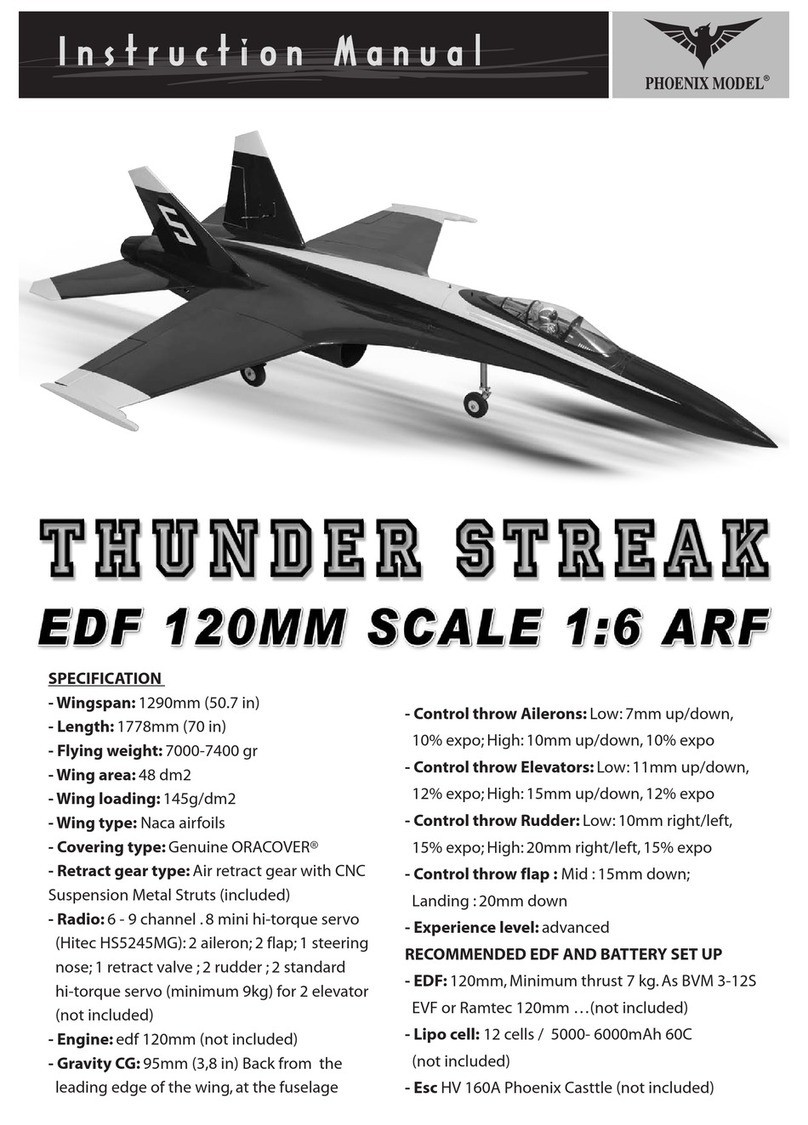
Wingspan : 1545mm (60.83 inches)
Length : 1296mm (51.02 inches)
Weight : 2400gr - 2600gr
Engine : 40 - 46 two stroke
Radio : 4 channel - 5 servos
g
Instruction Manual
Coloa
Wheel
Switch
Battery Receiver
screwScrew clasps
KIT CONTENTS: We have organized the parts as they come out of the box for better identification during
assembly. We recommend that you regroup the parts in the same manner. This will ensure you have all of parts
required before you begin assembly.
AIR FRAME ASSEMBLIES
• (2) Wing halves with ailerons
• (1) Fuselage with canopy.
• (1) Horizontal stabilizer with elevator halves
• (1) Vertical stabilizer with rudder
• (1) Instruction manual
MAIN GEAR ASSEMBLY
• (2) Main gear
• (2) 65mm diameter wheels
• (4) Wheel collars
• (4) 3mm x 4mm set screws
• (2) Nylon plate
• (4) 3mm x 12mm screws
TAIL GEAR ASSEMBLY
• (1) Tail gear
• (1) 25mm diameter wheel
• (1) Wheel collar
• (1) 3mm x 4mm set screw
• (2) Nylon clasps
• (6) 2mm x 10mm set screw
ELEVATOR CONTROL SYSTEM
• (1) Nylon clevises
• (1) Silicon tube
• (1) Nylon snap keeper
• (2) 2mm x 16mm screws
• (1) Nylon control horn w/plate
RUDDER CONTROL SYSTEM
• (1) Nylon clevises
• (1) Silicon tube
• (1) Nylon snap keeper
• (2) 2mm x 16mm screws
• (1) Nylon control horn w/plate
AILERON CONTROL SYSTEM
• (2) Metal pushrod
• (2) Nylon clevises
• (2) Silicon tube
• (2) Nylon snap keeper
• (2) Nylon control horn
MOTOR MOUNT ASSEMBLY
• (4) 3mm x 20mm machine screws
• (4) Lock washer
• (4) Nut M3
THROTTLE CONTROL SYSTEM
• (1) 1,3mm x 500mm wire
• (1) 3,5mm x 350mm nylon pushrod housing
• (1) Metal connector
• (1) 4mm x 4mm machine screw
FUEL TANK
• (1) Nylon fuel Tank
• (1) Metal clunk
• (1) Silicone tube / 110mm
• (1) Pre - assembled stopper w / 2 tube
• (1) 165mm x 250mm foam padding
MISCELLANEOUS ITEMS
• (1) Wood dihedral
• (1) 25mm x 600mm trim tape
• (4) 6mm x 45mm nylon screws
• (2) Plate of nylon screw
• (1) Spinner
• (2) Accessary Bag of wood
• (1) Decal sheet
• (1) Set of pushrod
ADDITIONAL ITEMS REQUIRED
• 40 two stroke Engine.
• 4 channel Radio with 4 servos.
• Glow plug to suit Engine.
• Propeller to suit Engine.
• Protective foam Rubber.
• Silicone fuel line.
• Stick on weight for balance.
KIT CONTENTS
2
Instruction Manual Dolphin 40