2) If your TV has a headphone output jack (usually located on the front or side), use the 1/8" to Stereo RCA
connection cable to connect your TV's headphone output jack to the RCA inputs on the rear of the Speaker.
In most cases, use of the headphone jack should automatically turn off your TV's internal speakers.
If, after connecting the cable to your TV's headphone jack, your TV speakers remain on, please skip to Point #5;
otherwise, skip to Point #6.
3) If your TV does not have a headphone output jack, or you would prefer to connect your Speaker to your TV's
RCA audio outputs (usually located on the rear connection panel), using the included Stereo RCA connection
cable, connect your TV's RCA audio outputs to the RCA inputs on the rear of the Speaker.
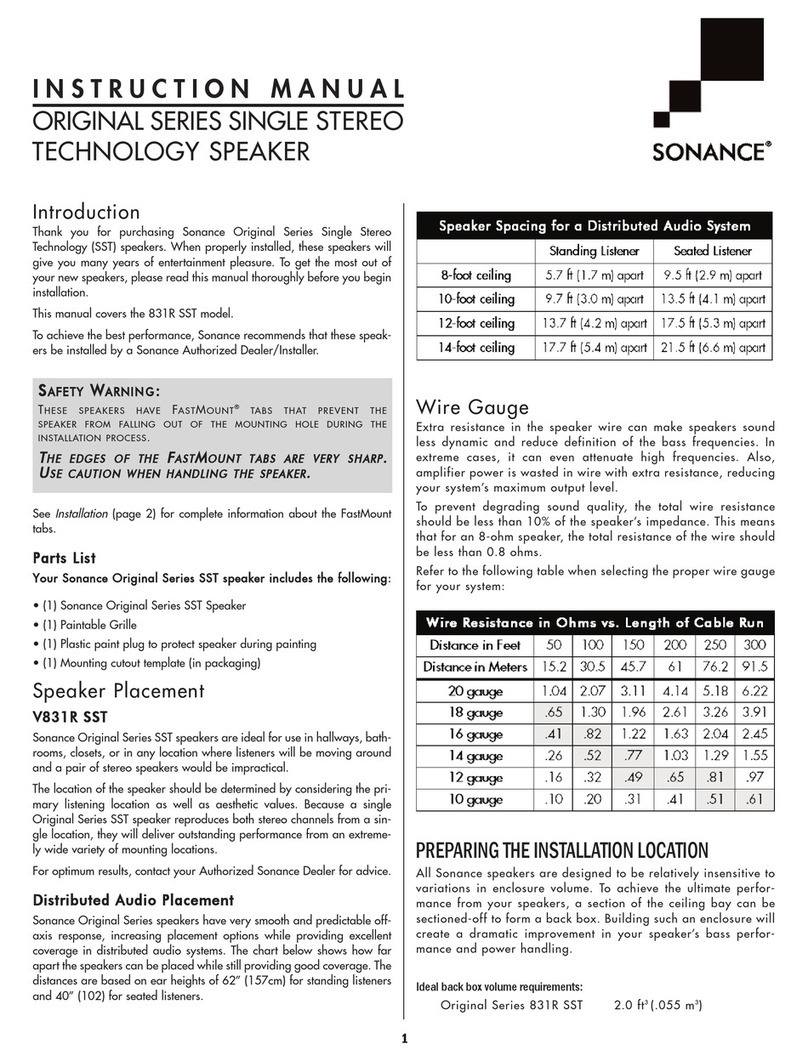
4) TV RCA audio outputs are either Variable (output level changes with TV volume setting) or Fixed (output level
does not change with TV volume setting). Some TV's RCA outputs can be set to be Fixed or Variable in the
Audio Settings section of your TV's menu system. If your TV has Variable, or both Variable & Fixed RCA audio
outputs, please use the Variable outputs. If your TV only has Fixed RCA outputs, please skip to Point #7.
5) To prevent the TV's internal speakers from interfering with the Speaker's output, please find the Audio Settings
section in your TV's menu system and turn off the TV's internal speakers. The TV's internal speakers must be
turned 'off'; the TV volume cannot just be turned down as this would result in no output on the headphone or
RCA jacks for your Pinnacle Speaker! If you are unable to turn off your TV's speakers and are connected to its
RCA outputs, please try using the headphone output instead.
6) Connect your Speaker's power supply to the input power jack on the rear of the Speaker and to live wall power.
For this connection type, you can simply continue to use your TV remote to control the Speaker's volume level
and do not need to, and should not, use the Speaker remote. Depending upon your TV's output level (in the
middle section of its Volume range) you may find the Speaker to be a bit too loud or too soft. If too loud, move
the Speaker's Gain switch to the 20 dB position; if too soft, move the Gain switch to the 40 dB position. Please
skip to the next section titled "Notes".
7) Install the included batteries into the Speaker remote and connect the included power supply to live wall power
and to the input power jack on the rear of the Speaker. To prevent the TV's internal speakers from interfering
with the Speaker's output, please find the Audio Settings section in your TV's menu system and turn off the TV's
internal speakers. (If you are unable to turn off your TV's internal speakers, please try using the headphone
output instead. If no headphone output is available, simply turn the TV volume all the way down and only use
the Speaker remote to control the Speaker's volume; in this case skip to Point #9.)
8) To control the Speaker's volume with this connection type, you can either use the Speaker remote or program
the Speaker to work with your TV remote as follows. With the Speaker active (LED Green or Blue):
Press and hold the Mute button on the rear of the Speaker until its power LED goes out.
On the rear of the Speaker, press the Speaker function button (Volume-, Volume+ or Mute) that you want to
program. The LED turns Red.
Point your TV remote at the front of the Speaker and press the appropriate function key on your TV remote.
If programming is successful, the Speaker LED should turn Green.
Repeat the steps above until all three TV remote functions are programmed into your Speaker.
Test all functions, if any fail to work properly repeat the steps above for that function. Depending upon your
TV model, a quick remote button press may work better than pressing & holding a remote button.
If, after repeated programming attempts, no functions work correctly, we suggest you try programming your
Speaker using a different (or the included) remote.
9) If you connected your Speaker to your TV's Fixed RCA outputs, depending upon your TV's output level, you may
find the Speaker to be a bit too loud or too soft. If too loud, move the Speaker's Gain switch to the 20 dB
position; if too soft, move the Gain switch to the 40 dB position.