manuals.online logo
Brands
  1. Home
  2. •
  3. Brands
  4. •
  5. RainWise
  6. •
  7. Weather Station
  8. •
  9. RainWise MKIII-SP1-LR User manual

RainWise MKIII-SP1-LR User manual

Other RainWise Weather Station manuals

RainWise MKIII-MB User manual

RainWise

RainWise MKIII-MB User manual

RainWise MK4-C User manual

RainWise

RainWise MK4-C User manual

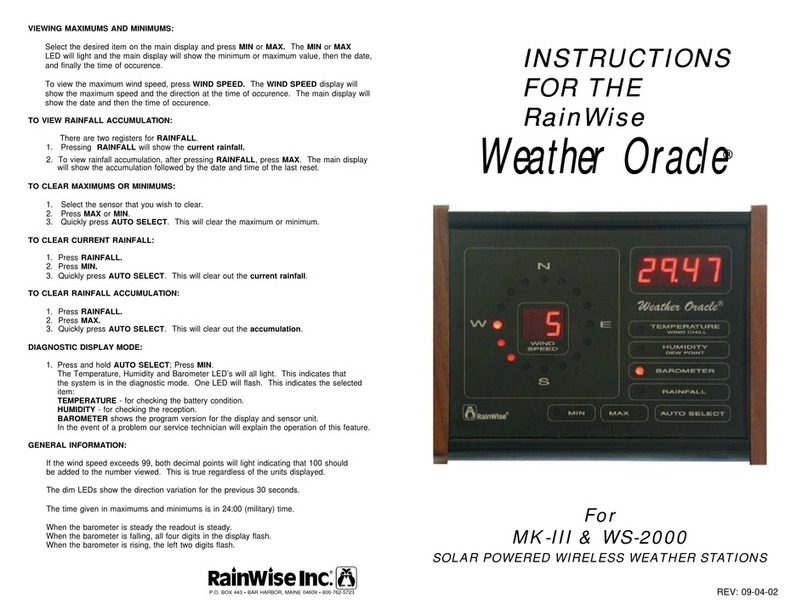
RainWise Weather Oracle User manual

RainWise

RainWise Weather Oracle User manual

RainWise PVMET-330 User manual

RainWise

RainWise PVMET-330 User manual

RainWise MK-III Series User manual

RainWise

RainWise MK-III Series User manual

RainWise PVmet 500 Series User manual

RainWise

RainWise PVmet 500 Series User manual

Popular Weather Station manuals by other brands

Bresser 7000016000000 instruction manual

Bresser

Bresser 7000016000000 instruction manual

Auriol AHFL 433 A1 operating instructions

Auriol

Auriol AHFL 433 A1 operating instructions

Hyundai WS 2202 instruction manual

Hyundai

Hyundai WS 2202 instruction manual

NexSens G2-HYDROMET quick start

NexSens

NexSens G2-HYDROMET quick start

IROX HBVR761 UV-X user manual

IROX

IROX HBVR761 UV-X user manual

La Crosse Technology C86371 instruction manual

La Crosse Technology

La Crosse Technology C86371 instruction manual

ADE WS 1711 operating instructions

ADE

ADE WS 1711 operating instructions

WAREMA EWFS Weather station eco Operating and installation instructions

WAREMA

WAREMA EWFS Weather station eco Operating and installation instructions

Auriol z29592 Operation and safety notes

Auriol

Auriol z29592 Operation and safety notes

Auriol 296289 Operation and safety notes

Auriol

Auriol 296289 Operation and safety notes

Hyundai WS 2266 instruction manual

Hyundai

Hyundai WS 2266 instruction manual

La Crosse Technology WS-2210 Operation manual

La Crosse Technology

La Crosse Technology WS-2210 Operation manual

La Crosse Technology WS-811561 manual 

La Crosse Technology

La Crosse Technology WS-811561 manual 

Ventus W177 owner's manual

Ventus

Ventus W177 owner's manual

National Geographic VA Colour RC instruction manual

National Geographic

National Geographic VA Colour RC instruction manual

Instant Transmission MA 10410 instruction manual

Instant Transmission

Instant Transmission MA 10410 instruction manual

Lutron Electronics PHB-318 Operation manual

Lutron Electronics

Lutron Electronics PHB-318 Operation manual

Oregon Scientific Alizé BAR266 user manual

Oregon Scientific

Oregon Scientific Alizé BAR266 user manual

manuals.online logo
manuals.online logoBrands
  • About & Mission
  • Contact us
  • Privacy Policy
  • Terms and Conditions

Copyright 2025 Manuals.Online. All Rights Reserved.

I-800-762-5723
1-800-762-5723
Instructions
for the RainWise
MKIII –SP1-LR
Weather Station
Rev: 1.0 - 03-20-09
A word about location and instrumentation:
Selecting the best location for the weather station is critical to ensure
accurate and reliable data. Keep the following facts in mind when se-
lecting your location.
1. The weather station should be higher than the receiver. Data is
transmitted at an angle slightly down from horizontal. Range can
be significantly reduced if the receiver is mounted higher than trans-
mitter.
2. Radio range is affected by the height of the station above the
ground. The station should be mounted approximately 10 feet
above the ground to ensure a reasonable range. Avoid mounting
the station on or near metal objects. Metal can interfere with the
radio signal.
3. Keep a clear line of sight. Try to avoid sending the signal through
trees or any other object if possible.
4. Try keep the weather station as close to the receiver as possible.
Although a range of 400 feet may be possible, the closer the re-
ceiver is to the transmitter the stronger the signal will be.
5. Keep the receiver away from all other electronics, its’ sensitivity
may be reduced by interference. Windows are generally good loca-
tions for receivers as long as the glass is not coated with a low E
metal film.
6. Whenever possible test the desired location. Set up the receiver
and make sure that it receives data from the weather station. You
can simply switch the weather station on and hold it roughly where
it will be mounted. Its usually easiest to do this with two people.
Mount the support tube as indicated; A tripod is
shown. You can also use U-bolts or a Mono Mount.
Insert the neck down end into the MKIII sensor as-
sembly until it bottoms with the retaining screw in
the slot. Tighten the screw.
1.
Rotate the assembly until the solar panel faces
TRUE SOUTH, TRUE NORTH if you are in the
southern hemisphere. Secure the support tube to
the assembly to prevent it from rotating.
2.
3.
This leaf wetness sensor is designed to be mounted on the
North side of the MK-III weather station. The bracket provided with the
sensor insures a solid and secure installation.
1. Loosen the two screws under the rain collec-
tor . Do not remove them completely.
2. Slide the sensor bracket into position between
the head of the screw and the large flat
washer.
3. Tighten the screws to secure both the leaf
wetness sensor and rain collector.
4. Plug the leaf wetness sensor connector into to
the MK-III.
5. Place the excess cable against the body of
the weather station as shown in the picture.
6. Use the two cable ties supplied to secure the
cable to the rain collector support arms.
Installing the Leaf Wetness Sensor
This completes the MK-III installation!
Please refer to Computer Interface Instruction manual for details on how to
install and configure the receiving side of the weather station.
Adjust the solar panel angle for optimum performance. Use
the table below to determine your optimum angle.
Latitude Panel Angle
(from vertical)
0° - 22.5° 60°
22.5° - 55° 30°
55° - 90° 15°
The top of the solar panel is hinged. Lift the bottom of the
solar panel up and insert the two support bars into the appro-
priate mounting holes in the solar panel.
4.
Turn the system on by pulling switch forward toward the front
of the unit. The switch will click into position. The system is
now transmitting.
5.